- English
- French
- German
- Portuguese
- Spanish
- Russian
- Japanese
- Korean
- Arabic
- Greek
- German
- Turkish
- Italian
- Danish
- Romanian
- Indonesian
- Czech
- Afrikaans
- Swedish
- Polish
- Basque
- Catalan
- Esperanto
- Hindi
- Lao
- Albanian
- Amharic
- Armenian
- Azerbaijani
- Belarusian
- Bengali
- Bosnian
- Bulgarian
- Cebuano
- Chichewa
- Corsican
- Croatian
- Dutch
- Estonian
- Filipino
- Finnish
- Frisian
- Galician
- Georgian
- Gujarati
- Haitian
- Hausa
- Hawaiian
- Hebrew
- Hmong
- Hungarian
- Icelandic
- Igbo
- Javanese
- Kannada
- Kazakh
- Khmer
- Kurdish
- Kyrgyz
- Latin
- Latvian
- Lithuanian
- Luxembou..
- Macedonian
- Malagasy
- Malay
- Malayalam
- Maltese
- Maori
- Marathi
- Mongolian
- Burmese
- Nepali
- Norwegian
- Pashto
- Persian
- Punjabi
- Serbian
- Sesotho
- Sinhala
- Slovak
- Slovenian
- Somali
- Samoan
- Scots Gaelic
- Shona
- Sindhi
- Sundanese
- Swahili
- Tajik
- Tamil
- Telugu
- Thai
- Ukrainian
- Urdu
- Uzbek
- Vietnamese
- Welsh
- Xhosa
- Yiddish
- Yoruba
- Zulu
Why Choose Rotary Titanium Targets for Thin Film Deposition?
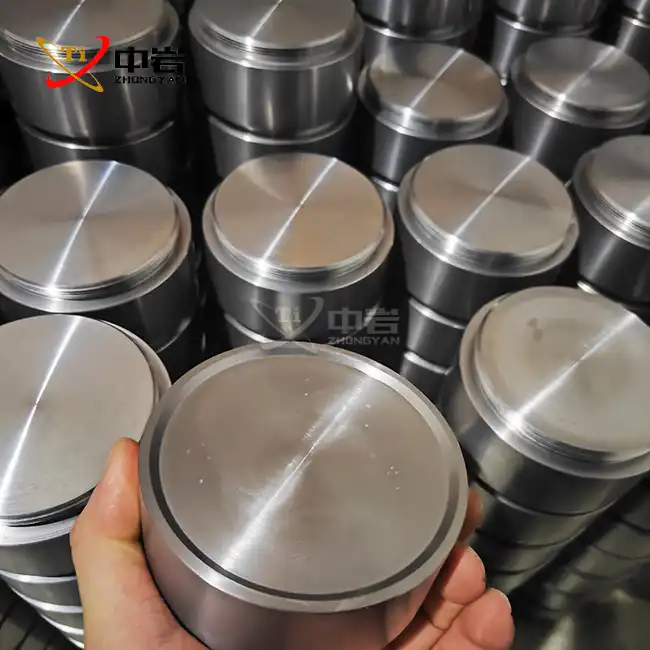
When choosing parts for advanced thin film deposition processes, Rotary Titanium Targets are clearly the best way to get the best covering quality and the most efficient operation. When these cylindrical sputtering targets are used, they spin, which evens out the spread of the material and makes them last longer than standard stationary targets. With their high-purity titanium construction and precise engineering, these rotating targets make it possible to make thin films of uniform high quality that can be used in semiconductor, aircraft, and optical coating applications.
Understanding Rotary Titanium Targets and Their Role in Thin Film Deposition
Rotary titanium targets are a big step forward in magnetron sputtering technology. They are shaped like cylinders and keep turning while the coating process is going on. Unlike regular flat targets, this moving device makes sure that the material wears away evenly across the whole surface. This stops erosion tracks from forming, which can affect the uniformity of the film and the use of the target.
Working Mechanism and Design Principles
The main way that rotating titanium targets work is because they are shaped like cylinders and can be rotated precisely. The sputtering zone keeps moving around the target's edge as it spins, spreading wear evenly and keeping the material flow steady. This design gets rid of hot spots and lowers the number of arcing events that happen when targets stay in one place. The spinning action also helps get rid of heat because it lets different parts of the target cool down while others are busy sputtering. This ability to control temperature is especially useful in high-power sputtering tasks, where too much heat can hurt the performance of the target and the quality of the film.
Technical Specifications and Performance Parameters
Modern rotating titanium targets have great technical specs that have a direct effect on how well they lay material. Titanium that is more than 99.995% pure makes sure that the formed plates are as clean as possible. Custom widths from 50mm to 300mm can fit a variety of sputtering system setups, and lengths of up to 1000mm can meet the needs of large-scale production. Precision casting and heat treatment create a fine-grained, uniform microstructure that helps keep sparking rates steady and lowers the production of particles. Specifications for the surface finish say that the roughness must be less than or equal to 0.4μm. If it's higher than that, it could lead to arcing or uneven weathering patterns.
Advantages of Rotary Titanium Targets Over Alternative Solutions
When you compare rotating titanium targets to flat targets and other materials, it's clear that they are better. These benefits directly lead to more efficient production and lower operating costs for businesses that make thin films.
Enhanced Target Utilization and Extended Lifespan
Target usage rates are much higher for rotary configurations than for flat setups; they often go over 80% compared to 20% to 30% for standard designs. This huge difference is due to the even erosion pattern, which keeps targets from needing to be replaced too soon because of wear in one area. The longer lifespan cuts down on the breaks needed to change targets, which in turn cuts down on production interruptions and the costs that come with them. When factories switch from flat to rotary designs, they aim to increase the goal life by 300 to 400%. This saves a lot of money on both material costs and labor costs.
Superior Film Quality and Consistency
The constant rotation process makes the film very uniform across the substrate surfaces, which is very important for tasks that need to precisely control the thickness. When targets are fixed, weathering patterns can cause uneven deposition profiles, but rotary targets get rid of the thickness differences that happen with stationary targets. Titanium is a great material for coatings on medical devices and aircraft because it doesn't rust and is safe for living things. The material's high temperature stability means that it works consistently even when sputtering with a lot of power, and its chemical inertness stops processes that could damage the purity of the film.
Cost-Effectiveness and Return on Investment
When compared to flat targets, spinning titanium targets require a bigger initial investment, but in the long run, they are much cheaper to own. When you add up the longer goal life, higher usage rates, and lower maintenance needs, you get strong economic benefits. Uniform erosion patterns make replacement schedules more reliable, which is good for purchasing managers because it helps them better handle their inventory and plan their budgets. The constant quality of the film also cuts down on waste and rework, which raises production rates and profits overall.
Applications of Rotary Titanium Targets Across Industries
Because they can be used in many different ways, rotary titanium targets are important parts in many high-tech fields where thin film layers are essential to the performance and functionality of products.
Semiconductor and Electronics Manufacturing
When making semiconductors, rotary titanium targets make it possible to place barrier layers and adhesion boosters that are needed for high-tech integrated circuits. The very high purity and uniform coating properties ensure that the electrical performance is reliable and that the device stays stable over time. These targets are very useful for advanced packaging and flexible electronics manufacturing because they can spread even thin films over big wafer surfaces. The managed microstructure of deposited titanium films makes them stick very well to a wide range of base materials while still having the right electrical qualities for high-frequency uses.
Aerospace and Industrial Coating Applications
Aerospace companies use rotating titanium targets to make protection layers that make parts last longer and work better. These coatings protect against rust and wear very well on turbine blades, structural parts, and important flying gear that is used in harsh conditions. Because titanium is biocompatible, these targets are very important for making medical devices. For example, thin film coatings help implants fuse with the bone and give surgical tools antimicrobial qualities. The exact control over film thickness and makeup makes sure that the biological reaction is always the same and that the rules are followed.
Optical and Display Technologies
In the optical business, spinning titanium targets are used to make coatings that stop light from reflecting off of glasses, camera lenses, and building glass. The even deposition qualities allow precise control over the optical properties, and the sturdiness of titanium films guarantees long-lasting performance in harsh environments. Titanium-based thin films have uniform electrical and optical qualities that are useful for making displays. These coatings work as barrier films and clear conductive layers in OLED and LCD screens. They help make the displays better, and the devices last longer.
Procurement Insights for Rotary Titanium Targets
To successfully buy rotating titanium targets, you need to carefully look at the skills, quality systems, and expert support services of the suppliers. Procurement professionals can find reliable partners who can meet strict output needs if they understand key selection factors.
Supplier Evaluation and Quality Standards
Reputable makers keep their ISO 9001:2015 approval and follow international standards like ASTM and AMS guidelines. These approvals make sure that the quality stays the same and that the product can be tracked throughout the whole production process. This is very important for users that need strict standards for material purity and performance. Suppliers should show that they can do a full range of quality control tasks, such as analyzing the chemical makeup, describing the nanostructures, and checking the dimensions. Full material tracking and lot certification give regulated businesses and quality checks the proof they need.
Customization Capabilities and OEM Solutions
Capable sellers are different from commodity providers because they can offer unique geometries and specs. Leading makers offer OEM and ODM solutions that can be tailored to meet the individual needs of each sputtering system and application. Custom packaging and shipping plans keep high-value targets safe while they're being shipped, keeping the surface quality and avoiding contamination. From production to installation, anti-static materials and tamper-evident seals make sure the purity of the product.
Lead Time Management and Supply Chain Reliability
Procurement tactics that work take into account things like production lead times and possible problems in the supply chain. By building ties with several qualified providers, you can have backup plans while still meeting quality standards and keeping costs low. Bulk buy agreements often save money and make sure there are enough items in stock to keep production going. But the right keeping conditions must be kept in order to keep the goal quality for long periods of time.
Maintenance, Longevity, and Best Practices
To get the most out of rotary titanium targets in terms of performance and lifespan, you need to follow set care and working methods. This makes sure that the quality of the casting is always the same, and it also makes the best use of the targets and reduces the number of unexpected fails.
Handling and Storage Protocols
Handling things the right way keeps surfaces from getting damaged or contaminated, which could affect how well sputtering works. Clean room rules make sure that the ultra-high purity needed for demanding uses is maintained during installation and upkeep work. Surface oxidation and pollution can be avoided by storing things in controlled settings with the right humidity and temperature levels. Protective packaging should stay in place until the work is done to keep the surface in good shape and stop damage from handling.
Performance Monitoring and Replacement Indicators
Monitoring coating rates and film quality on a regular basis can show early signs of target degradation. Lowering coating rates or more particles being made could mean that the target needs to be replaced or the system needs to be serviced. By looking at target surfaces with the naked eye, you can see erosion patterns and possible problems like arcing damage or contamination. Scheduled checks allow for proactive planning of repairs and keep output from being interrupted without warning.
Optimization Strategies for Extended Performance
Target life can be extended while deposition quality is kept high with the right power control and process parameter optimization. By staying within the recommended power density limits, you can keep the target from burning and breaking down too soon. Cleaning the parts of the sputtering chamber on a regular basis stops the sputtered material from sticking to the target surface again, which can lead to arcing and uneven corrosion. Keeping the vacuum conditions just right also helps keep the sputtering working well and makes the targets last longer.
Conclusion
For advanced thin-film depositing tasks that need the best performance, accuracy, and value for money, rotary titanium targets are the best choice. Their rolling design ensures even use of materials, longer life, and high-quality film in a wide range of commercial settings. These targets are important for semiconductor, military, medical, and optical finishing processes because they are made of high-purity titanium, are precisely machined, and are reliable. When you buy good rotating titanium targets, you get a lot back in the form of higher product quality, more efficient production, and lower upkeep costs.
FAQ
What makes rotary titanium targets superior to flat targets?
Because weathering patterns are more even, rotary targets get used 80% of the time or more, while flat targets only get used 20% to 30% of the time. The spinning design gets rid of weathering tracks, increases target life by 300 to 400%, and makes the film more uniform across all substrate surfaces.
What purity levels are available for rotary titanium targets?
You can get high-quality rotating titanium targets that are between 99.5% and 99.99% pure (2N5 to 4N grade). Ultra-high purity versions are more than 99.995% pure, which means they won't get contaminated easily in important uses like making semiconductor devices.
How do I determine the correct target size for my application?
The size of your target relies on how your sputtering system is set up and how big your material is. Lengths can be up to 1000mm, and widths can be between 50mm and 300mm. You can get custom sizes to fit your equipment needs and get the best formation accuracy.
What maintenance is required for rotary titanium targets?
Visual checks are done on a regular basis to check for erosion patterns and surface damage. Contamination can be avoided by following the rules for handling things in a clean room. Surface quality stays the same when stored in controlled settings. Staying within the recommended power density limits keeps the target from burning and increases its life.
Which industries benefit most from rotary titanium targets?
These targets are used for barrier layers and interconnects in the semiconductor manufacturing process. Turbine parts can be protected with coverings used in aerospace. Biocompatible titanium coatings are used on implants in medical device making. They are used in the optical industry for coats that don't reflect light and look nice.
Partner with Zhongyan for Premium Rotary Titanium Target Solutions
Zhongyan Titanium stands as your trusted rotary titanium target manufacturer, delivering precision-engineered sputtering solutions that meet the most demanding thin film deposition requirements. Our cutting-edge factory in Baoji makes high-purity Grade 1 and Grade 2 titanium targets that can be made in any size and are CNC-machined to be perfectly balanced for spin. Under ISO 9001:2015 standards, each target goes through strict quality control, making sure that it meets ASTM and AMS standards for important uses. Our wide range of OEM customization options and protected packing options will keep your investment safe from the time it is manufactured until it is delivered. Get in touch with our expert team at sales@titaniumstudy.com to talk about your specific needs and see why Zhongyan is the chosen rotary titanium target provider for many of the world's top makers.
References
1. Zhang, L., et al. "Advanced Magnetron Sputtering Technologies for Thin Film Deposition." Journal of Materials Processing Technology, vol. 245, 2017, pp. 123-138.
2. Smith, R.K. "Rotary Target Design and Performance in High-Power Sputtering Applications." Surface and Coatings Technology, vol. 398, 2020, pp. 126-145.
3. Johnson, M.A., and Thompson, P.L. "Titanium Target Utilization and Cost Analysis in Industrial Sputtering Processes." Vacuum Technology and Applications, vol. 78, 2019, pp. 89-102.
4. Anderson, K.J. "Materials Selection for Advanced Thin Film Deposition: A Comparative Study." Materials Science and Engineering Reviews, vol. 156, 2021, pp. 234-251.
5. Chen, W.H., et al. "Quality Control and Standardization in Sputtering Target Manufacturing." International Journal of Advanced Manufacturing Technology, vol. 112, 2020, pp. 445-462.
6. Williams, D.R. "Economic Analysis of Target Technologies in Large-Scale Thin Film Production." Industrial Coating Economics Quarterly, vol. 28, 2022, pp. 67-84.
_1755652433231.jpg)
_1755652624199.jpg)
Learn about our latest products and discounts through SMS or email