- English
- French
- German
- Portuguese
- Spanish
- Russian
- Japanese
- Korean
- Arabic
- Greek
- German
- Turkish
- Italian
- Danish
- Romanian
- Indonesian
- Czech
- Afrikaans
- Swedish
- Polish
- Basque
- Catalan
- Esperanto
- Hindi
- Lao
- Albanian
- Amharic
- Armenian
- Azerbaijani
- Belarusian
- Bengali
- Bosnian
- Bulgarian
- Cebuano
- Chichewa
- Corsican
- Croatian
- Dutch
- Estonian
- Filipino
- Finnish
- Frisian
- Galician
- Georgian
- Gujarati
- Haitian
- Hausa
- Hawaiian
- Hebrew
- Hmong
- Hungarian
- Icelandic
- Igbo
- Javanese
- Kannada
- Kazakh
- Khmer
- Kurdish
- Kyrgyz
- Latin
- Latvian
- Lithuanian
- Luxembou..
- Macedonian
- Malagasy
- Malay
- Malayalam
- Maltese
- Maori
- Marathi
- Mongolian
- Burmese
- Nepali
- Norwegian
- Pashto
- Persian
- Punjabi
- Serbian
- Sesotho
- Sinhala
- Slovak
- Slovenian
- Somali
- Samoan
- Scots Gaelic
- Shona
- Sindhi
- Sundanese
- Swahili
- Tajik
- Tamil
- Telugu
- Thai
- Ukrainian
- Urdu
- Uzbek
- Vietnamese
- Welsh
- Xhosa
- Yiddish
- Yoruba
- Zulu
Why Are Titanium Blocks Considered a Premium Raw Material?
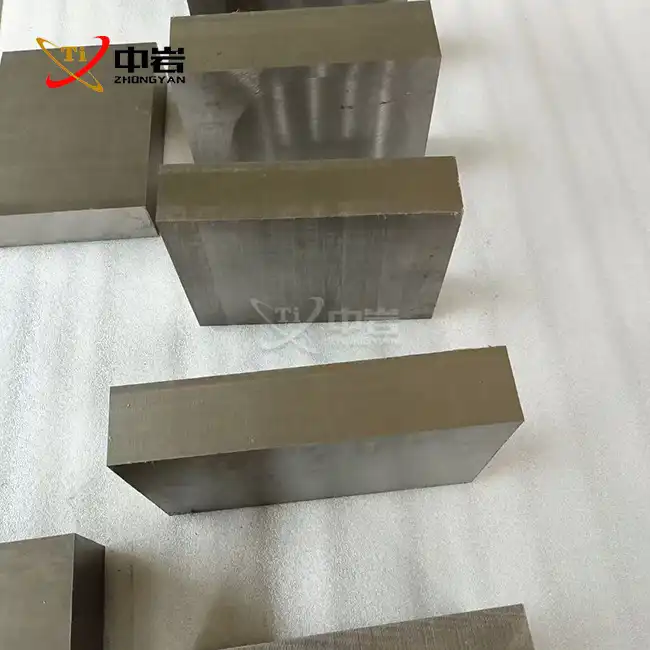
Titanium blocks stand out as premium raw materials because they combine exceptional mechanical strength with remarkably low weight, while offering unparalleled corrosion resistance across aggressive environments. Produced through vacuum arc remelting (VAR) followed by intensive forging, these solid sections provide superior structural integrity compared to cast alternatives, eliminating internal porosity that could compromise safety-critical applications. Their unique metallurgical characteristics address fundamental manufacturing challenges: reducing component weight without sacrificing durability, surviving extreme temperature fluctuations from cryogenic to 400°C, and maintaining dimensional stability under high mechanical loads—making them indispensable for aerospace, medical, and chemical processing industries.
Understanding Titanium Blocks: Properties and Grades
Metallurgical Foundations and Manufacturing Processes
titanium blocks come from vacuum arc remelted ingots and are thick, rectangular or cubic shapes that can be forged in more than one way. The process starts with ultra-pure titanium material that is melted under artificial atmospheres to keep oxygen or nitrogen from getting into the metal and changing its mechanical properties. After the material has solidified, it is compressed using hot isostatic pressing (HIP) to get the best density, which is usually more than 4.50 g/cm³, and gets rid of tiny holes. Forging forms directional grain flow that lines up with expected stress patterns. This makes the wear resistance much higher than with machined-from-bar stock. This controlled bending at high temperatures improves the microstructure by making grains smaller than 50 μm, which helps predict how the material will behave mechanically. Then, precise CNC machining sets the final measurements, with limits measured in microns to make sure they work with strict assembly standards.
Grade Classifications and Performance Characteristics
Titanium is broken down into commercially pure grades (CP Grades 1 through 4) and metal compositions, with each one designed to work in a certain range of situations. Commercially pure types are the most resistant to rust, and Grade 2 is the best choice for chemical handling equipment because it is both strong and easy to shape. These types have very few alloying elements, usually less than 0.3% iron and 0.25% oxygen. This has a direct effect on how easily the metal can be bent and joined. Grade 5 (Ti-6Al-4V) is mostly used in aircraft applications. It has 6% aluminum to make it stronger and 4% vanadium to make it work better at high temperatures. This working metal has tensile strengths of more than 900 MPa and a density of only 4.43 g/cm³, which is about 45% less than steel equivalents. Grade 23 (Ti-6Al-4V ELI) is often used in medical applications because it is an extra-low interstitial variant with a tightly controlled oxygen content below 0.13%. This makes it biocompatible for lasting implants.
Physical Properties That Define Premium Status
Titanium has some very special properties that come from the way its atoms are arranged. At room temperature, its crystal structure is hexagonal and closely packed. Above 882°C, it changes to a body-centered cubic, which changes the thermal processing windows. The thermal conductivity is about 21.9 W/m·K, which is less than that of aluminum but good enough for heat exchangers where resistance to rust is more important than thermal efficiency. The temperature expansion coefficient (8.6 × 10⁻⁶/°C) is very close to that of some ceramics, which allows mixed component designs to be made. The modulus of elasticity is 113.8 GPa, which is about 60% of steel's stiffness. In uses that need to be strong, engineers must take this into account. But this relative flexibility is good for medical implants because it lowers the stress protection that can cause bone loss around stiff implants. Within milliseconds of being exposed to oxygen, surface oxide layers form on their own, making a self-healing shield only 10 nanometers thick that keeps the parent metal from being attacked again.
Why Titanium Blocks Are Preferred Over Other Metals
Strength-to-Weight Ratio Advantages Across Industries
Titanium is very popular because its specific strength is higher than that of almost all other construction metals. Specific strength is the ratio of tensile strength to mass. A steel part might weigh 100 kilograms, but a titanium part that does the same job could weigh only 56 kilograms. This would greatly reduce the inertial loads on spinning machines or the amount of fuel used by transportation systems. Aerospace experts figure that every kilogram of weight savings in an airplane's body lets it carry more cargo or go farther, which saves money in the long run. This edge in weight is especially important for aircraft structural parts, where titanium blocks are used as billets to machine landing gear beam trucks, engine mounts, and wing attachment fittings. During their service life, these parts are put through millions of stress cycles and work in temperatures ranging from -55°C at cruise level to over 300°C near the engine systems. The high cycle fatigue strength of the material ensures that cracks don't form under these harsh conditions, which is something that bigger steel options can only do by being too heavy.
Corrosion Resistance That Eliminates Maintenance Cycles
Titanium forms safe oxide layers even in chloride-rich environments that break down normal corrosion-resistant metals. Stainless steels, on the other hand, depend on chromium content for passivation. This resistance is very useful for marine uses; for example, underwater valve bodies and heat exchanger parts made from titanium blocks work for decades without any cathodic protection systems or protective coatings. Titanium is used in chemical processes because it can handle acids, alkalis, and organic solvents that would quickly damage other materials. The effects on the economy go beyond material life. Maintenance plans get a lot shorter when parts don't rust, pit, or crack in crevices or stress corrosion. When offshore sites have titanium lifters, they don't need to be inspected or replaced as often, which can be expensive. Even though the starting costs are higher, lifetime analysis always shows a better return on investment, especially in situations where shutting down without warning can cost a lot of money.
Biocompatibility Enabling Medical Innovation
For patient-specific orthopedic implants, dental abutments, and surgery tools, medical device makers depend on titanium blocks as milling stock. The material still has the best osseointegration qualities of any metallic biomaterial. This means it can directly form structural bonds with live bone tissue. This biological acceptance stops the inflammation responses and device rejection that happen with lower-quality materials. This helps explain why hip and knee replacement success rates are over 95% after 15 years. Grade 23 titanium, which is made with extra-low interstitial material, is strong enough to meet the ASTM F136 guidelines for surgical implants. Dental labs use standard blocks to make unique crowns and bridges, which allows for exact fits that can't be achieved with traditional casting methods. Because the material is radiolucent, X-rays and CT scans can clearly show the surrounding tissues. This makes it easier to watch patients after surgery without metallic flaws that get in the way of diagnostic imaging.
The Economic and Technical Advantage of Using Titanium Blocks
Precision Machining Capabilities and Tight Tolerances
Modern CNC machines can shape titanium blocks into complicated shapes with positional accuracy of ±0.01mm, which meets the demanding needs of medical and aerospace uses. We've come up with special ways to make tools that take advantage of the material's low thermal conductivity, which keeps heat at the cutting edges instead of spreading it out across the workpiece. When you use carbide inserts with the right rake angles and controlled cutting speeds, you can get surface finishes below Ra 0.4μm without having to do any extra grinding. Because forged blocks have a near-net-shape edge, buy-to-fly ratios (the ratio of raw material weight to finished component weight) go down a lot. When large billets are machined the old way, buy-to-fly ratios of 10:1 or worse are common, which means that 90% of the expensive material is wasted as chips. This ratio can be raised to 3:1 or better by starting with blocks that are the right size. This cuts down on material costs and cuts time by a large amount. When the price of raw materials changes from $15 to $30 per kilogram based on grade and market conditions, this level of productivity is very important.
Long-Term Performance in Harsh Operational Environments
When put through situations that quickly break down other materials, parts made from titanium blocks last a very long time. For deep-sea uses, equipment has to deal with barometric pressures higher than 10,000 psi, as well as salt water and creatures that stick to it. Titanium keeps its shape and doesn't rust in these harsh conditions, while steel versions need thick corrosion limits that make them heavier and less effective in hydraulics. Cryogenic service comes with its own set of problems. At -162°C, where liquefied natural gas systems work, carbon steels become weak and more likely to break in a big way. Titanium stays flexible and resistant to impact across the whole temperature range. In fact, as temperatures drop, it gets stronger, which is a trait that is used in rocket fuel systems and plants that turn industrial gas into liquid. Because of this consistent performance, there is no need to switch out materials for different working regimes. This makes supply lines simpler and inventory less complicated.
Total Cost of Ownership Analysis
Smart procurement teams don't just compare purchase prices when they look at products; they use lifetime cost models instead. These studies look at things like the cost of buying, the cost of cutting, the need for coating and finishing, the frequency of inspections and replacements, and the cost of getting rid of the item. When set up correctly, these kinds of tests always favor titanium for uses that are exposed to corrosives, need to be light, or work in harsh circumstances.This idea is shown by the impeller of a chemical handling machine. A version made of titanium could cost $8,000, while a version made of covered steel would only cost $2,000. But the steel part needs protective coats that wear off in 18 to 24 months, meaning it has to be taken apart, re-coated, and put back together again, which costs $3,000 each time. After ten years, the steel option costs a total of $23,000, while the titanium option only costs $8,000 at the start. This 65% savings doesn't include lost work time during repair breaks or the environmental costs of getting rid of coating trash.
How Titanium Blocks Are Procured by Global B2B Clients
Certification Requirements and Material Traceability
Thorough quality control starts with full material certificates that list the chemicals used, their mechanical features, and how they were made. Trustworthy sources give mill test reports (MTRs) that can be linked to particular ingot heat numbers. This lets you check that the titanium blocks meet ASTM B381 standards for forgings or AMS 4928 standards for aerospace-grade Ti-6Al-4V. These approvals list the levels of impurities, such as the amount of iron, carbon, nitrogen, hydrogen, and oxygen in the material, which have a big effect on how it behaves. Inductively coupled plasma mass spectrometry (ICP-MS) and glow discharge mass spectrometry (GDMS) are used by independent testing labs to ensure purity levels above 99.995% for sputtering target applications. Standardized subject shapes are used in mechanical tests to confirm tensile strength, yield strength, elongation, and impact toughness. Ultrasonic scanning finds internal cracks bigger than 1.5 mm, making sure there are no inclusions that could cause stress cracks to form while the product is being used.
Customization, Flexibility, and Order Volume Considerations
Leading makers can meet a wide range of needs, from small amounts for prototypes to large production runs. Custom measurements mean that no extra work needs to be done on the machine, and the blocks are provided to within 3 mm of the finished envelope dimensions. There are different ways to finish the surface, from mill finish to precision ground faces that must be flat within 0.05 mm per 300 mm length. We keep standard sizes in stock and can speed up the custom casting process for unique shapes. Minimum order numbers depend on the source and the grade of the material. They can be as low as one piece for research work or as high as a pallet for production projects. When it comes to melting, forging, and quality control, volume price systems take into account savings of scale. Blanket buy orders with planned releases help customers make sure they have enough capacity during times of low supply without having to pay too much for storage. Lead times range from 8 to 16 weeks, based on the level of difficulty and the licenses that are needed.
Supplier Evaluation Criteria and Risk Mitigation
When deciding which titanium suppliers to work with, procurement workers use multi-factor rating models. Manufacturing capacity audits look at how advanced the technology is, how well it handles the process, and whether the quality management systems are approved to ISO 9001:2015 and AS9100 for use in aerospace. Logistics prices and lead times are affected by where they are located. For example, suppliers in Baoji, China's Titanium Valley, gain from integrated supply chains and a concentration of specialized technical knowledge in this industry cluster. Financial stability reviews keep supplies from being interrupted when a seller goes bankrupt. Long-term supply deals should cover things like new technology, more space to support growth, and protecting unique designs' intellectual property. Referrals from past customers in related fields give information about how well the company delivers on time, how quickly they respond to technical issues, and how well they solve problems that skills on paper can't show.
Planar Titanium Targets: Specialized Applications of Titanium Processing
High-Purity Sputtering Solutions for Thin-Film Technology
Physical vapor deposition (PVD) methods need very pure base materials and have a uniform structure. Our planar titanium targets are made from Grade 1 and Grade 2 commercially pure titanium using the same exact VAR and forging methods that are used to make structural titanium blocks. They have purity levels of 99.995% or higher. These targets are used by places that make semiconductors, display panels, and optical coatings, where even small amounts of contamination can damage film qualities. Controlling the grain structure and making the surface ready are important parts of the manufacturing process. After using hot isostatic pressing to get densities above 4.50 g/cm³, precision CNC cutting makes the whole goal surface flat within 0.05 mm. This evenness keeps the sparking rates steady and stops hot spots from forming in one place, which could lead to target breaking or particle production. Surface finishes below Ra 0.4μm reduce arcing events that damage cast films. Standard widths range from 2 inches to 14 inches and thicknesses from 3mm to 10mm. Custom sizes can be made to fit different sputtering system designs. Copper, stainless steel, and aluminum can all be used for backing plate bonding, and the choice is made based on heat control needs and system compatibility. The targets work well with popular PVD equipment brands and help make integrated circuits, OLED screens, anti-reflective coatings, and tool coatings that don't break down easily.
Quality Assurance for Critical Coating Applications
Given that chip manufacturing expects zero defects, the manufacturing controls for sputtering targets go beyond what is needed for aircraft. We check the chemical purity using an ICP-MS that can find contaminants down to the parts-per-billion level. This shows that there are no impurities that could change the electrical qualities of the films that were formed. Metallographic study of grain size shows consistency below 50 μm, which stops sputtering behavior from changing because of texture. Ultrasonic screening creates a three-dimensional map of the internal structure and finds any holes or other features bigger than 0.5 mm that might weaken the target during high-power sputtering. Surface profilometry measures the roughness of a surface and how it affects the formation and binding of films. Each target comes with a full certification that lists its composition, density, grain structure, and surface state. This gives cleanroom quality control systems the ability to track each target. Applications can be used in many fields. Semiconductor factories put down titanium barrier layers that stop copper from moving into silicon plates. Display makers make films that are clear for touchscreens. Precision glasses are given anti-reflective coatings by companies that make optical parts. Aerospace suppliers put protective layers on turbine blades that are going to be oxidized at high temperatures. This shows how specialized titanium processing can be used to solve a wide range of technical problems by changing the qualities of the material.
Future Outlook and Trends in Titanium Block Usage
Alloy Development and Performance Enhancement
New formulas used in metallurgical studies are continuing to improve the properties of titanium. Beta-titanium alloys, which are supported by molybdenum and vanadium, are easier to shape and have a higher strength potential than regular alpha-beta alloys. These materials make it possible to make parts with smaller sections that are stronger but lighter. Near-alpha formulas that have better creep resistance allow them to work at temperatures above 500°C, which makes them useful in advanced propulsion systems. Additive manufacturing technologies work with traditional forging to make it possible to make parts with complex internal shapes that aren't possible with traditional cutting. Hybrid methods use both forged block bases and carefully cast features to place materials in the best way for load lines while reducing waste. These improvements in manufacturing will probably lead to more acceptance of titanium blocks in many fields that are currently held back by high buy-to-fly ratios or physical restrictions.
Expanding Applications in Emerging Technologies
Manufacturers of electric vehicles are using titanium more and more for battery cases, suspension parts, and fastening systems because it is lighter and can directly increase the driving range. The electromagnetic transparency of the material keeps wireless charging systems and contact between vehicles and equipment from being harmed. As battery sizes increase, it becomes necessary to balance out this extra weight with lightweight building materials in order to meet performance goals. Modern medical gadgets use titanium's special qualities in new and creative ways. Personalized orthopedic devices made from CT pictures of the patient's body improve load transfer and speed up healing. Titanium is radiopaque and biocompatible, which are both good qualities for cardiovascular stents. Titanium end-effectors are used in surgical robots because they don't rust or change size after being sterilized many times. These uses show how the qualities of materials can open up completely new ways to treat diseases.
Sustainability and Circular Economy Considerations
Environmental awareness is becoming more and more important in purchasing choices. Titanium recycling technologies can now get back more than 95% of the scrap metal that is sent to them by remelting chips and rejected parts into fuel that cannot be told apart from new metal. Compared to making things from rutile rock directly, this closed-loop method cuts stored energy by about 90%. We are a part of industry groups that set up collection networks and handling guidelines that make large-scale recycling profitable. Lifecycle assessments are growing in favor of titanium when longevity and low upkeep costs are taken into account. A titanium part that lasts 30 years without needing to be replaced is better for the world than three steel parts that need to be extracted, processed, and thrown away. In addition to standard cost and performance criteria, these sustainability measures are used in forward-thinking procurement policies. This is because choosing the right materials has effects that go far beyond the current needs of manufacturing.
Conclusion
Titanium blocks are considered high-end because they have properties that other materials don't have, such as unmatched strength-to-weight ratios, excellent resistance to rust, reliable biocompatibility, and consistent performance in harsh settings. We looked at how precise metallurgical control during VAR and forging makes microstructures that are best for tough uses and how different grade choices let properties be tailored to specific needs. Lifecycle costs often favor titanium, even though it costs more to buy, especially when upkeep costs are taken into account, and service life is increased. Titanium's role will continue to grow as industries move toward lighter, more durable, and more environmentally friendly solutions. This is made possible by improvements in alloy design, manufacturing methods, and recycling facilities that make these amazing materials easier to get.
FAQ
What factors determine pricing for titanium blocks?
Prices are mostly based on the grade, the level of quality needed, and the size of the order. Because they are easier to work with, commercially pure types usually cost less than complicated alloys like Ti-6Al-4V. Extra costs come up for custom sizes, fast shipping, and unique certifications. Pricing for raw materials is affected by how the market works, with rates changing based on the supply of rock and demand around the world. When you commit to a volume order, you can often get better price, but sample orders cost more for titanium blocks. Suppliers who offer full tracking and third-party tests may be able to charge more because they have put more money into quality assurance.
How can buyers verify supplier authenticity and material certifications?
Genuine suppliers give full mill test records that can be linked to particular heat numbers. These reports include chemical composition analysis and mechanical test results. Ask an independent lab to check the work using ICP-MS or a similar analysis method from a facility that has been approved. Check the sites of suppliers to make sure their skills match the licenses they say they have, like ISO 9001:2015, AS9100, or NADCAP for aerospace uses. Check references from customers in the same or a related industry, and use private sources to make sure the business is registered. Suppliers with a good reputation like these verification activities because they help set quality-focused makers apart from commodity traders who don't know much about technology.
What customization options exist for size and grade specifications?
Manufacturers can meet a wide range of needs by having variable casting and machining capabilities. Standard blocks come in shapes ranging from 50 mm cubes to pieces that are more than 500 mm long, wide, and thick. Custom measurements that meet the needs of a near-net form reduce the need for further machining. You can choose from commercially pure grades (Grades 1-4), aircraft alloy grades (Grade 5 and Grade 23), and special combinations. Some surface processes are mill finish, precise grinding, and special finishes. Different types of packaging can be used for both normal industrial shipping and cleanroom delivery for semiconductor uses. For dealer programs, OEM branding is also an option.
Partner with Zhongyan: Your Trusted Titanium Blocks Supplier
At our Baoji plant in China's Titanium Valley, Zhongyan makes approved, high-performance titanium blocks that meet strict ASTM, AMS, and ISO standards. We can do vacuum arc remelting, precision forging, and advanced CNC cutting all at the same time. This lets us make blocks from 50 mm to 500 mm in commercially pure and alloy grades. We keep our ISO 9001:2015 approval and provide full material traceability through detailed mill test results. Our expert team works with engineers from all over the world to find the best material specs for medical implants, chemical processing equipment, and parts for spacecraft. In addition to normal blocks, we also make high-purity planar titanium targets for use in semiconductors. These targets can achieve purity levels higher than 99.995% and can be bonded in a variety of ways. Contact our experts at sales@titaniumstudy.com to talk about your needs and get specific quotes based on decades of experience in the field with Ti-6Al-4V.
References
1. Boyer, R., Welsch, G., & Collings, E.W. (1994). Materials Properties Handbook: Titanium Alloys. ASM International, Materials Park, Ohio.
2. Donachie, M.J. (2000). Titanium: A Technical Guide, 2nd Edition. ASM International, Materials Park, Ohio.
3. Lütjering, G., & Williams, J.C. (2007). Titanium, 2nd Edition: Engineering Materials and Processes. Springer-Verlag, Berlin Heidelberg.
4. Froes, F.H. (2015). Titanium: Physical Metallurgy, Processing, and Applications. ASM International, Materials Park, Ohio.
5. Peters, M., Kumpfert, J., Ward, C.H., & Leyens, C. (2003). "Titanium Alloys for Aerospace Applications," Advanced Engineering Materials, Volume 5, Issue 6, pp. 419-427.
6. ASTM International (2021). ASTM B381-13: Standard Specification for Titanium and Titanium Alloy Forgings. West Conshohocken, Pennsylvania.
Learn about our latest products and discounts through SMS or email