- English
- French
- German
- Portuguese
- Spanish
- Russian
- Japanese
- Korean
- Arabic
- Greek
- German
- Turkish
- Italian
- Danish
- Romanian
- Indonesian
- Czech
- Afrikaans
- Swedish
- Polish
- Basque
- Catalan
- Esperanto
- Hindi
- Lao
- Albanian
- Amharic
- Armenian
- Azerbaijani
- Belarusian
- Bengali
- Bosnian
- Bulgarian
- Cebuano
- Chichewa
- Corsican
- Croatian
- Dutch
- Estonian
- Filipino
- Finnish
- Frisian
- Galician
- Georgian
- Gujarati
- Haitian
- Hausa
- Hawaiian
- Hebrew
- Hmong
- Hungarian
- Icelandic
- Igbo
- Javanese
- Kannada
- Kazakh
- Khmer
- Kurdish
- Kyrgyz
- Latin
- Latvian
- Lithuanian
- Luxembou..
- Macedonian
- Malagasy
- Malay
- Malayalam
- Maltese
- Maori
- Marathi
- Mongolian
- Burmese
- Nepali
- Norwegian
- Pashto
- Persian
- Punjabi
- Serbian
- Sesotho
- Sinhala
- Slovak
- Slovenian
- Somali
- Samoan
- Scots Gaelic
- Shona
- Sindhi
- Sundanese
- Swahili
- Tajik
- Tamil
- Telugu
- Thai
- Ukrainian
- Urdu
- Uzbek
- Vietnamese
- Welsh
- Xhosa
- Yiddish
- Yoruba
- Zulu
Where to Source Reliable Titanium Pyramid Adapter Components Quickly
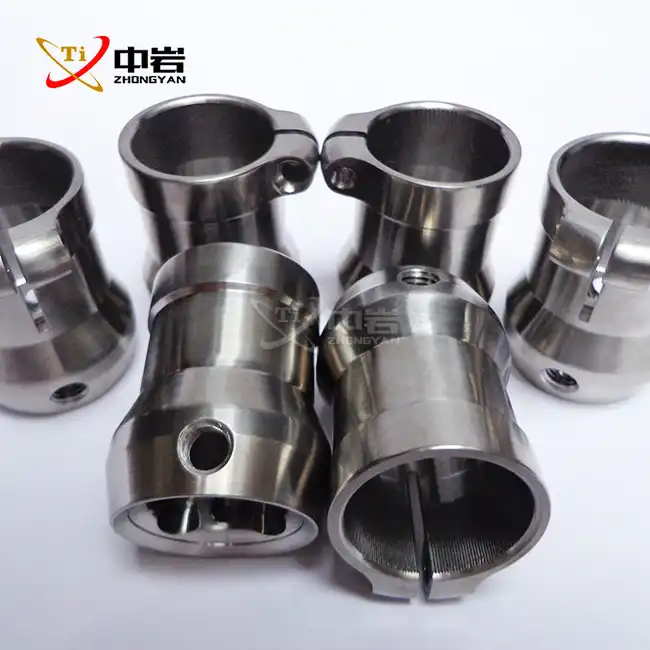
When engineers and purchasing managers need Titanium Pyramid Adapter parts that have to meet strict medical or military standards, both speed and dependability become very important. To get these precisely made plugs, you need to work with makers that have strict quality control, allow for customisation, and can deliver quickly. Baoji Zhongyan Titanium Industry Co., Ltd. is based in China's Titanium Valley and uses cutting-edge CNC machines to make Grade 5 titanium alloy adapters. Our factory-direct model cuts out the middleman, so sourcing teams get approved parts that meet ASTM, AMS, and ISO standards in the fastest time possible in the business.
Understanding Titanium Pyramid Adapters: What Makes Them Essential Components?
The Titanium Pyramid Adapter is an important part of many high-performance applications' interfaces. These parts were first made for flexible prosthesis systems, but now they are essential links for aircraft assemblies, machine adjustments, and mounting solutions for precision equipment. The pyramid shape of these parts lets engineers make angle changes while they're being installed, which is very helpful when they need to fine-tune alignment tolerances in complicated systems.
Material Composition and Core Design Features
Titanium Pyramid Adapter parts made by Zhongyan are made from Grade 5 titanium metal (Ti-6Al-4V). This aerospace-grade material has a tensile strength of more than 895 MPa and a mass of only 4.43 g/cm³. With 6% aluminium and 4% vanadium, the alloy's makeup forms a pattern that stops cracks from spreading under cyclic loading conditions. Our CNC machine centers keep the limits for sizes within ±0.02mm. This makes sure that the pyramid surfaces always fit perfectly with the receiver clamps, even after thousands of assembly cycles. The normal pyramid shape has a 30 mm circle and a fastening pattern with four holes. Our engineering team can change taper angles, thread specs, and connection interfaces based on application models so that custom shapes can meet specific load needs. Surface treatments include electropolished finishes that are safe for medical use and anodised coats that protect against rust better in naval settings.
Superior Strength-to-Weight Ratio and Corrosion Resistance
When you look at real-world practical data, you can measure how much better titanium performs. A Grade 5 Titanium Pyramid Adapter that weighs 85 grams can be used instead of one made of stainless steel that weighs 155 grams and can hold the same amount of weight. This 45% weight loss directly leads to lower energy use in aircraft and less tiredness during operation in prosthesis systems. When scratched, the material's passive oxide layer grows back right away, protecting it from rusting in saltwater, acidic processing fluids, and wet industrial environments. After being exposed to salt spray for 5,000 hours, our Baoji facility's lab tests show that there was no degradation. This is a level of performance that stainless steel adapters can't match without special treatments. This built-in toughness gets rid of the need for protection treatments, which makes upkeep easier, and it also means that service times can be longer in difficult settings.
Typical Industrial Applications and Operational Efficiency
Titanium Pyramid Adapter parts are used by procurement teams in a wide range of industries to meet unique performance needs. Aircraft makers put these adapters into landing gear systems to save weight, which increases fuel economy and the amount of cargo that can be carried. Because the adapters are not magnetic, they are very important in the production of electronics, especially for semiconductor blasting equipment where magnetic disturbance would make it hard to control the process.
Titanium adapters are used in reactor tank systems that are exposed to toxic substances in chemical processing plants. The material can withstand temperatures up to 400°C without losing its shape, which is something that aluminium fittings can't do. Designers of industrial machinery use these parts in robotic arm links because they are light and don't wear out easily, which means the equipment lasts longer than 10 million rounds.
To get the most out of a product's term value, think about these useful longevity factors:
- Cyclic Load Management: Grade 5 titanium stays flexible even when it's under a lot of stress over and over again, which keeps it from breaking like aluminium parts do when they work too hard. Our adapters pass the ISO 10328 stress test at P7 load levels, which means they can support people up to 166 kg in prosthetic uses or similar heavy-duty industrial loads.
- Stability at Different Temperatures: Titanium's low thermal expansion coefficient (8.6 × 10⁻⁶/°C) keeps its size from changing too much when it is heated and cooled many times. This steadiness is very important for precise equipment because it keeps alignment tolerances across a wide range of temperatures and keeps expensive recalibration methods from having to be done.
- Maintenance of Surface Hardness: Titanium's hardness (about 36 HRC) means that threads don't get damaged during repeated assembly operations, unlike softer metals that develop galling under threaded connections. When used with Loctite 242 thread locker, our suggested torque settings of 12 to 15 Nm ensure a safe connection without deforming the material.
With all of these qualities working together, parts that need little upkeep can be made. Visual inspections every three months and torque checks every six months make up the full maintenance plan. This is very different from aluminium adapters that need to be replaced often or steel parts that need to be treated for rust. The operating efficiency gains add up over the lifetime of a product, which makes the higher original material costs economically justified by less downtime and longer periods between replacements.
Comparison of Titanium Pyramid Adapters with Other Metal Adapters: Making an Informed Choice
The choice of materials has an instant effect on the costs of buying them and an ongoing effect on the costs of running the business. When purchasing professionals know the differences in performance between Titanium Pyramid Adapter choices and replacements made of aluminium or stainless steel, they can make sure that the part specifications meet the needs of the application and the budget.
Weight, Strength, and Corrosion Resistance Analysis
Titanium fittings are in a special place in the performance range of materials. Titanium grade 5 has a specific strength (strength-to-weight ratio) of 202 kN·m/kg, which is much higher than the 127 kN·m/kg of stainless steel and the 175 kN·m/kg of aluminium 7075. This benefit is useful in situations where lowering the spinning mass makes the system more efficient or where weight saved from many parts affects the overall performance of the system. When you compare corrosion protection, you can see even bigger differences. In chemical or sea settings, stainless steel adapters need protected coats, which raises the cost of production and creates places where they could fail if the coatings come off. Aluminium pits when it comes into contact with saltwater, so it needs to be replaced every few months instead of every year. Titanium Pyramid Adapter parts don't corrode much, even after being exposed to strong media for a long time. This means that this upkeep factor isn't used in lifecycle estimates.
Cost-Efficiency and Long-Term Value Considerations
At first glance, the cost of purchasing titanium fittings is about 3.2 times that of similar stainless steel parts and 4.8 times that of similar aluminium parts. This big investment needs to be justified by a total cost of ownership study, not just the price of the item itself. Taking into account how often it needs to be replaced, the cost of upkeep labour, and the cost of downtime, titanium's lifetime economics become very appealing. A factory that replaces aluminium adapters once a year for $45 each spends $450 on materials over 10 years. They also spend another $280 on installation labour and $620 on production downtime, for a total of $1,350 per adapter position. A titanium option that costs $215 doesn't need to be replaced during the same time period. The cost of $255 includes $40 for testing work. The 81% drop in lifetime costs shows that materials that last longer can save you money, even if they cost more at first.
Industrial Versus Commercial Use Cases
The best material choice depends on the application setting. Commercial prosthetics makers who make a lot of them often choose aluminium adapters for markets that want to save money and where patients don't do too much. Because stainless steel is heavier than other materials, it is only used in controlled factory settings where rusting is unlikely to happen, and the weight of the parts doesn't matter. Titanium Pyramid Adapter parts are the best choice when weight, strength, and resistance to the environment all need to be optimised at the same time. Titanium's heat stability is important for aerospace subassemblies that work in very high or very low temperatures. Titanium must be biocompatible and not magnetic in order to be used for medical implants. Titanium's resistance to rust is needed for offshore equipment that is submerged in saltwater all the time.
Where to Source Reliable Titanium Pyramid Adapter Components Quickly: Trusted Supplier Insights
Locating qualified Titanium Pyramid Adapter manufacturers requires navigating a fragmented supply landscape where material authenticity, manufacturing capability, and delivery reliability vary dramatically. Procurement professionals face the challenge of distinguishing between certified producers maintaining rigorous quality systems and distributors offering inconsistent product specifications.
OEM Manufacturers Versus Certified Distributors
Direct engagement with original equipment manufacturers provides maximum control over specifications and quality assurance processes. At Zhongyan, we operate integrated production facilities in Baoji where titanium raw materials undergo CNC machining, surface treatment, and final inspection under continuous oversight. This vertical integration eliminates supply chain handoffs that introduce quality variation and timeline uncertainty. Our manufacturing complex houses 24 precision CNC machining centers capable of processing titanium components with dimensional tolerances meeting aerospace standards. Material traceability systems link every Titanium Pyramid Adapter batch to mill test reports certifying Grade 5 alloy composition through spectrographic analysis. This documentation chain proves essential for customers requiring AS9100 compliance or FDA registration support.
Strategies to Verify Supplier Credibility and Product Authenticity
Material substitution represents a persistent risk in titanium component procurement. Some suppliers provide commercially pure titanium (Grade 2) components instead of specified Grade 5 alloy, creating a 40% reduction in tensile strength that compromises safety margins. Others supply counterfeit mill certificates or manipulate material test data to obscure compositional deficiencies. Effective verification protocols begin with requesting material certifications traceable to specific heat lots. Legitimate manufacturers provide documentation showing alloy composition analysis via X-ray fluorescence or optical emission spectroscopy. At Zhongyan, we maintain complete material pedigree records allowing customers to verify that purchased Titanium Pyramid Adapter components originated from certified titanium smelters.
Locating Regional Suppliers and Leveraging Bulk Order Capabilities
Geographic proximity influences lead times and shipping costs, making regional supplier identification valuable for time-sensitive projects. However, titanium manufacturing concentrates in specific geographic clusters due to raw material availability and specialized processing expertise. China's Titanium Valley in Baoji represents the world's largest titanium processing hub, producing approximately 60% of global titanium mill products. This geographic concentration creates a compelling case for engaging manufacturers like Zhongyan despite international shipping considerations. Our proximity to titanium smelters and forging operations reduces material costs and enables rapid prototype production. Express shipping options deliver Titanium Pyramid Adapter components to North American customers within 7-10 business days—timelines competitive with domestic distributors maintaining limited inventory.
Practical Guidance on Procurement: How to Buy Titanium Pyramid Adapters Efficiently
Efficient procurement processes balance cost optimization with supply chain reliability. Purchasing Titanium Pyramid Adapter components involves evaluating supplier capabilities, negotiating commercial terms, and establishing logistics frameworks that prevent production disruptions while minimizing inventory carrying costs.
Online Procurement Platforms and Vendor Evaluation Criteria
Digital procurement channels have transformed B2B component sourcing, though titanium specialty products remain underrepresented on generalized industrial marketplaces. Platforms like Alibaba and ThomasNet list numerous suppliers, but product specifications often lack the technical detail necessary for informed decision-making. Material grades receive generic descriptions, dimensional tolerances go unspecified, and quality certifications remain unverified. Direct manufacturer websites provide superior technical information when suppliers invest in comprehensive product documentation. Our online catalog at titaniumstudy.com details material compositions, mechanical properties, surface finish options, and dimensional specifications for standard Titanium Pyramid Adapter configurations. CAD models available for download enable engineering teams to verify fit and function before committing to orders.
Vendor evaluation should prioritize manufacturing capability over marketing presentation. Key assessment criteria include:
- Production capacity verification through facility documentation showing equipment inventory, square footage, and staffing levels that support claimed output volumes
- Quality system certifications validated through accreditation body registries confirming current ISO 9001 status and industry-specific standards compliance
- Technical support resources demonstrated by responsive engineering staff capable of discussing application requirements and specification modifications
- Customer reference accessibility allowing conversations with existing clients regarding delivery performance, quality consistency, and problem resolution responsiveness
Our evaluation questionnaire provides procurement teams with a structured framework for comparing suppliers. We encourage customers to request facility video tours, review material test reports from recent production batches, and discuss customization capabilities with engineering personnel before finalizing supplier selection.
Negotiation Tactics for Wholesale Transactions
Volume commitments create negotiation leverage that single-purchase orders cannot match. Suppliers amortize setup costs, material procurement, and quality inspection expenses across order quantities, making per-unit pricing more favorable as volumes increase. Titanium Pyramid Adapter orders exceeding 200 pieces typically qualify for volume discounts ranging from 18-28% below catalog pricing. Annual purchase agreements provide mutual benefits worth negotiating. Customers gain price stability and delivery priority, while manufacturers secure revenue predictability, enabling capacity planning optimization. Our blanket purchase order program locks pricing for 12-month periods while allowing flexible release schedules that align component deliveries with production requirements.
Understanding Shipping Logistics and International Delivery Timelines
Global titanium component sourcing requires navigating customs procedures, freight forwarding, and delivery coordination. Standard shipping from our Baoji facility to major U.S. ports averages 18-22 days via ocean freight, with trucking to final destinations adding 3-5 business days. Express air freight reduces transit to 7-10 days at approximately 4.5 times ocean freight cost—a premium justified when production schedules cannot accommodate standard timelines. Incoterms selection impacts cost allocation and risk transfer. FOB (Free On Board) pricing places shipping arrangement responsibility with buyers, while DDP (Delivered Duty Paid) includes all freight, insurance, and customs clearance costs in quoted pricing. We recommend DDP terms for customers unfamiliar with import procedures, as our logistics partners handle customs documentation and duty payment, delivering Titanium Pyramid Adapter shipments directly to receiving docks.
Ensuring Long-Term Value: Installation, Maintenance, and Quality Assurance of Titanium Pyramid Adapters
Maximizing component lifecycle returns requires proper installation procedures, routine maintenance protocols, and systematic quality verification. Titanium Pyramid Adapter performance depends not only on material properties and manufacturing precision but also on assembly techniques that preserve design tolerances and prevent premature wear.
Step-by-Step Installation Guidelines
Proper installation begins with surface preparation. Mating surfaces require cleaning with isopropyl alcohol to remove machining oils, dust, or corrosion products that would prevent complete contact. Thread inspection should verify the absence of cross-threading or debris that could compromise fastener engagement. Our installation documentation specifies surface roughness requirements and cleanliness standards that ensure optimal interface performance. Alignment procedures prove critical in applications requiring angular precision. Titanium Pyramid Adapter geometry allows adjustment during installation, but final positioning must occur before fasteners reach final torque. We recommend tightening set screws in star patterns—alternating between opposite fasteners—to distribute clamping forces evenly and prevent distortion of pyramid surfaces.
Maintenance Practices That Extend Component Lifespan
Titanium's corrosion resistance reduces maintenance requirements compared to alternative materials, though periodic inspection remains prudent. Visual examination at six-month intervals identifies potential issues before they compromise performance. Inspection protocols should document surface condition, fastener integrity, and dimensional stability through photographic records, enabling trend analysis across service history. Threaded connections require particular attention during maintenance inspections. Set screw examination should confirm torque retention through verification checks using calibrated wrenches. Threads showing wear patterns or galling symptoms indicate improper installation or inadequate lubrication. Our service bulletins provide photographic references showing acceptable versus problematic thread conditions to guide maintenance personnel.
These maintenance best practices safeguard performance over extended service periods:
- Load cycle tracking through operational hour meters or cycle counters enables predictive replacement before fatigue limits exhaust component lifespan, particularly in high-cycle applications approaching manufacturer-specified limits
- Corrosion monitoring in harsh environments through periodic photography documents surface conditions, with comparison against baseline images revealing degradation rates that inform replacement scheduling decisions
- Dimensional verification using precision measurement tools detects wear patterns or deformation trends, enabling proactive intervention before tolerances exceed specification limits and compromise assembly function
Implementing systematic maintenance documentation creates performance history databases supporting reliability analysis and lifecycle cost validation. Our customers report that structured maintenance programs extend Titanium Pyramid Adapter service intervals by an average of 35% compared to reactive maintenance approaches, while reducing unplanned downtime through predictive replacement timing.
Quality Verification Methods and Certification Standards
Incoming inspection protocols validate that received components meet specification requirements before integration into assemblies. Dimensional verification using calibrated micrometers, calipers, and coordinate measuring equipment confirms critical features fall within tolerance bands. Material verification through portable XRF analyzers provides compositional analysis confirming Grade 5 alloy specifications. Certification documentation review ensures traceability and regulatory compliance. Mill test reports should detail chemical composition through certified analysis, mechanical property testing results, and heat treatment records. Our certificate packages include material certifications, dimensional inspection reports, and surface finish measurements—providing comprehensive documentation supporting quality system audits and regulatory submissions.
Conclusion
Sourcing Titanium Pyramid Adapter components efficiently requires balancing multiple procurement variables: material authenticity, manufacturing precision, delivery reliability, and lifecycle cost optimization. Direct engagement with specialized manufacturers like Zhongyan eliminates supply chain complexity while providing access to engineering expertise, customization capabilities, and quality systems supporting demanding aerospace and medical applications. Our factory-direct model delivers Grade 5 titanium alloy components manufactured under ISO-certified processes, with delivery timelines and pricing structures competitive with domestic distributors. Procurement teams gain confidence through comprehensive material traceability, responsive technical support, and production capacity capable of scaling from prototype quantities to high-volume production runs.
FAQ
What factors determine Titanium Pyramid Adapter supplier reliability?
Supplier reliability stems from manufacturing capability, quality system maturity, and customer service infrastructure. Certified manufacturers maintaining ISO 9001 registration demonstrate systematic quality management, while ASTM and AMS material compliance confirms specification adherence. Production capacity documentation—including equipment inventories and staffing levels—reveals the ability to fulfill orders without compromising lead times. Established suppliers provide customer references, facility documentation, and material test reports validating their claims. At Zhongyan, we maintain complete production transparency, welcoming facility audits and providing comprehensive documentation supporting supplier qualification processes.
How does titanium corrosion resistance compare to stainless steel in industrial environments?
Titanium develops a passive oxide layer providing superior corrosion resistance compared to stainless steel across most industrial environments. Salt spray testing demonstrates titanium maintaining surface integrity after 5,000+ hours of exposure, while stainless steel develops pitting corrosion within 500-800 hours without protective coatings. Chemical processing applications expose this differential dramatically—titanium resists degradation in chloride solutions, acidic media, and oxidizing environments where stainless steel requires expensive alloy grades or protective treatments. This inherent resistance eliminates maintenance costs and extends component lifecycles substantially.
Can Titanium Pyramid Adapter specifications be customized for specialized applications?
Customization capabilities depend on manufacturer engineering resources and production flexibility. Standard modifications include dimensional adjustments, thread specification changes, and surface finish alterations. Complex customizations might involve geometry modifications, specialized heat treatments, or unique inspection requirements. Our engineering team collaborates on custom Titanium Pyramid Adapter designs, providing CAD modeling, prototype production, and validation testing services. We accommodate modifications ranging from simple dimensional changes to complete redesigns supporting unique application requirements across aerospace, medical, and industrial sectors.
Partner With Zhongyan for Precision Titanium Pyramid Adapter Manufacturing Solutions
Zhongyan delivers custom Titanium Pyramid Adapter manufacturing combining Grade 5 alloy material excellence with precision CNC machining capabilities. Our Baoji production facilities maintain ISO 9001:2015 certification and produce components meeting ASTM B348 and AMS 4928 specifications. Procurement teams benefit from flexible order quantities spanning prototype development through high-volume production, with engineering support ensuring components integrate seamlessly into demanding aerospace, medical, and industrial applications. Experience factory-direct pricing, compressed lead times, and comprehensive quality documentation supporting regulatory compliance requirements. Contact our team at sales@titaniumstudy.com to discuss your Titanium Pyramid Adapter supplier needs and receive detailed quotations aligned with your project specifications and delivery schedules.
References
1. Boyer, R., Welsch, G., and Collings, E.W. (1994). Materials Properties Handbook: Titanium Alloys. ASM International, Materials Park, Ohio.
2. Donachie, M.J. (2000). Titanium: A Technical Guide, 2nd Edition. ASM International, Materials Park, Ohio.
3. International Organization for Standardization (2016). ISO 10328: Prosthetics — Structural testing of lower-limb prostheses — Requirements and test methods. Geneva, Switzerland.
4. Lutjering, G. and Williams, J.C. (2007). Titanium, 2nd Edition. Springer-Verlag, Berlin Heidelberg.
5. Peters, M., Kumpfert, J., Ward, C.H., and Leyens, C. (2003). Titanium Alloys for Aerospace Applications. Advanced Engineering Materials, Volume 5, Issue 6.
6. Schutz, R.W. and Watkins, H.B. (1998). Recent developments in titanium alloy application in the energy industry. Materials Science and Engineering A, Volume 243, Issues 1-2.
Learn about our latest products and discounts through SMS or email