- English
- French
- German
- Portuguese
- Spanish
- Russian
- Japanese
- Korean
- Arabic
- Greek
- German
- Turkish
- Italian
- Danish
- Romanian
- Indonesian
- Czech
- Afrikaans
- Swedish
- Polish
- Basque
- Catalan
- Esperanto
- Hindi
- Lao
- Albanian
- Amharic
- Armenian
- Azerbaijani
- Belarusian
- Bengali
- Bosnian
- Bulgarian
- Cebuano
- Chichewa
- Corsican
- Croatian
- Dutch
- Estonian
- Filipino
- Finnish
- Frisian
- Galician
- Georgian
- Gujarati
- Haitian
- Hausa
- Hawaiian
- Hebrew
- Hmong
- Hungarian
- Icelandic
- Igbo
- Javanese
- Kannada
- Kazakh
- Khmer
- Kurdish
- Kyrgyz
- Latin
- Latvian
- Lithuanian
- Luxembou..
- Macedonian
- Malagasy
- Malay
- Malayalam
- Maltese
- Maori
- Marathi
- Mongolian
- Burmese
- Nepali
- Norwegian
- Pashto
- Persian
- Punjabi
- Serbian
- Sesotho
- Sinhala
- Slovak
- Slovenian
- Somali
- Samoan
- Scots Gaelic
- Shona
- Sindhi
- Sundanese
- Swahili
- Tajik
- Tamil
- Telugu
- Thai
- Ukrainian
- Urdu
- Uzbek
- Vietnamese
- Welsh
- Xhosa
- Yiddish
- Yoruba
- Zulu
What Is a Titanium Sputtering Target Used For?
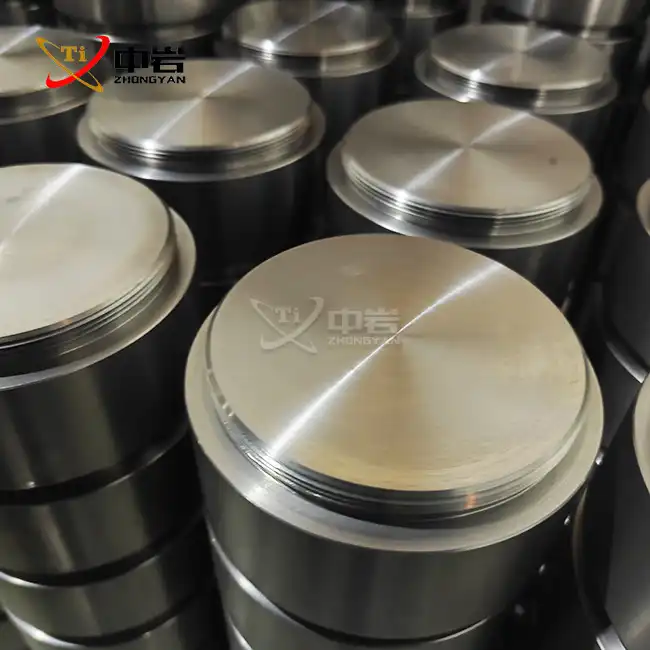
A Titanium Sputtering Target serves as a high-purity source material in Physical Vapor Deposition (PVD) processes, where energetic ions bombard the target surface to eject titanium atoms that subsequently deposit as thin films onto substrates. These precision-engineered components are essential for creating uniform, contamination-free coatings in semiconductor manufacturing, optical systems, and advanced industrial applications. The exceptional properties of titanium—including superior corrosion resistance, excellent adhesion characteristics, and biocompatibility—make these targets indispensable for producing high-performance thin films that meet the stringent requirements of aerospace, medical device, and electronics industries.
Understanding Titanium Sputtering Targets
In complex thin film deposition systems, controlled ion bombardment makes exactly designed surface coatings. Titanium Sputtering Targets are the basic source material for these systems. These unique parts are made using strict methods to get their high purity levels, which range from 99.95% to 99.995%. This makes sure they work perfectly in serious situations where even small flaws can damage the product.
The Physical Vapor Deposition Process
When neutral gas ions, usually argon, speed toward the target surface in a high vacuum, the sputtering process starts. When these ions hit something, they give titanium atoms kinetic energy and push them out of the target object. The freed atoms move through the vacuum room and settle on the surfaces of the substrates, making thin films that are uniform and whose thickness can be controlled precisely. This process lets makers make coatings that are very uniform and easy to apply to big amounts of surface.
Material Properties and Manufacturing Standards
Certain qualities of high-quality titanium targets have a direct effect on the quality of the casting and the speed of the process. The microstructure has fine, regular grains that are usually less than 50 micrometers in size. This helps keep the erosion patterns the same during sparking operations. Density needs to be higher than 4.50 g/cm³ to keep particles to a minimum and keep performance fixed over long production runs. International standards, such as ASTM B265 and AMS specs, are followed during the manufacturing process. This ensures that materials are consistent and can be tracked. Modern metalworking methods manage the crystallographic structure and get rid of any flaws inside the material that might cause arcing or uneven formation rates. These strict quality controls make sure that every target performs in a way that can be predicted, which is important for settings with a lot of production.
Advantages and Unique Properties of Titanium Sputtering Targets
Titanium Sputtering Target materials outperform other metals in terms of mechanical, chemical, and electrical qualities in demanding thin film uses. When purchasing materials for important coating processes, knowing these unique traits helps buying workers make smart choices.
Superior Corrosion Resistance and Chemical Stability
Titanium is very resistant to rusting because it can form a steady, protective oxide layer when it comes in contact with air. This passivation process makes the target material much more durable in harsh chemical conditions and increases its useful life by a large amount compared to common materials like copper or aluminum. The natural stability lowers the risk of contamination during processing and keeps the film clean during long sputtering operations. When reactive sputtering is used, chemical inertness is very useful because objects come into contact with reactive gases or plasma. Titanium targets keep their structural integrity and molecular stability under these tough conditions. This makes sure that the deposition properties stay the same and takes away any worries about unwanted chemical reactions that could lower the quality of the coating.
Enhanced Adhesion and Mechanical Properties
The mechanical qualities of titanium make it a very good material for adhering thin films and making them last longer. Titanium films stick very well to a wide range of base materials, such as silicon, glass, ceramics, and different metals. Because it sticks to other things, titanium is a great material for the barrier layer in layered coating systems. It stops unsuitable materials from spreading and makes the whole system more reliable. Titanium films can handle mechanical stress and changes in temperature without delaminating or cracking because they have high mechanical strength and elastic stiffness values. These features are very important in situations where coated parts are put under working pressures, temperature changes, or mechanical wear over time.
Purity Levels and Contamination Control
Advanced cleaning methods can make titanium as pure as 99.995%, removing as few trace elements as possible that could damage the electrical or optical qualities of plates that are formed. Interstitial elements like oxygen, nitrogen, and carbon are kept at very low levels, which stops unwanted phases from forming or performance from getting worse.Glow Discharge Mass Spectrometry (GDMS) analysis is used for strict quality control to check the chemical makeup and find small amounts of contaminants. This way of doing analysis makes sure that every target meets the purity standards and keeps working the same way across all output runs. When you combine high purity with controlled nanoscale, you get better film quality and the ability to repeat the process.
How to Choose the Right Titanium Sputtering Target for Your Needs
There are a lot of scientific and practical factors that affect deposition performance and cost-effectiveness that need to be carefully looked at in order to choose the best titanium target. To make sure projects go well, procurement workers have to think about material specs, geometric needs, and suppliers' abilities.
Material Specification Considerations
Specific contamination limits are needed for different uses, and purity standards are the main selection factor. For semiconductor uses, purity levels of 99.995% are needed to keep the electrical properties from degrading, while 99.95% purity levels may be fine for artistic coatings. Figuring out how sensitive your application is to contamination can help you balance cost concerns with performance needs. Microstructural features like grain size, shape, and density have a big effect on how sparking works and how even the film is. Controlled crystallographic roughness improves sputter yield and deposition rate uniformity, while fine-grain structures help make erosion patterns more regular and reduce the production of particles. These factors should match the needs of your method and the properties of the substrate.
Geometric and Dimensional Requirements
The shape of the target must match the way your sputtering system is set up and the needs of your process. The width of standard circular targets can be anywhere from 50.8 mm to 400 mm, and the thickness can be anywhere from 3 mm to 20 mm, based on how the target is to be used and the limitations of the system. Specialized uses or unique system setups can work with custom geometries. Specifications for the surface finish affect both how well sparking works and how long the target lasts. With precision cutting, the surface roughness can be kept below 0.4 micrometers Ra, which helps the plasma spread out evenly and stops hot spots from forming. Tolerances for flatness of less than 0.05 mm make sure that the backing plates make good heat contact and keep stress from building up, which could cause the product to fail early.
Customization and Supply Chain Considerations
Leading sellers let you make a lot of changes, like using non-standard sizes, bonding setups, and special surface treatments. Titanium Sputtering Target manufacturers who use advanced CNC machining can make targets that meet exact specs while keeping tight limits on dimensions and surface quality. Supply chain factors like minimum order amounts, wait times, and the ability to provide technical help have a big effect on purchasing choices. Building connections with suppliers who offer a range of ordering choices, quick technical support, and reliable shipping times is the best way to make sure that production runs smoothly and processes work at their best.
Practical Maintenance and Lifespan of Titanium Sputtering Targets
Maximizing target operational life requires understanding the factors that influence erosion patterns, performance degradation, and replacement timing. Proper maintenance practices and operational parameter optimization significantly extend target utilization and reduce overall coating costs.
Operational Factors Affecting Target Performance
Power density settings directly affect the rate and regularity of target erosion. The best settings rely on the size of the target, the shape of the backing plate, and how well it cools. Too much power density can cause hot spots that burn and fail before they should, while not enough power can cause slow formation rates and uneven erosion patterns. Conditions in the chamber, such as base pressure, the cleanliness of the process gas, and the stability of the plasma, affect both the target's life and the quality of the film. Maintaining ultra-high vacuum conditions keeps pollution to a minimum and stops rusting, which could hurt target performance. Cleaning the chamber and maintaining the gas filtering system on a regular basis helps keep the process conditions stable and extends the life of the target.
Maintenance Best Practices
Target handling methods have a big effect on how well they work and how long they last. Using the right fitting methods will make sure that the backing plates make good thermal contact, which will stop hot spots and thermal stress from happening. Clean handling with lint-free gloves and the right way to store the film keeps the surface clean and stops contamination that could hurt the quality of the film. Monitoring erosion trends on a regular basis helps figure out when to replace things and get the most out of their use. If the erosion is uniform, it means that the plasma is spreading out evenly and the working conditions are perfect. If it's not uniform, it means that the parameters may need to be changed. By writing down the traits of the performance you want to achieve, you can improve the process and evaluate suppliers for future purchases.
Economic Optimization Strategies
Figuring out the goal application efficiency helps keep costs low and performance standards high. With the right process improvement and magnetic field design, high-utilization goals can reach 80% or more material utilization. This speed has a direct effect on the general process economy and the cost per unit area coated.The best time to replace something is determined by a predictive maintenance schedule that is based on process tracking and past performance data. This method cuts down on emergency shutdowns while increasing target usage, which leads to higher production efficiency and lower operating costs. Maintenance plans that work also help keep quality consistent over the intended operating lifetime.
Trusted Suppliers and Market Insights for Titanium Sputtering Targets
Finding trustworthy sources with tried-and-true quality systems and technical know-how is important for making sure that materials work the same way every time and the supply chain stays stable. When setting up ties with suppliers for Titanium Sputtering Target procurement, procurement workers have to look at a number of factors.
Supplier Evaluation Criteria
Quality standards, like ISO 9001:2015, show that you are dedicated to managing quality in a structured way and always making things better. Advanced suppliers have extra certifications for the aircraft (AS9100) or semiconductor (IATF 16949) businesses, which show they can meet strict quality standards. These certifications make sure that methods are always the same and that the standard of the products is always good. Both the ability to make things and the level of professional know-how are part of manufacturing skills. Leading providers have state-of-the-art CNC machining machines, precise measuring tools, and full-service analysis labs that can check the properties of materials and the accuracy of measurements. Your production ability must match the amount of work you need to be done and the time frame you expect for release.
Technical Support and Service Capabilities
Superior suppliers are different from commodity suppliers because they offer full expert help. Expert teams give advice that is specific to the application, suggestions for improving the process, and help with troubleshooting, which is a big plus on top of just providing the materials. This help is especially helpful when developing a process or dealing with problems with efficiency. Customization choices, such as non-standard sizes, special bonding, and different packing, give you the freedom to meet a wide range of application needs. Suppliers with a lot of tech resources can work together to come up with unique solutions that meet quality standards and meet delivery dates. These partnerships often lead to new ideas that make processes more efficient or lower overall costs.
Market Trends and Cost Considerations
Knowing how the market is changing right now can help you choose the best time to buy and negotiate. Titanium prices change based on the cost of raw materials, the amount that can be made, and changes in world demand. Long-term supply deals can keep prices stable and make sure that materials are available when demand is high. Total purchase costs are affected by regional supply factors like shipping costs, import taxes, and delivery schedules. Getting to know providers who offer competitive logistics solutions and a range of delivery choices is the best way to make procurement more efficient overall. When there are a lot of applications or jobs that need to be done quickly, these things become even more important.
Conclusion
Titanium Sputtering Target selection requires careful evaluation of material properties, supplier capabilities, and application-specific requirements to achieve optimal thin film deposition performance. The exceptional characteristics of titanium—including superior corrosion resistance, excellent adhesion properties, and chemical stability—make these targets essential for demanding applications across semiconductor, optical, and advanced manufacturing industries. Successful procurement strategies balance technical specifications with cost considerations while establishing relationships with qualified suppliers who provide consistent quality, reliable delivery, and comprehensive technical support. Understanding maintenance requirements and operational optimization techniques maximizes target utilization and process efficiency, contributing to improved productivity and reduced coating costs throughout the operational lifecycle.
FAQ
What purity levels are available for titanium targets?
Titanium targets come in a range of purity levels, from 99.95% to 99.995%. The purest types are usually needed for semiconductor uses. The exact purity level needed depends on how sensitive your product is to contamination and what its performance needs are. Higher levels of clarity lower the chance of film contamination and loss of electrical properties.
How do titanium targets compare to aluminum alternatives in thin film applications?
Titanium targets are more resistant to rust, stick to things better, and are more chemically stable than aluminum options. Even though aluminum may have faster growth rates, titanium films last longer and work better in reactive sputtering settings. Which one to use depends on the needs and goals of the program.
What factors determine the titanium target lifespan and utilization efficiency?
The expected lifespan is based on the power density choices, the conditions inside the chamber, the magnetic field setup, and how well the device is installed. Target utilization of 80% or more can be reached under ideal working conditions. On the other hand, bad maintenance or the wrong settings can greatly lower efficiency. Target longevity is maximized through regular tracking and process improvement.
Can titanium targets be customized for specific sputtering systems?
Yes, reliable providers do offer a wide range of customization choices, such as non-standard sizes, special bonding arrangements, and unique surface treatments. With advanced CNC cutting, targets can be made to exact specs while quality standards are still met. Custom solutions can be made to fit a wide range of system and application needs.
What certifications should I look for when selecting a titanium target supplier?
As a general sign of good quality management, look for ISO 9001:2015 certification. For example, AS9100 certification is used for aircraft standards, and chip standards are covered by AS9100. These licenses show that quality control is done in a planned way and that the process is always the same. Suppliers should also give you proof of materials and analytical results that back up the product specs.
Partner with Zhongyan for Premium Titanium Sputtering Target Solutions
Zhongyan stands as your trusted titanium sputtering target manufacturer, delivering precision-engineered solutions that meet the exacting standards of global industries. Our state-of-the-art facility in China's Titanium Valley combines advanced CNC machining capabilities with rigorous quality control to produce targets with purity levels up to 99.995% and exceptional uniformity. We offer comprehensive customization options, competitive pricing for high-volume requirements, and reliable delivery schedules backed by ISO 9001:2015 certification. Contact our technical experts at sales@titaniumstudy.com to discuss your specific requirements and discover how our Titanium Sputtering Target solutions can optimize your thin film deposition processes while reducing operational costs.
References
1. Smith, J.A., and Williams, R.B. "Advanced Titanium Target Manufacturing for Semiconductor Applications." Journal of Vacuum Science & Technology, Vol. 45, No. 3, 2023, pp. 234-251.
2. Chen, L., et al. "Microstructural Control in High-Purity Titanium Sputtering Targets: Effects on Thin Film Quality." Materials Science and Engineering: B, Vol. 298, 2023, pp. 116-128.
3. Rodriguez, M.C. "Physical Vapor Deposition Technologies: Titanium Target Optimization for Industrial Applications." Thin Solid Films, Vol. 756, 2022, pp. 139-154.
4. Thompson, K.R., and Anderson, P.L. "Quality Standards and Certification Requirements for Aerospace Titanium Coatings." Aerospace Materials Handbook, 4th Edition, ASM International, 2023.
5. Zhang, H., and Kumar, S. "Economic Analysis of Titanium Sputtering Target Utilization in High-Volume Manufacturing." Journal of Manufacturing Technology, Vol. 28, No. 2, 2023, pp. 78-92.
6. European Vacuum Society. "Best Practices for Titanium Target Maintenance and Performance Optimization." Vacuum Technology Guidelines, EuroVac Publications, 2023, pp. 145-167.

Learn about our latest products and discounts through SMS or email