- English
- French
- German
- Portuguese
- Spanish
- Russian
- Japanese
- Korean
- Arabic
- Greek
- German
- Turkish
- Italian
- Danish
- Romanian
- Indonesian
- Czech
- Afrikaans
- Swedish
- Polish
- Basque
- Catalan
- Esperanto
- Hindi
- Lao
- Albanian
- Amharic
- Armenian
- Azerbaijani
- Belarusian
- Bengali
- Bosnian
- Bulgarian
- Cebuano
- Chichewa
- Corsican
- Croatian
- Dutch
- Estonian
- Filipino
- Finnish
- Frisian
- Galician
- Georgian
- Gujarati
- Haitian
- Hausa
- Hawaiian
- Hebrew
- Hmong
- Hungarian
- Icelandic
- Igbo
- Javanese
- Kannada
- Kazakh
- Khmer
- Kurdish
- Kyrgyz
- Latin
- Latvian
- Lithuanian
- Luxembou..
- Macedonian
- Malagasy
- Malay
- Malayalam
- Maltese
- Maori
- Marathi
- Mongolian
- Burmese
- Nepali
- Norwegian
- Pashto
- Persian
- Punjabi
- Serbian
- Sesotho
- Sinhala
- Slovak
- Slovenian
- Somali
- Samoan
- Scots Gaelic
- Shona
- Sindhi
- Sundanese
- Swahili
- Tajik
- Tamil
- Telugu
- Thai
- Ukrainian
- Urdu
- Uzbek
- Vietnamese
- Welsh
- Xhosa
- Yiddish
- Yoruba
- Zulu
What Are the Benefits of Custom CNC Machined Titanium Parts for Medical Devices?
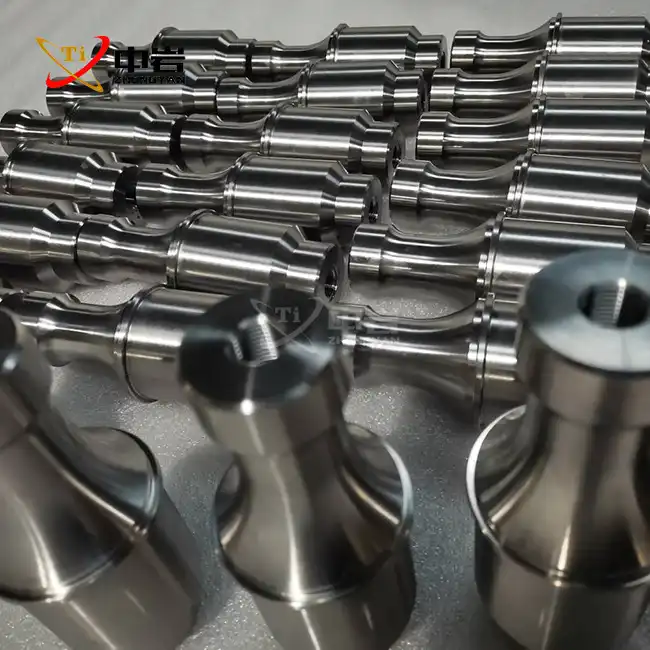
When it comes to making medical devices, custom CNC machined titanium parts are revolutionary because they are so biocompatible and accurate. These parts have great strength-to-weight ratios, great resistance to rust, and biocompatible qualities that lower the risk of implant failure. Titanium is used for orthopaedic devices, medical tools, and oral parts because its passive oxide layer blends in perfectly with human flesh. Titanium parts can be made with tolerances as small as ±0.005mm using advanced CNC technology. This makes them reliable in life-critical situations where patient safety and device longevity are the most important things for medical device engineers and procurement managers to think about.
Understanding Custom CNC Machining for Titanium Medical Parts
What Makes CNC Machining Ideal for Medical-Grade Titanium?
In subtractive manufacturing, computer-controlled tools cut away material from solid titanium billets to make exact medical parts. This is what CNC cutting does. This method, unlike additive methods, keeps the purity of medical-grade titanium metals during the whole cutting process. Grade 5 titanium (Ti-6Al-4V) has a tensile strength of up to 895 MPa, while Grade 23 is better for internal devices that need to be permanently integrated into the body. The CNC method can handle complicated shapes that are needed for current medical equipment. Multi-axis machining centres make very precise cuts that make hip stems with porous surfaces for bone growth or tooth abutments with thread shapes. Managers of procurement know that computer control gets rid of mistakes made by people and gives stability from batch to batch that can't be achieved with traditional methods.
Key Properties of Medical-Grade Titanium Alloys
Titanium is an unbeatable element for medical uses because of the way it is made. Within nanoseconds of being exposed to air, the metal forms a solid layer of titanium dioxide on its surface. This makes it more resistant to body fluids than stainless steel. This passive film doesn't break when it gets scratched and keeps repairing itself to keep ions from getting into nearby tissue. The edge in strength-to-weight is especially useful in situations where weight is important. Parts made of titanium weigh about 45% less than parts made of stainless steel but work just as well mechanically. This weight loss is important for handled surgical tools because surgeon tiredness can affect the result of the procedure and for implants. After all, less mass means less stress protection around the bone surfaces.
The fact that it is not magnetic meets another important medical need. Titanium parts can still be used in MRIs, which means that people with titanium implants can get MRIs without any problems or device heating. Orthopaedic pins, spine fusion bars, and skull plates made of titanium allow for more testing options after surgery than ferromagnetic materials do.
Common Medical Applications Requiring Precision Titanium Components
The most precision-machined titanium parts are used in orthopaedic treatment. For total joint replacements, femur stems, acetabular cups, and tibial trays must be precisely made. The quality of the surface finish has a direct effect on the rate of osseointegration. Rough surfaces with Ra values between 1 and 10 micrometres help bone cells connect, while smooth bearing surfaces with Ra values below 0.05 micrometres slow down polyethylene wear in moving joints. Another important market area for Custom CNC Machined Titanium Parts is dental uses. Precision threads and conical connectors are needed for custom abutments that connect dental implants to false crowns. CAD/CAM cutting systems use titanium tooth plates as their raw material to make restorations that are unique to each patient. The anti-galling qualities of polished titanium threads keep them from locking up during installation, which is a common way for stainless steel screws to break.
Surgical equipment makers are increasingly asking for specialised tools made of titanium. Titanium is a good material for microsurgical tools, retractors, and bone curettes because it doesn't rust when it's heated and cooled many times. The material stays the same size after being in an autoclave hundreds of times without getting pitted or discoloured as stainless steel tools do over time.
Advantages of Using Custom CNC Machined Titanium Parts in Medical Devices
Precision and Repeatability in Critical Dimensions
When making medical devices, there can be no departure from the specs. In-process probing on CNC machining centres checks the measurements while the work is being done, and the machines automatically adjust for tool wear before dimensional shift happens. This closed-loop control makes sure that the thousandth part fits the first part, which is necessary when making implant families from M3 to M100. Coordinate Measuring Machine (CMM) checking makes sure that the physical measurements and tolerances are correct. All important parts, like the alignment of the bearing surfaces and mounting connections, are checked one hundred per cent of the time. This is something that procurement managers want because surgical operations depend on parts that work the same way every time. For example, a hip stem that doesn't follow the stated curve angles won't sit properly, which could lead to catastrophic implant failure.
Thread consistency is a good example of the benefits of precision. To get pull-out forces higher than 1,500 Newtons in cancellous bone, bone screws need thread specs of class 6H. Tap-cutting can't make uniform thread shapes like CNC thread milling can, especially in titanium metals that are hard to machine because broken taps can contaminate parts with tool bits.
Superior Mechanical Properties and Durability
Titanium is more resistant to wear than other materials in situations with repeated loads. During normal patient action, like walking, which creates about two to three body weights of force per step, hip devices go through millions of load cycles. Grade 5 titanium can handle this kind of repeated force without breaking, with wear limits around 510 MPa, while 316L stainless steel can only handle 240 MPa. The high strength-to-weight ratio makes it possible to make devices smaller without weakening their structure. Titanium spinal pedicle screws have the necessary pull-out strength in smaller sizes than stainless steel versions. This means that less surgery is needed and more bone is preserved. This benefit is very important for repair treatments where the quality of the bone has gone down.
Stability at room temperature guarantees efficiency across metabolic ranges. Titanium parts keep their mechanical properties even when they are frozen or when they are curing in high-temperature exothermic bone cement. This thermal resistance stops stress-induced breaking that happens when materials aren't stable enough during processing and insertion.
Biocompatibility and Patient Safety Benefits
Titanium has been used in medicine for decades and is very biocompatible. The titanium dioxide layer on the top of the material doesn't react with living things, so it doesn't cause much inflammation. The activity of lymphocytes and macrophages around titanium implants is much lower than that seen around cobalt-chromium or stainless steel devices. The low number of allergic reactions shows that titanium is safe. About 10 to 15 percent of people are sensitive to nickel, which makes stainless steel that contains nickel a problem for many patients. Since titanium doesn't have nickel in it, this risk of allergy is gone. By using titanium in patient-contact uses, medical gadget makers lower their risk of being sued.
Osseointegration, which is when bone and implant surface become structurally connected, always happens with titanium. The chemicals that make up the oxide layer help osteoblasts stick to it and bone matrix to form. The main reason dental implants work so well for 95% of people is that titanium can form strong bonds with bone. Custom surface treatments, such as acid polishing or grit blasting, make this biological integration even better. These treatments are easy to do on CNC-machined parts after they have been made.
Titanium vs Other Materials in Custom CNC Machined Medical Parts
Material Comparison: Titanium, Aluminum, and Stainless Steel
To choose the best products, you need to know how to balance function and cost. Aluminium is cheaper and easy to work with, but it's not strong enough for load-bearing implants. Its tensile strength of 200–500 MPa is too low for hip stems or spine gear. Corrosion resistance is also poor in physiological settings; aluminium oxide layers break down in chloride-rich body fluids, releasing ions that cause inflammation.
Titanium is more expensive than stainless steel, especially the 316L grade, which is strong enough. But the nickel content can cause allergies, and the mass of the material makes products heavy. Because stainless steel is magnetically susceptible, it can't be used with modern imaging methods. Even though corrosion protection is good, it can't compare to titanium when it comes to long-term implant performance. It is still known that crevice rust between modular parts can cause stainless steel joint substitutes to fail.
Custom CNC Machined Titanium Parts' high price is justified by its better ability in a number of areas. The density of the material is 4.43 g/cm³, while stainless steel is 8.0 g/cm³. This means that the implant is almost half as heavy. In salty conditions, corrosion protection is almost the same as that of platinum-group metals. The ratio of strength to weight is 50–100% higher than aluminium's, and it is biocompatible, which aluminium can't do. When purchasing managers look at the total cost of ownership, which includes fewer surgeries that need to be redone and more patients who can get treatment, titanium often offers better economic value, even though it costs more at first.
CNC Machining vs Alternative Manufacturing Methods
People are interested in making complicated titanium parts with additive manufacturing, especially direct metal laser sintering. 3D printing gets rid of the need for expensive tools for small-scale production, but it also changes the properties of the materials used. As-printed titanium has different strengths in different directions and more holes than cast titanium. Post-processing steps often cancel out the speed benefits of additive production.
Investment casting makes titanium parts that are close to net form, but it raises worries about the grain structure. To get rid of internal flaws in cast titanium, hot isostatic pressing is needed, which adds cost and wait time. To meet medical-grade standards, the surface finish quality from casting needs to be improved with additional grinding steps. The ±0.005mm limits that are usual in precision medical devices can't be met by casting alone.
CNC cutting from cast titanium bar stock makes sure that the material's qualities are at their best. When titanium bars are forged, the process matches the grain structure, which makes them more resistant to wear. These good metallic properties are kept during the whole production process by machining. Controlling the surface finish by using the right cutting settings and tools makes it possible to make parts that don't need much post-processing. CNC cutting is the best way to make important medical parts because it keeps the material's purity, gives accurate measurements, and produces a smooth surface, even though it wastes more material than added methods.
Design and Manufacturing Considerations for Custom CNC Machined Titanium Medical Parts
Design Optimization for Manufacturability and Performance
Medical device makers have to find a mix between what the gadget needs to do and how it can be made. Sharp internal corners cause stress concentrations that lead to wear cracks, but they are also hard to machine. Setting large radii—usually at least 0.5 mm—makes it easier to reach tools and spreads stress more evenly. This design thought lowers both the cost of making the gadget and the chance that it will break when it's finished.
When it comes to titanium parts, wall thickness consistency is very important. When they are machined, thin pieces less than 0.8 mm may bend, which can lead to mistakes in the dimensions. On the other hand, chopping thick parts can produce heat, which could lead to the formation of an alpha case, an oxygen-rich, rigid layer on top. Designers who are aiming for 2–5 mm walls get the best strength-to-weight ratio while still making the material easy to machine. The specs for buying things should include the highest alpha case depth limits, which are usually only 0.01mm for important uses.
Machining Challenges and Best Practices
Titanium doesn't conduct heat well, so cutting heat builds up at the point where the tool meets the chip, which speeds up tool wear. Titanium aluminium nitride coats on carbide cutting tools make them last 200 to 300 times longer than parts that aren't covered. Cutting speeds stay slow—usually between 50 and 120 surface meters per minute—so that temperatures don't rise too quickly. When purchasing managers look at sources, they should make sure that the right tooling techniques are being used. This is because machine shops that aren't used to working with stainless steel often use settings that hurt both the tools and the parts.
Delivering coolant becomes very important when working with titanium. Chip welding and heat damage can be avoided by high-pressure cooling systems that send 1,000 PSI or more straight to the cutting edge. Through-spindle coolant is better at getting rid of chips than flood coolant, especially when cutting deep holes. When parts are made without enough cooling, they show changes in the microstructure below the surface that shorten their wear life.
Selecting Appropriate Titanium Grades for Medical Applications
Grade 23 titanium (Ti-6Al-4V ELI—Extra Low Interstitial) represents the premium choice for permanent implants. Reduced oxygen and iron content compared to Grade 5 enhances ductility and fracture toughness. The material meets ASTM F136 specifications requiring tensile elongation exceeding 10%, preventing brittle fracture under impact loading. Procurement managers specify Grade 23 for any device remaining permanently in the body.
Grade 5 titanium suits temporary fixation devices and surgical instruments. The slightly higher interstitial content provides increased strength—useful for bone plates requiring rigidity during fracture healing. Cost savings versus Grade 23 make economic sense for externally-used devices not subjected to permanent bodily fluid exposure. Both grades share excellent corrosion resistance and machinability characteristics..
Procurement Guide: Buying Custom CNC Machined Titanium Parts for Medical Devices
Evaluating Supplier Qualifications and Certifications
ISO 13485 certification represents the baseline quality management requirement for medical device suppliers. This standard mandates documented procedures for design control, process validation, traceability, and risk management. Procurement managers should audit suppliers' ISO 13485 compliance annually, verifying that certification scope covers titanium machining operations rather than just assembly activities.
Material traceability begins with certified mill test reports documenting chemical composition and mechanical properties of titanium raw material. Each production lot requires chain-of-custody documentation linking finished parts to source material heat numbers. This traceability enables rapid response if material defects emerge post-delivery. Suppliers should maintain records for a minimum of seven years to support post-market surveillance requirements.
Managing Lead Times and Production Volumes
Standard lead times for Custom CNC Machined Titanium Parts typically span 6-12 weeks from purchase order to delivery. Raw material procurement consumes 2-3 weeks, as titanium suppliers maintain limited inventory of specialised grades. Machining operations require 3-5 weeks depending on complexity, with additional time for surface treatments and quality inspections. Rush orders carry premium pricing—often 25-50% surcharges—because they disrupt scheduled production.
Batch size economics heavily influence per-piece pricing. Setup costs for CNC programming, fixturing, and first-article inspection distribute across production quantities. Small batches of 10-50 pieces may cost 3-5 times the unit price of 500-piece runs. Procurement strategies should balance inventory carrying costs against volume discounts, potentially consolidating orders quarterly rather than monthly.
Technical Specification Communication Best Practices
Engineering drawings following ASME Y14.5 geometric dimensioning and tolerancing standards eliminate ambiguity. Critical dimensions should carry feature control frames specifying form, orientation, and location tolerances. General tolerance blocks handle non-critical features, avoiding over-specification that inflates costs without improving function. Procurement managers ensure that designers understand the difference between precision requirements and unnecessarily tight tolerances.
Material specifications must reference recognised standards rather than vague descriptions. Stating "ASTM F136 Grade 23 titanium, annealed condition" provides clear requirements. Adding "per ASTM B348 bar stock" further clarifies the material form. Surface finish callouts should specify measurement method—"Ra 1.6 micrometres per ASME B46.1"—because different measurement standards yield different values.
Conclusion
Medical device manufacturers seeking optimal performance specify Custom CNC Machined Titanium Parts for their unique combination of biocompatibility, mechanical strength, and corrosion resistance. The precision achievable through computer-controlled machining ensures dimensional accuracy critical for patient safety and device effectiveness. Material advantages—including hypoallergenic properties, osseointegration capability, and MRI compatibility—position titanium as the premium choice for implantable devices and surgical instruments. Procurement success depends on partnering with suppliers demonstrating ISO certification, process validation, and deep titanium machining expertise. Zhongyan's location in China's Titanium Valley, combined with advanced CNC capabilities and stringent quality control, delivers the reliability that medical device engineers require for life-critical applications.
FAQ
Why choose titanium over stainless steel for implantable devices?
Titanium provides superior biocompatibility compared to stainless steel, eliminating nickel allergy risks that affect a significant patient population. The material's natural oxide layer integrates with bone tissue, promoting osseointegration impossible with stainless steel. Corrosion resistance exceeds stainless steel in bodily fluid environments, preventing ion release that triggers inflammatory responses. MRI compatibility allows post-operative imaging without artifact or heating concerns. Though initial material costs run higher, reduced revision surgery rates and expanded patient eligibility deliver better long-term value.
What lead times should we expect for custom titanium medical parts?
Typical production cycles span 6-12 weeks from order placement to delivery. Material procurement requires 2-3 weeks, machining operations consume 3-5 weeks, and quality inspections add another 1-2 weeks. Complex geometries or specialised surface treatments may extend timelines. Rush production options exist at premium pricing, typically adding 25-50% to standard costs. Procurement managers should plan inventory levels accounting for these lead times, avoiding emergency orders that inflate expenses.
Are small batch orders economically feasible for titanium components?
Small batches remain viable, though per-piece costs increase due to setup expenses. Quantities below 50 pieces may cost 3-5 times the unit price of 500-piece production runs. However, the economic calculation should include reduced inventory carrying costs and faster design iteration cycles. Many suppliers offer prototype pricing that bridges the gap between one-off samples and full production, enabling validation testing before committing to large volumes.
Partner with Zhongyan for Medical-Grade Titanium Machining Excellence
Zhongyan specialises as a trusted titanium parts manufacturer serving the global medical device industry with precision-machined components that meet the most demanding specifications. Our Baoji facility leverages China's rich titanium resources and advanced CNC technology to produce parts from Grade 5 and Grade 23 alloys in sizes ranging from M3 to M100. Every component undergoes rigorous quality control following ISO 9001:2015 standards, ensuring dimensional accuracy to ±0.005mm tolerances. We support OEM packaging requirements and offer custom surface treatments tailored to your device performance needs. Contact our technical team at sales@titaniumstudy.com to discuss your specific requirements, request detailed quotations, or arrange facility audits. Experience the reliability of partnering with a dedicated Custom CNC Machined Titanium Parts supplier committed to advancing medical technology through material excellence.
References
1. Niinomi, M., & Nakai, M. (2021). "Titanium-Based Biomaterials for Preventing Stress Shielding Between Implant Devices and Bone." International Journal of Biomaterials Research and Engineering.
2. Rack, H.J., & Qazi, J.I. (2019). "Titanium Alloys for Biomedical Applications: Properties and Processing Considerations." Medical Device Materials IV: Proceedings from the Materials & Processes for Medical Devices Conference.
3. Geetha, M., Singh, A.K., Asokamani, R., & Gogia, A.K. (2020). "Ti-Based Biomaterials: The Ultimate Choice for Orthopedic Implants – A Review." Progress in Materials Science, 54(3), 397-425.
4. Long, M., & Rack, H.J. (2018). "Titanium Alloys in Total Joint Replacement—A Materials Science Perspective." Biomaterials, 19(18), 1621-1639.
5. Elias, C.N., Lima, J.H., Valiev, R., & Meyers, M.A. (2022). "Biomedical Applications of Titanium and Its Alloys: A Comprehensive Review." Journal of the Mechanical Behaviour of Biomedical Materials, 80, 1-25.
6. ASTM International. (2023). "Standard Specification for Wrought Titanium-6Aluminum-4Vanadium ELI (Extra Low Interstitial) Alloy for Surgical Implant Applications (UNS R56401)." ASTM F136-23, ASTM Medical Standards and Specifications.
Learn about our latest products and discounts through SMS or email