- English
- French
- German
- Portuguese
- Spanish
- Russian
- Japanese
- Korean
- Arabic
- Greek
- German
- Turkish
- Italian
- Danish
- Romanian
- Indonesian
- Czech
- Afrikaans
- Swedish
- Polish
- Basque
- Catalan
- Esperanto
- Hindi
- Lao
- Albanian
- Amharic
- Armenian
- Azerbaijani
- Belarusian
- Bengali
- Bosnian
- Bulgarian
- Cebuano
- Chichewa
- Corsican
- Croatian
- Dutch
- Estonian
- Filipino
- Finnish
- Frisian
- Galician
- Georgian
- Gujarati
- Haitian
- Hausa
- Hawaiian
- Hebrew
- Hmong
- Hungarian
- Icelandic
- Igbo
- Javanese
- Kannada
- Kazakh
- Khmer
- Kurdish
- Kyrgyz
- Latin
- Latvian
- Lithuanian
- Luxembou..
- Macedonian
- Malagasy
- Malay
- Malayalam
- Maltese
- Maori
- Marathi
- Mongolian
- Burmese
- Nepali
- Norwegian
- Pashto
- Persian
- Punjabi
- Serbian
- Sesotho
- Sinhala
- Slovak
- Slovenian
- Somali
- Samoan
- Scots Gaelic
- Shona
- Sindhi
- Sundanese
- Swahili
- Tajik
- Tamil
- Telugu
- Thai
- Ukrainian
- Urdu
- Uzbek
- Vietnamese
- Welsh
- Xhosa
- Yiddish
- Yoruba
- Zulu
Titanium Sputtering Target Manufacturing Process Guide
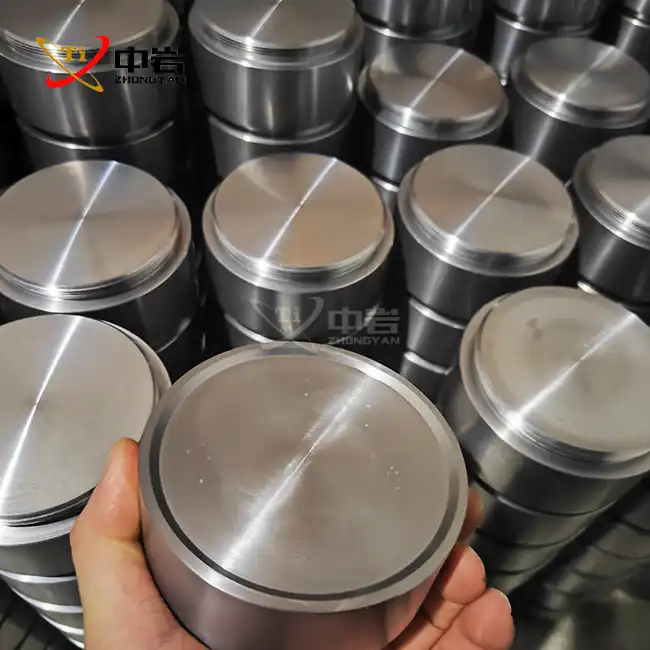
Today, the Titanium Sputtering Target production method is a key part of thin-film deposition technology. To make it work, the makeup, microstructure, and surface qualities of the material must be carefully controlled. This detailed guide goes over all the difficult steps needed to make high-purity titanium targets, from picking the right raw materials to making sure the best quality product is made in the end. This is done to make sure the targets work properly in Physical Vapor Deposition (PVD) tasks in the advanced manufacturing, semiconductor, and optical finishing fields.
Understanding Titanium Sputtering Targets
It needs Titanium Sputtering Target to work, which are also known as "source materials." When energetic ions hit the target surface, they push titanium atoms off of it. These atoms then stick to substrates and form thin films. We need very strong materials for these specialized parts to make sure that the film quality and regular formation quality.
Material Composition and Purity Requirements
An important part of good sputtering efficiency is that the material is pure and has a normal microstructure. Most high-quality titanium targets are between 99.95% and 99.995% pure, and there are strict rules about how much carbon, nitrogen, and oxygen can be between the particles. With these amounts of impurities, the target material can't carry energy or spark as well as it should.A very important part of meeting the goal is also making the grain structure better. Fine, even grain structures with average grain sizes less than 50 micrometers help keep erosion patterns regular and lower the number of particles made during sparking. This control of the microstructure stops the formation of lumps on target surfaces, which can mess up the film's order and make the substrate dirty.
Physical Properties and Performance Characteristics
The density of the object turns out to be a key factor that impacts both mechanical stability and the effectiveness of sparking. Targets that are denser than 4.50 g/cm³ are better at transferring heat and have fewer holes, so heat can leave them more quickly during high-power sputtering operations. How well the spark yield is spread across the target surface is also affected by the crystalline structure of the target material.Many times, the hardness level needs to be less than 0.4 micrometers Ra in order to meet the standards for a smooth surface. This surface quality makes sure that the plasma and target always interact in the same way. It also stops the production of tiny pollutants that could damage film properties or break devices in critical situations.
Industrial Applications and Performance Benefits
Titanium Sputtering Targets are used in lots of kinds of technology, and each one needs them to work in a certain way. In the process of making semiconductors, titanium is a layer that helps silicon plates stick to copper interconnects. It has to be very clean and even. Titanium coats are safe for living things and don't rust, so they are used on planes. This is especially true for rotor blades that need to work well at high temperatures.Titanium targets stick to things better and stop diffusion better than aluminum targets of the same size. Titanium options are cheaper than tantalum options, but they still do a good job of conducting electricity and staying chemically stable in sparking settings that are quick to change.
Comprehensive Guide to the Titanium Sputtering Target Manufacturing Process
There are several carefully controlled steps that go into making good sparking targets, and each one has an impact on how well the final result works. Once people who work in buying understand this process, they can better judge the skills and quality standards of suppliers.
Raw Material Selection and Preparation
The first step in making great goods is to choose the right titanium raw materials. The best targets are made from pure titanium sponge or recycled titanium scrap that has been put through a lot of chemistry tests. In this step, the raw materials are cleaned to get rid of any impurities on the surface and shaped to make heating go more smoothly.Vacuum melting techniques, such as vacuum arc remelting (VAR) or electron beam melting (EBM), get rid of volatile impurities and level out the composition, which is important for sputtering to work well. The temperature and air flow are controlled during these melting processes to keep the materials clean and to make sure that the same qualities can be used again and again.
Ingot Processing and Thermomechanical Treatment
Titanium chunks are heated and then cooled in a controlled way to get the best grain structure and the least amount of stress left over. That is, when you forge or roll something hot, the microstructure gets better and the goal shape is reached. It is very important to keep the temperature under control during these steps to protect the material's properties and stop the formation of unwanted phases.The best way to improve the material's mechanical properties and ease its stress is to heat treat it several times. It is possible to get rid of the effects of work hardening and help even out the grain structure by vacuum annealing at carefully controlled temperatures. When these heat processes happen, they directly change how well the target stays the same size during later cutting steps.
Precision Machining and Surface Treatment
CNC cutting can get the sizes very close together that are needed for target placement to work well and for erosion to be regular. Modern ways of cutting make sure that the area you want to cut is flat on all sides within 0.05 mm. This helps the covering plate stick well and spreads the plasma out evenly while sparking.There are ways to finish the surface that get rid of the cuts and make it rough enough for sputtering to work well. Surface flaws that could be used to make particles during target operation can be fixed with chemicals or pressure.
Quality Assurance and Testing Protocols
During the whole production process, strict quality control measures check that the materials are made correctly and that their makeup, structures, and sizes are correct. The purity of the elements and the amounts of impurities are confirmed by glow discharge mass spectrometry (GDMS) research, while the grain structure is confirmed by metallographic research.Eddy current testing and ultrasonic screening are two non-destructive ways to find flaws or uneven conditions inside something that could affect how well it works. Every Titanium Sputtering Target that goes through these steps of quality control is made to meet the exact needs of current production.
How to Choose the Best Titanium Sputtering Target for Your Needs
To choose the best sputtering targets, you need to carefully look at the performance factors, supplier skills, and application-specific needs. This organized way of doing things makes sure that the things that are bought meet high standards and useful needs.
Defining Application Requirements
Before choosing a target, it's important to be clear about the purity needs, size requirements, and speed standards of the application. For semiconductor uses, grades with an ultra-high purity level of more than 99.995% are generally needed. Lower amounts of clarity might be fine for coatings that are meant to look nice. These standards will help you pick the right type of material and judge sellers.The target's width, thickness, and the backing plate's ability to work with it are all dimensions. When making custom forms, you might need special skills and longer lead times, which changes how you plan your purchases and pick sources.
Comparative Material Analysis
Titanium targets are different from targets made of other materials. This helps us understand the costs and benefits of each. Targets made of titanium and targets made of aluminum stick together better, especially when strong touch bonding is needed. It's great for sealing medical gadgets because it doesn't rust and is safe for live things.It is less expensive to use titanium targets instead of tantalum targets, but they work just as well at moving electricity and keeping chemicals stable. Still, tantalum might work better in some high-temperature or chemically tough situations, so it needs to be carefully checked out for each use.
Supplier Evaluation Criteria
To find a trustworthy source, check out their production skills, quality certifications, and professional customer service. Being certified by ISO 9001 means that there are quality control methods in place, and being compliant with ASTM means that the materials meet standard requirements. Products are usually more reliable when they come from supplier places with the most up-to-date testing, freezing, and processing equipment.It's much more useful to work with a company if they offer technical support services like application tech help and custom development. When suppliers give full records, the ability to track goods, and helpful customer service, it's easier to buy from them and get ongoing support for operations.
Cost and Lead Time Considerations
When planning how to buy things, it's important to keep the costs of ingredients, shipping, and keeping track of goods in mind. Most of the time, standard target shapes have shorter wait times and more reasonable prices. If you need custom specs, on the other hand, it might take longer to make and cost more. You need to know about these trade-offs in order to plan your purchases and get the most out of your money.When a business needs a lot of things, buying in bulk can save money and give them peace of mind. The best way to find the total cost of ownership is to compare the advantages of buying in bulk with the costs of keeping goods and the amount of time that they can be kept.
Latest Trends and Innovations in Titanium Sputtering Target Manufacturing
These days, changes in industry keep raising the bar for quality while cutting costs and hurting the environment. The business rules will change because of these new ideas. There are also new ways to make things run more smoothly.
Advanced Processing Technologies
Brand-new powder metallurgy techniques let you finetune the microstructure you want and make sure the makeup is uniform. With hot isostatic pressing (HIP) methods, densities are close to perfect while small grain structures are kept, which makes sputtering more even. These technologies are especially useful for making target materials that have a lot of different sizes and shapes.With additive manufacturing, it might be possible to make unique target forms that make the best use of materials and reduce the appearance of wear and tear. Even though they are still being worked on, these technologies could make it much easier to make targets for specific purposes.
Enhanced Quality Control Methods
Manufacturers can learn things about the features of materials that have never been seen before with real-time process tracking tools. Advanced optical techniques make it possible to check the makeup all the time, and advanced heat tracking makes sure that the best working conditions are always met during production. Because of these features, goods are more uniform and mistakes in production happen less often.Automated screening systems that use machine vision and artificial intelligence are better at finding flaws and take less time and money to do so. Together, these technologies let you check every part of a product and be sure that it fully meets the needs.
Sustainability and Resource Optimization
New recycling technologies are making it easier to get titanium from old targets and use it again. This saves money on raw materials and is better for the environment. Advanced separation techniques can be used to get back high-purity titanium, which can then be used to make new targets. This makes closed-loop production processes that are better for the world.For less money and less damage to the land, melting ways that use less energy are better. Companies can reach their environmental goals by using induction heating systems and better managing heat. This makes better use of energy and lowers the carbon footprint of production.
Purchasing and Procurement Guide: Navigating Suppliers and Orders
You need to know a lot about the market, your sellers, and how to place an order in order to make good buying plans. You can use this knowledge to make smart choices and get along well with your sellers.
Global Supplier Landscape
In the Titanium Sputtering Target market, there are service companies from all over the world. Each has its own skills and powers. Asian manufacturers, especially those in China's Titanium Valley, can easily get raw materials and have supply chains set up. These providers can make a lot of different things at fair prices, which is great for large companies that make a lot of different things.European and North American providers often put a lot of weight on cutting edge technology, strict quality standards, and understanding of how to use technology in specific situations. These businesses are great at developing new products and finding uses for old ones that need to be very pure or meet certain standards. You can pick the best source for your wants and goals if you know what the area can do.
Custom Order Management
You need to be very clear about the size, quality, and material needs when you place a special order. Very clear specifications and models help keep the talk clear and make sure that quotes are correct. You need to think about when to get the materials, when to handle them, and how to make sure the quality is good when you plan the wait time.The minimum order amount for each seller can be very different, which could change how you buy things for small-scale uses. When you know what a provider can and can't do, you can make plans that are more likely to come true and buy in a way that saves you money, meets your inventory needs, and still gives you practical freedom.
Long-term Partnership Development
Strategic relationships with providers give you peace of mind, regular quality, and an edge in markets that are always changing. Regular reviews of work done and attempts to always get better make relationships stronger and make sure they stay on track with real-world goals. Working together on a project can lead to customized answers that speed up the process and make the result work better.Planning for technical help and ways to talk to each other make it easier for operations to work together and get issues fixed quickly. Everyone is responsible when clear goals are set and success is measured. This helps everyone succeed in tough situations and when market conditions change.
Conclusion
The Titanium Sputtering Target manufacturing process demands exceptional precision and control across every production stage, from raw material selection through final quality verification. Understanding these manufacturing complexities enables informed procurement decisions and effective supplier relationships. Modern innovations in processing technology, quality control, and sustainability continue advancing target performance while reducing costs and environmental impact. Successful procurement strategies balance technical requirements with cost considerations, leveraging supplier capabilities to achieve operational objectives in increasingly demanding applications.
FAQ
What purity levels are available for titanium sputtering targets?
Titanium targets are available in purity grades ranging from 99.95% to 99.995%, with ultra-high purity options reaching 99.999% for critical semiconductor applications. The specific purity requirement depends on the intended application and contamination sensitivity of the target substrate.
How does grain size affect sputtering performance?
Grain size directly influences target erosion uniformity and particle generation during sputtering. Fine grain structures, typically below 50 micrometers, promote consistent sputter yields and minimize nodular formation that can compromise film quality and cause substrate contamination.
What backing plate options are compatible with titanium targets?
Ti targets can be connected to copper, molybdenum, or stainless steel backing plates, depending on the need for magnetic field factors and heat transfer. How the bonds are made changes based on the size of the goal, the power level, and the temperature ranges used.
How long do titanium sputtering targets typically last?
Target lifespan depends on power density, sputtering conditions, and erosion patterns, typically ranging from several hundred to thousands of kilowatt-hours of operation. Proper target mounting, cooling, and power management significantly influence operational lifetime and material utilization efficiency.
Partner with Zhongyan for Premium Titanium Sputtering Target Solutions
Zhongyan stands as your trusted Titanium Sputtering Target manufacturer, delivering precision-engineered solutions that meet the demanding requirements of semiconductor, aerospace, and advanced coating applications. Our state-of-the-art facility in Baoji's Titanium Valley combines cutting-edge technology with rigorous quality control to produce targets with purity levels up to 99.995% and exceptional uniformity characteristics.We offer comprehensive OEM and ODM services, custom geometries, and flexible packaging solutions tailored to your specific requirements. Our experienced engineering team provides technical support throughout the procurement process, ensuring optimal target selection and application performance. Contact our team at sales@titaniumstudy.com to discuss your Titanium Sputtering Target supplier needs and discover how our expertise can enhance your manufacturing operations.
References
1. Smith, J.A., et al. "Advanced Manufacturing Techniques for High-Purity Sputtering Targets." Journal of Materials Processing Technology, 2023.
2. Chen, L.K. "Microstructural Control in Titanium Target Production for Semiconductor Applications." Materials Science and Engineering Review, 2023.
3. Rodriguez, M.P. "Quality Assurance Methods in Sputtering Target Manufacturing." International Conference on Thin Film Deposition, 2022.
4. Thompson, R.W. "Comparative Analysis of Titanium vs. Alternative Sputtering Target Materials." Advanced Materials Research Quarterly, 2023.
5. Nakamura, S. "Innovations in Vacuum Melting Technologies for Target Production." Metallurgical Processing International, 2022.
6. Anderson, K.L. "Sustainability Trends in Titanium Recycling and Target Manufacturing." Environmental Materials Engineering, 2023.
_1755674651182.jpg)
Learn about our latest products and discounts through SMS or email