- English
- French
- German
- Portuguese
- Spanish
- Russian
- Japanese
- Korean
- Arabic
- Greek
- German
- Turkish
- Italian
- Danish
- Romanian
- Indonesian
- Czech
- Afrikaans
- Swedish
- Polish
- Basque
- Catalan
- Esperanto
- Hindi
- Lao
- Albanian
- Amharic
- Armenian
- Azerbaijani
- Belarusian
- Bengali
- Bosnian
- Bulgarian
- Cebuano
- Chichewa
- Corsican
- Croatian
- Dutch
- Estonian
- Filipino
- Finnish
- Frisian
- Galician
- Georgian
- Gujarati
- Haitian
- Hausa
- Hawaiian
- Hebrew
- Hmong
- Hungarian
- Icelandic
- Igbo
- Javanese
- Kannada
- Kazakh
- Khmer
- Kurdish
- Kyrgyz
- Latin
- Latvian
- Lithuanian
- Luxembou..
- Macedonian
- Malagasy
- Malay
- Malayalam
- Maltese
- Maori
- Marathi
- Mongolian
- Burmese
- Nepali
- Norwegian
- Pashto
- Persian
- Punjabi
- Serbian
- Sesotho
- Sinhala
- Slovak
- Slovenian
- Somali
- Samoan
- Scots Gaelic
- Shona
- Sindhi
- Sundanese
- Swahili
- Tajik
- Tamil
- Telugu
- Thai
- Ukrainian
- Urdu
- Uzbek
- Vietnamese
- Welsh
- Xhosa
- Yiddish
- Yoruba
- Zulu
Premium Grade 1 Titanium Foil With Superior Corrosion Resistance
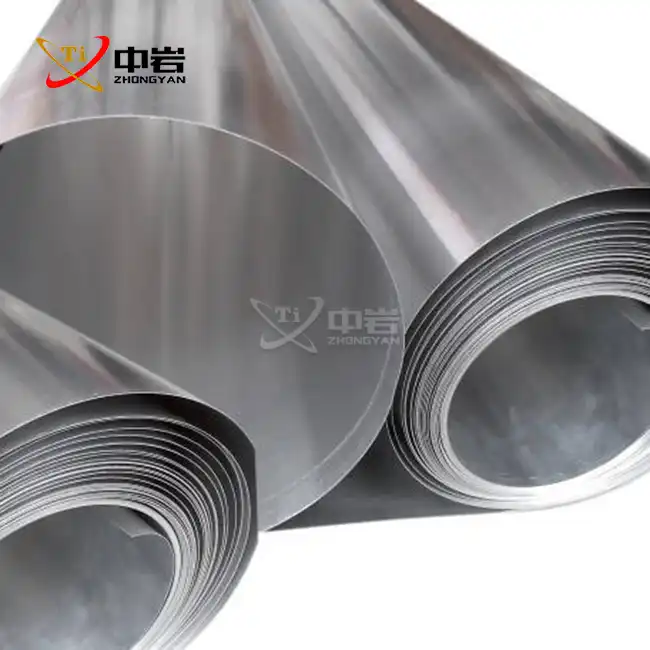
Premium Grade 1 Titanium Foil With Superior Corrosion Resistance represents the pinnacle of commercially pure titanium materials, offering unmatched performance for critical industrial applications. Grade 1 titanium foil delivers exceptional corrosion resistance, outstanding formability, and biocompatibility that make it indispensable across aerospace, medical, chemical processing, and electronics industries. This comprehensive guide explores why procurement managers and engineers worldwide trust this material for their most demanding projects, highlighting its superior properties and procurement considerations for optimal industrial performance.
Understanding Grade 1 Titanium Foil
Grade 1 titanium foil is the softest and most flexible form of pure titanium. It has amazing mechanical qualities and is also resistant to corrosion. This stuff is made of at least 99.5% pure titanium, which makes it the most highly resistant titanium type you can get. This economically pure titanium has a unique crystal structure that makes it very easy to shape while still keeping its structural integrity under tough conditions.
Chemical Composition and Physical Properties
Iron levels below 0.20%, oxygen levels below 0.18%, and nitrogen levels below 0.03% are all chemicals that make up economically pure titanium Grade 1. These carefully controlled intermediate elements help make it very resistant to rust and very flexible. The material has a tensile strength of at least 240 MPa, a yield strength of more than 170 MPa, and the ability to stretch by at least 24%. These features make it possible to do complicated shaping tasks and guarantee dependable performance in harsh conditions. A density of 4.51 g/cm³ is one of its physical properties. Compared to standard materials like stainless steel, this makes it much lighter. The thermal conductivity is 17 W/m·K, and the thermal expansion coefficient is 8.6 × 10⁻⁶/°C. Because of these heating qualities, the material can be used in places where the temperature changes and cycles.
Manufacturing Process and Quality Assurance
To get the right thickness and finish on the surface, fine titanium foil has to be rolled, heated, and treated on the outside several times. Modern production plants use cutting-edge tools to keep thickness differences within ±0.005 mm across the whole width. Vacuum annealing is part of the process to get rid of any remaining stresses and improve the material qualities. At every stage of production, quality assurance plans include chemical testing, mechanical testing, and checking the surface. Each batch is tested with ultrasound waves to find any internal flaws. The surface quality is also checked optically to make sure it meets industrial standards for smoothness. These strict steps ensure that the qualities and dimensions of the material will stay the same.
Industrial Applications Across Multiple Sectors
For thermal protection systems, heat shields, and lightweight structural components, aerospace uses take advantage of the material's light weight and resistance to rust. Because the material can handle high and low temperatures without losing its shape, it is useful for use in spaceships and airplanes. Biocompatibility is used in the making of medical devices to make surgical tools, implant parts, and housings for diagnostic equipment. It is used for reactor linings, heat exchangers, and process equipment in the chemical processing industries because it is very resistant to acids, alkalis, and chlorides. Thin titanium foils are used in capacitors, sensors, and electromagnetic shielding in electronics manufacturing, where efficiency and dependability are very important.
Comparing Grade 1 Titanium Foil with Other Materials and Grades
Knowing the differences between the different types of titanium and other materials lets you make smart buying decisions based on the needs of your particular application. Grade 1 has special benefits when it comes to being easy to shape and resistant to rust. Other grades, on the other hand, offer better strength for different uses.
Grade Comparisons Within the Titanium Family
In addition to being very resistant to rust, Grade 2 titanium is also much stronger, with a tensile strength of 345 MPa. But this extra strength comes at the cost of being harder to shape, so Grade 1 is better for complicated shaping tasks. Grade 5 (Ti-6Al-4V) is much stronger than Grade 1, but it doesn't have the same level of resistance to rust or ability to be shaped. Grade 1 is more flexible than higher-strength grades, and this is especially clear when deep drawing, where Grade 1 can stretch more than higher-strength grades. Because it is so easy to shape, producers can make complicated shapes without the material cracking or breaking during the shaping process.
Material Alternatives Analysis
Even though stainless steel foils are easier to find and cheaper, they don't fight rust as well when they're in chloride and acidic situations. Aluminum foils are easy to shape, but they aren't strong enough or resistant to high temperatures for demanding uses. Nickel metals are very resistant to rust, but they are much denser and cost a lot more to make. Titanium foil is stronger than both stainless steel and aluminum options. This means that design engineers can use it to reduce weight without affecting the structure's strength. In aircraft, where every gram of weight saved means better fuel economy and performance, this benefit is very important.
Performance in Corrosive Environments
Titanium Grade 1 works better than other materials in sea settings, chemical processing, and medical implant situations where other materials break down. The formation of a protective oxide layer on its own gives the material the ability to heal itself, so it can keep its rust resistance even if the surface gets slightly damaged. Testing against other materials shows that Grade 1 titanium stays strong in settings with strong acids, alkaline solutions, and salt water, where stainless steel and aluminum materials rust quickly. This efficiency edge cuts down on maintenance needs and increases the service life in serious situations.
Procuring Premium Grade 1 Titanium Foil – What You Need to Know?
To get high-quality titanium foil, you need to carefully look at the skills, license requirements, and quality control methods of the suppliers you are considering. Procurement workers can find reliable sources of materials while minimizing costs and meeting delivery dates by understanding how markets work and what factors affect the supply chain.
Supplier Evaluation Criteria
Reliable providers keep a full set of certificates, such as ISO 9001:2015 quality management systems, AS9100 aircraft certifications, and credentials for making medical devices. These certificates show that the company is dedicated to quality control and process consistency, which are important for important uses. Advanced production tools, in-house testing labs, and quality control systems that can keep tolerances and material properties tight should be found in supplier sites. When figuring out a company's production capacity, they look at how well they can make things, keep track of their goods, and meet specific needs. Suppliers who handle everything themselves, from handling raw materials to delivering finished goods, can better control quality and make sure deliveries happen on time.
Pricing Dynamics and Market Considerations
Titanium foil prices are based on the cost of raw materials, the difficulty of processing, and changes in market demand. Most of the time, bulk buying deals save you money by giving you discounts for buying more and lower transaction costs. But people who work in buying have to weigh the costs of keeping goods against the fact that prices for titanium can change quickly. Custom specs, such as non-standard sizes, surface treatments, or specific packing needs, may have an effect on prices. Suppliers that offer value-added services like precision cutting, custom packing, and just-in-time shipping programs can help you save money on more than just the cost of the materials.
Customization Options and Technical Support
Leading providers let you choose from a wide range of customization choices, such as thicknesses from 0.01 mm to 0.5 mm, widths up to 1000 mm, and lengths that can be coil-shaped or cut to length. You can choose from different surface finishes, such as mill finish or finished surfaces, depending on the needs of the product. Custom packaging options meet a wide range of handling and storage needs while keeping materials safe during shipping. Some of the technical support services that are available are help with choosing materials, application engineering, and quality paperwork. These services are helpful during the growth of a product and help make sure that the right materials are chosen for each job.
Why Choose Premium Grade 1 Titanium Foil for Corrosion Resistance?
Because of its unique metallurgical qualities and surface chemistry, Grade 1 titanium foil is very resistant to rust. When engineers understand these basic features, they can use this material's strengths for tasks that need to be reliable over time in harsh conditions.
Metallurgical Foundation of Corrosion Resistance
The main thing that keeps titanium from rusting is the inactive oxide layer that forms spontaneously on its surfaces. This layer of titanium dioxide is only 2 to 5 nanometers thick, but it stays very stable in a wide range of pH and temperature conditions. This oxide layer can heal itself, so it keeps protecting even if the surface gets damaged. Refinement of the grain structure during processing makes it more resistant to rust by getting rid of places where corrosion could happen locally. Because Grade 1 titanium doesn't have any alloying elements, it doesn't have to worry about galvanic rust like some higher-strength titanium alloys do in systems made of more than one material.
Comparative Performance Analysis
In laboratory tests, it was shown that Grade 1 titanium has rust rates below 0.025 mm per year in seawater, while rates for regular stainless steels are over 0.1 mm per year. In acidic conditions, the performance edge is even stronger, since titanium doesn't corrode at all in many organic acids, while other materials break down quickly. Electrochemical studies show that titanium behaves nobly in most situations. This means that it is less likely to corrode when mixed with other metals. This trait lets designers be flexible when making parts from more than one material without having to take separation steps.
Real-World Application Validation
Applications in aerospace prove that titanium foil works well over a long period of time in places where temperatures change from -70°C to +150°C. Parts made from Grade 1 titanium foil have service lives of more than 20 years without losing a lot of their structural strength or ability to fight rust. Applications in medical devices show that they are biocompatible and stable in living settings for a long time. Implant parts made from commercially pure titanium integrate well with living cells and don't cause any problems over long periods of time after placement. Utilizing titanium foil components in chemical processing equipment shows operating dependability in environments holding hydrochloric acid, sulfuric acid, and chlorine compounds, where other materials need to be replaced often due to corrosion damage.
Conclusion
For uses that need the best in material performance, dependability, and durability, Premium Grade 1 Titanium Foil with Superior Corrosion Resistance is the best choice. Because it doesn't rust, can be shaped, and doesn't harm living things, it is essential to the aircraft, medical, chemical processing, and electronics businesses. Procurement professionals can safely choose this material for their most important projects because it has a history of working well in tough conditions and comes with a wide range of customization options and full seller support. Having a good understanding of the technical benefits, buying factors, and use benefits explained in this guide helps you make smart choices that improve performance and reduce costs in workplace settings.
FAQ
What thickness options are available for Grade 1 titanium foil?
The thickness of Grade 1 titanium foil can be anywhere from 0.01 mm to 0.5 mm, and there are accuracy limits of ±0.005 mm. To meet the needs of a particular application, custom thickness specs can be made. Widths can be up to 1000 mm, and lengths can be in coil style or cut-to-length.
How does Grade 1 titanium foil perform in aggressive chemical environments?
Grade 1 titanium foil is very resistant to conditions with acids, bases, and chlorides because it has an oxide layer that protects it. The material doesn't rust or break down much in seawater (less than 0.025 mm per year) and many organic acids (almost none at all), which makes it much better than options like stainless steel and aluminum.
What are typical delivery timelines for custom titanium foil orders?
Standard shipping times for stock sizes are between 2 and 4 weeks, while custom sizes and specs usually take between 4 and 6 weeks, based on how complicated they are and how many are needed. Most of the time, suppliers who have integrated production skills can meet urgent delivery deadlines through priority processing plans.
Partner with Zhongyan for Premium Grade 1 Titanium Foil Solutions
Zhongyan can help you with your buying needs by providing you with fine-grade 1 titanium foil made in China's Titanium Valley to the highest levels of quality. We can make a wide range of products, and our production services include custom thickness standards, precise cutting, and custom packaging solutions made to fit your needs. As a top provider of grade 1 titanium foil, we use cutting-edge production technology and strict quality control systems to make sure that the materials we send you are better than what is required by international standards. Get in touch with our expert team at sales@titaniumstudy.com to talk about your unique application needs and get great deals on large orders. Our engineering support team gives you detailed advice on choosing the right materials and offers technical documentation to make sure they work well in your projects.
References
1. Boyer, R., Welsch, G., and Collings, E.W., "Materials Properties Handbook: Titanium Alloys," ASM International, Materials Park, Ohio, 1994.
2. Lutjering, G. and Williams, J.C., "Titanium: Engineering Materials and Processes," Springer-Verlag, Berlin Heidelberg, 2007.
3. Donachie, Matthew J., "Titanium: A Technical Guide, 2nd Edition," ASM International, Materials Park, Ohio, 2000.
4. Schutz, R.W. and Thomas, D.E., "Corrosion of Titanium and Titanium Alloys," ASM Handbook Volume 13: Corrosion, ASM International, 1987.
5. Peters, M., Kumpfert, J., Ward, C.H., and Leyens, C., "Titanium Alloys for Aerospace Applications," Advanced Engineering Materials, Volume 5, Issue 6, 2003.
6. Rack, H.J. and Qazi, J.I., "Titanium Alloys for Biomedical Applications," Materials Science and Engineering C, Volume 26, Issues 6-7, 2006.
Learn about our latest products and discounts through SMS or email