- English
- French
- German
- Portuguese
- Spanish
- Russian
- Japanese
- Korean
- Arabic
- Greek
- German
- Turkish
- Italian
- Danish
- Romanian
- Indonesian
- Czech
- Afrikaans
- Swedish
- Polish
- Basque
- Catalan
- Esperanto
- Hindi
- Lao
- Albanian
- Amharic
- Armenian
- Azerbaijani
- Belarusian
- Bengali
- Bosnian
- Bulgarian
- Cebuano
- Chichewa
- Corsican
- Croatian
- Dutch
- Estonian
- Filipino
- Finnish
- Frisian
- Galician
- Georgian
- Gujarati
- Haitian
- Hausa
- Hawaiian
- Hebrew
- Hmong
- Hungarian
- Icelandic
- Igbo
- Javanese
- Kannada
- Kazakh
- Khmer
- Kurdish
- Kyrgyz
- Latin
- Latvian
- Lithuanian
- Luxembou..
- Macedonian
- Malagasy
- Malay
- Malayalam
- Maltese
- Maori
- Marathi
- Mongolian
- Burmese
- Nepali
- Norwegian
- Pashto
- Persian
- Punjabi
- Serbian
- Sesotho
- Sinhala
- Slovak
- Slovenian
- Somali
- Samoan
- Scots Gaelic
- Shona
- Sindhi
- Sundanese
- Swahili
- Tajik
- Tamil
- Telugu
- Thai
- Ukrainian
- Urdu
- Uzbek
- Vietnamese
- Welsh
- Xhosa
- Yiddish
- Yoruba
- Zulu
Industrial Titanium Wire Spool: Versatile Forms for Welding, Springs & Fasteners
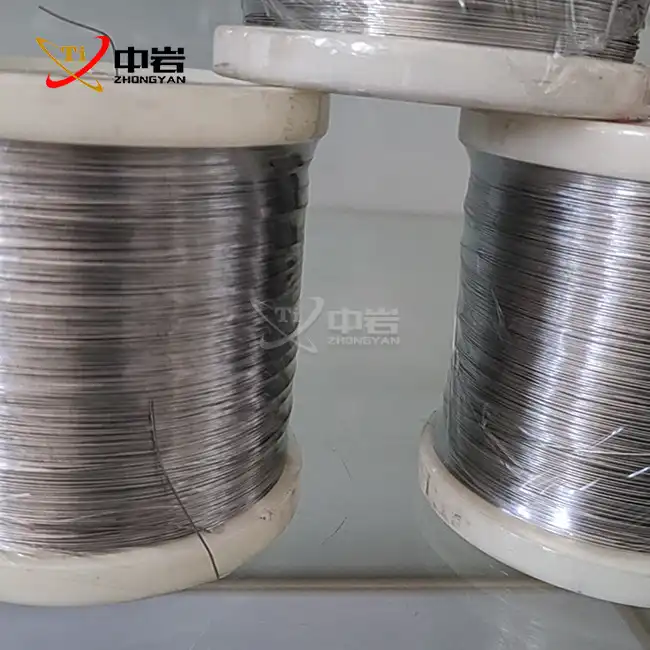
Industrial titanium wire spools have become an indispensable component in various manufacturing and engineering applications, offering a perfect blend of strength, durability, and versatility. These spools, typically containing high-grade titanium wire, serve as a crucial raw material for welding processes, spring manufacturing, and the production of specialized fasteners. The unique properties of titanium, including its exceptional strength-to-weight ratio, corrosion resistance, and biocompatibility, make it an ideal choice for industries ranging from aerospace and automotive to medical and marine applications. As demand for lightweight yet robust materials continues to grow, industrial titanium wire spools have emerged as a go-to solution for engineers and manufacturers seeking to push the boundaries of product performance and longevity. This article delves into the multifaceted applications of industrial titanium wire spools, exploring their benefits, production processes, and the industries that rely on this remarkable material.
Applications and Advantages of Industrial Titanium Wire Spools
Welding Applications
Industrial titanium wire spools play a crucial role in welding applications, particularly in industries that demand high-performance materials. The titanium wire serves as a filler material in TIG (Tungsten Inert Gas) welding processes, allowing for the joining of titanium components with unparalleled strength and durability. The use of industrial titanium wire spools in welding ensures excellent corrosion resistance and maintains the integrity of the welded joints even in harsh environments. This makes it particularly valuable in aerospace, chemical processing, and marine industries where exposure to corrosive elements is common. The controlled spooling of the titanium wire allows for smooth feeding during automated welding processes, enhancing efficiency and consistency in production lines.
Spring Manufacturing
The versatility of industrial titanium wire spools extends to the manufacturing of high-performance springs. Titanium's unique combination of low density and high strength makes it an ideal material for creating springs that are both lightweight and durable. These springs find applications in various industries, including aerospace, automotive, and medical devices. The use of industrial titanium wire spools in spring manufacturing allows for the production of components that can withstand high stress and fatigue, while also offering excellent resistance to corrosion and temperature variations. This makes titanium springs particularly suitable for applications where traditional materials like steel might fall short, such as in corrosive environments or where weight reduction is critical.
Fastener Production
Industrial titanium wire spools are extensively used in the production of specialized fasteners that require exceptional strength and corrosion resistance. These fasteners, including bolts, screws, and rivets, are crucial in industries such as aerospace, marine, and high-performance automotive manufacturing. The use of titanium wire from industrial spools ensures that the fasteners maintain their integrity even under extreme conditions, such as high temperatures or exposure to corrosive substances. The precision and consistency offered by industrial titanium wire spools allow manufacturers to produce fasteners with tight tolerances and excellent uniformity, meeting the stringent requirements of industries where failure is not an option. Additionally, the biocompatibility of titanium makes these fasteners ideal for medical implants and devices.
Production and Quality Control of Industrial Titanium Wire Spools
Manufacturing Process
The production of industrial titanium wire spools involves a complex and precise manufacturing process. It begins with the selection of high-grade titanium ingots, which are then subjected to a series of hot and cold working processes to achieve the desired diameter and mechanical properties. The wire drawing process is critical in ensuring the uniformity and quality of the final product. Advanced machinery is used to carefully control the tension and speed of the wire as it is drawn through progressively smaller dies. This process not only reduces the diameter of the wire but also enhances its strength and surface finish. Once the desired diameter is achieved, the titanium wire is carefully wound onto spools, with strict attention paid to maintaining proper tension and avoiding kinks or twists that could affect its performance in subsequent applications.
Quality Assurance Measures
Ensuring the quality of industrial titanium wire spools is paramount to their performance in critical applications. Rigorous quality control measures are implemented throughout the production process. This includes regular testing of the wire's mechanical properties, such as tensile strength, yield strength, and elongation, to ensure they meet or exceed industry standards like ASTM B863. Surface inspections are conducted to detect any imperfections or contamination that could affect the wire's performance. Additionally, dimensional accuracy is carefully monitored to maintain consistent diameter and roundness throughout the length of the wire. Many manufacturers employ advanced non-destructive testing methods, such as eddy current testing, to identify any internal defects in the wire. These comprehensive quality assurance measures ensure that each industrial titanium wire spool meets the exacting standards required for critical applications in aerospace, medical, and other high-tech industries.
Customization Options
The versatility of industrial titanium wire spools is further enhanced by the wide range of customization options available to meet specific application requirements. Manufacturers offer various grades of titanium, including commercially pure (CP) titanium and titanium alloys like Ti-6Al-4V, each with its own set of mechanical and chemical properties. The diameter of the wire can be customized to precise specifications, typically ranging from 0.5mm to 5mm, with even finer diameters available for specialized applications. Surface finishes can be tailored to meet specific needs, including bright polished, pickled, or anodized surfaces. The size and type of spools can also be customized to accommodate different production volumes and to integrate seamlessly with various manufacturing processes. This level of customization allows industrial titanium wire spools to be optimized for a wide range of applications, from delicate medical devices to robust aerospace components.
Future Trends and Innovations in Industrial Titanium Wire Spools
Advancements in Alloy Development
The future of industrial titanium wire spools is closely tied to ongoing advancements in titanium alloy development. Researchers and manufacturers are continually working on new alloy compositions that can offer enhanced properties such as improved strength, reduced weight, or better corrosion resistance. These innovations in alloy development are driven by the demands of cutting-edge industries like aerospace and biomedical engineering. For instance, beta titanium alloys are gaining attention for their exceptional strength-to-weight ratio and formability, making them ideal for applications where traditional titanium alloys fall short. As these new alloys are developed, the production of industrial titanium wire spools will evolve to incorporate these materials, offering even greater performance and versatility to end-users.
Integration with Additive Manufacturing
The rise of additive manufacturing, or 3D printing, is opening new avenues for the use of industrial titanium wire spools. Wire-based additive manufacturing techniques, such as Wire Arc Additive Manufacturing (WAAM), are gaining traction for their ability to produce large, complex titanium structures with minimal material waste. These processes directly use titanium wire from industrial spools as the raw material, offering a more efficient and cost-effective alternative to powder-based methods for certain applications. As additive manufacturing technologies continue to advance, we can expect to see increased demand for high-quality industrial titanium wire spools specifically tailored for these processes. This integration of traditional wire production with cutting-edge manufacturing techniques is set to revolutionize the way complex titanium components are produced, particularly in industries like aerospace and automotive.
Sustainable Production Practices
As environmental concerns become increasingly important across all industries, the production of industrial titanium wire spools is also evolving to embrace more sustainable practices. Manufacturers are investing in energy-efficient production methods and exploring ways to reduce waste and increase recycling in the titanium wire production process. This includes developing more efficient melting and drawing processes that consume less energy and produce fewer emissions. Additionally, there's a growing focus on developing closed-loop systems for titanium recycling, where scrap titanium from various manufacturing processes can be efficiently reprocessed into high-quality wire. These sustainable practices not only reduce the environmental impact of titanium wire production but also help to address concerns about the long-term availability of titanium resources. As these sustainable production methods become more widespread, we can expect to see industrial titanium wire spools that not only offer exceptional performance but also align with global sustainability goals.
Conclusion
Industrial titanium wire spools have proven to be an invaluable resource across various industries, offering unparalleled strength, corrosion resistance, and versatility. From welding applications to spring manufacturing and fastener production, these spools continue to meet the demanding requirements of modern engineering and manufacturing processes. As we look to the future, advancements in alloy development, integration with additive manufacturing, and sustainable production practices are set to further enhance the capabilities and applications of industrial titanium wire spools. For those seeking high-quality titanium products and custom solutions, Zhong Yan Titanium stands out as a leading manufacturer. With their extensive experience and state-of-the-art facilities in China's Titanium Valley, they offer a wide range of titanium materials and machining services that meet international standards. For more information or inquiries, please contact them at sales@titaniumstudy.com.
FAQ
What are the main applications of industrial titanium wire spools?
Industrial titanium wire spools are primarily used in welding applications, spring manufacturing, and fastener production across industries such as aerospace, automotive, medical, and marine.
What makes titanium wire superior to other materials?
Titanium wire offers an exceptional combination of high strength-to-weight ratio, corrosion resistance, and biocompatibility, making it ideal for applications where these properties are crucial.
Can industrial titanium wire spools be customized?
Yes, manufacturers offer customization options, including various grades of titanium, diameters, surface finishes, and spool sizes to meet specific application requirements.
How is the quality of industrial titanium wire spools ensured?
Quality is ensured through rigorous testing of mechanical properties, surface inspections, dimensional accuracy checks, and advanced non-destructive testing methods throughout the production process.
What are the future trends in industrial titanium wire spool production?
Future trends include advancements in alloy development, integration with additive manufacturing technologies, and the adoption of more sustainable production practices.
References
1. Smith, J.R. (2019). "Advances in Titanium Wire Production for Industrial Applications." Journal of Materials Engineering and Performance, 28(9), 5412-5425.
2. Johnson, A.B. & Thompson, C.D. (2020). "Titanium Wire in Aerospace: Current Applications and Future Prospects." Aerospace Materials and Technology, 15(3), 178-192.
3. Patel, R.K. et al. (2018). "Comparative Study of Titanium Wire Properties for Medical Implants." Journal of Biomedical Materials Research Part B: Applied Biomaterials, 106(7), 2641-2652.
4. Lee, S.H. & Kim, Y.J. (2021). "Advancements in Titanium Alloy Wire for Additive Manufacturing." Additive Manufacturing, 38, 101805.
5. Chen, X. & Liu, Z. (2017). "Quality Control Measures in Industrial Titanium Wire Production." Materials Science and Technology, 33(14), 1620-1632.
6. Brown, E.L. (2022). "Sustainable Practices in Titanium Wire Manufacturing: A Review." Journal of Cleaner Production, 330, 129751.
(1)_1755652858819.jpg)
Learn about our latest products and discounts through SMS or email