- English
- French
- German
- Portuguese
- Spanish
- Russian
- Japanese
- Korean
- Arabic
- Greek
- German
- Turkish
- Italian
- Danish
- Romanian
- Indonesian
- Czech
- Afrikaans
- Swedish
- Polish
- Basque
- Catalan
- Esperanto
- Hindi
- Lao
- Albanian
- Amharic
- Armenian
- Azerbaijani
- Belarusian
- Bengali
- Bosnian
- Bulgarian
- Cebuano
- Chichewa
- Corsican
- Croatian
- Dutch
- Estonian
- Filipino
- Finnish
- Frisian
- Galician
- Georgian
- Gujarati
- Haitian
- Hausa
- Hawaiian
- Hebrew
- Hmong
- Hungarian
- Icelandic
- Igbo
- Javanese
- Kannada
- Kazakh
- Khmer
- Kurdish
- Kyrgyz
- Latin
- Latvian
- Lithuanian
- Luxembou..
- Macedonian
- Malagasy
- Malay
- Malayalam
- Maltese
- Maori
- Marathi
- Mongolian
- Burmese
- Nepali
- Norwegian
- Pashto
- Persian
- Punjabi
- Serbian
- Sesotho
- Sinhala
- Slovak
- Slovenian
- Somali
- Samoan
- Scots Gaelic
- Shona
- Sindhi
- Sundanese
- Swahili
- Tajik
- Tamil
- Telugu
- Thai
- Ukrainian
- Urdu
- Uzbek
- Vietnamese
- Welsh
- Xhosa
- Yiddish
- Yoruba
- Zulu
Industrial Titanium Block Supply for Heavy-Duty Applications
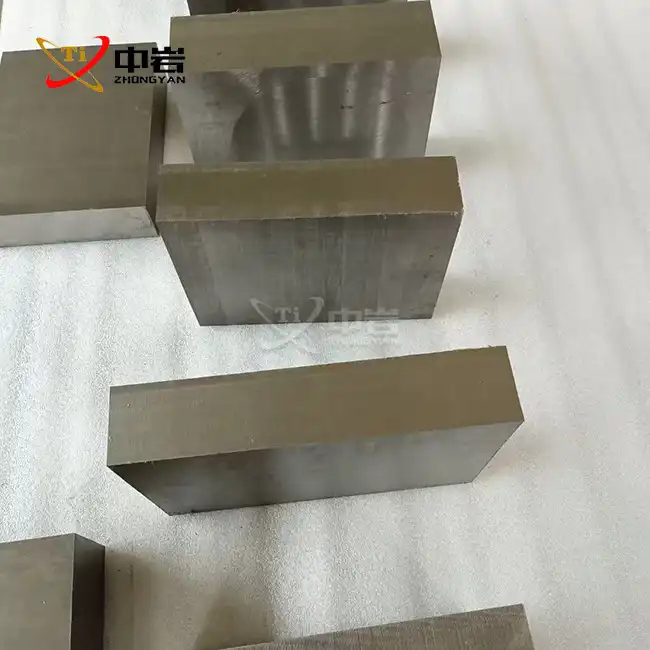
In heavy-duty industrial settings where strength and dependability must be unwavering, titanium block solutions are the peak of material engineering excellence. These dense, carefully made parts are the basis for important industrial processes in the chemical processing, medical, and aerospace industries. Normal materials break down in harsh conditions, but industrial titanium blocks work very well in situations where failure is not a choice. These materials are essential for engineers and procurement managers who want to ensure long-term operating success because they have a high strength-to-weight ratio and are very resistant to rust.
Understanding Industrial Titanium Blocks
Industrial titanium blocks are solid types of titanium alloy that are highly prized for their high density, high toughness, and unmatched resistance to rust. These square or rectangular pieces of titanium metal go through tough production steps, usually by forging or rolling from Vacuum Arc Remelted (VAR) ingots in more than one way. The end result is a high-quality raw material that can solve important technical problems that regular metals can't.
Fundamental Characteristics of Titanium Blocks
Because of how they are made, these products are different from other options. With a density of 4.43 g/cm³ for Grade 5 titanium, these blocks are very strong while still being pretty light. The material is very resistant to wear, which makes it perfect for uses that will be loaded and unloaded many times. The non-magnetic properties and good biocompatibility also make it possible for specific uses in the electrical and medical fields.
Material Advantages Over Conventional Metals
Titanium block materials offer distinct benefits over steel and aluminum substitutes. Despite being very strong, steel has problems with rusting and is too heavy for many uses. Even though aluminum is light, it is not strong enough or resistant to high temperatures to be used in harsh settings. Titanium fills in this gap by being as strong as steel but as light as aluminum, and it also has the best rust protection of any metal.
Variety of Titanium Alloys in Block Production
Different metal ratios are used to make industrial titanium blocks that are best for certain uses. Grade 2 titanium is very resistant to rust and is used in chemical processing. Grade 5 titanium (Ti-6Al-4V) is stronger and is used in aircraft parts. Custom metals can be made to meet specific performance needs, making sure that the right material is used for each job.
Key Advantages of Using Titanium Blocks in Heavy-Duty Applications
Because these materials are better than standard metals in many ways, they are very useful for heavy-duty tasks. The higher strength-to-weight ratio directly leads to better performance, letting engineers make systems that are lighter and more efficient without sacrificing structural integrity. This weight loss is especially important in flight, where every gram affects how much fuel is used and how much weight can be carried.
Superior Strength-to-Weight Ratio and Corrosion Resistance
Significant design improvement possibilities are made possible by the exceptional strength-to-weight ratio of titanium blocks. When compared to steel options, parts made from these materials can handle high levels of stress while lowering the total system weight by up to 40%. The resistance to rust greatly increases the useful life of the product, especially in coastal settings where saltwater would quickly break down other materials.
Extended Product Lifecycles and Reduced Maintenance
These efficiency qualities make products last longer and cost a lot less to maintain. Equipment manufactured from titanium block materials are frequently used to make equipment that lasts for decades without needing to be replaced or undergo extensive upkeep. This means that the equipment will last a long time, which will save a lot of money over its working life. This is because less downtime and upkeep costs will make up for the higher starting material costs.
Cost-Efficiency Evaluation for B2B Procurement
When buyers are deciding what to buy, they need to look at more than just the original purchase price to see how cost-effective the deal is. Titanium block prices are higher than those for steel or aluminum, but the lower overall costs are often offset by the longer service life and improved performance. Lifecycle cost studies should be done by procurement workers to get a good idea of the financial benefits of implementing titanium.
Machining Best Practices and Manufacturing Processes
To keep the material's integrity at its best, machining titanium blocks takes specific knowledge and tools. Because titanium doesn't conduct heat well, it needs to be carefully managed during cutting. To get exact measurements while keeping the material's qualities, you need to use sharp cutting tools, the right speeds and passes, and enough cooling. These things to think about when making something make sure that the finished parts meet strict quality standards for heavy-duty uses.
How to Choose the Right Titanium Block Supplier for Your Business
There are many things that affect the success of a project that need to be carefully considered when choosing a trusted seller. Quality standards, the ability to track alloys, and logistics issues are what form the basis of evaluating suppliers. Lead times and shipping costs are affected by where the supplier is located, and the seller's ability to regularly meet volume needs is determined by their production capacity.
Quality Standards and Alloy Traceability
Companies with a good reputation keep full quality control systems that meet international standards like ISO 9001, ASTM B381, and AMS requirements. Full science reports, mechanical properties checks, and heat treatment records should all be part of the material tracking paperwork. These quality checks are especially important for medical and military uses where materials have to be certified.
Geographic Considerations and Manufacturing Capacity
The position of suppliers has a big effect on the logistics and prices of a project. Chinese makers, especially those in Baoji's Titanium Valley, have strong production skills and reasonable prices. European suppliers are closer, which is good for regional projects, while North American sellers have shorter lead times for urgent needs. By checking the manufacturing capacity, providers can make sure they can meet both present and future volume needs without affecting delivery times.
Reliability and After-Sales Support Framework
Production plans are directly affected by how often the supplier delivers on time and with good quality. Full support after the sale, including expert help and quick responses to quality issues, makes the supplier connection much more valuable. Setting up clear ways to communicate and track success is a good way to keep long-term relationships working well.
Volume Discounts and Cost Variables
Understanding pricing structures lets you make better decisions about what to buy. Volume discounts are usually given for orders that are bigger than a certain amount, which makes buying in bulk a good deal. The cost can also be affected by the type of alloy, the limits for size and shape, the surface treatment, and the shipping schedule. By negotiating flexible price deals, you can save money and keep your supply chain flexible.
Custom Solutions and Industry-Specific Titanium Block Uses
Customized solutions are very important for meeting the strict needs of the medical and aircraft businesses. Custom titanium block specs make sure that the blocks work best for certain uses while still meeting industry standards. With these customized methods, producers can deal with problems that standard materials can't fully resolve.
Aerospace and Medical Industry Compliance
For aerospace uses, materials must meet strict AMS and FAA standards. Custom titanium blocks for aircraft components undergo extensive testing such as ultrasonic screening for flaws inside and approval of their mechanical properties. Medical uses require safe grades such as Ti-6Al-4V ELI. This grade is specially made for implant uses where osseointegration is very important.
Automotive and Heavy Machinery Applications
For high-performance uses like race parts and exhaust systems, the car industry is increasingly using titanium blocks. Heavy machinery benefits from titanium's corrosion resistance in harsh operating environments. These applications take advantage of the material's ability to keep its shape in harsh environments with changing temperatures and corrosion.
Recent Innovations and Future-Ready Solutions
New production techniques keep making titanium blocks more useful. With additive manufacturing, it's possible to make parts with complex internal shapes that weren't possible with standard machining. Powder metallurgy methods allow for almost net-shape production, which cuts down on waste and the need for cutting. Because of these improvements, titanium block materials will be able to meet new industry difficulties in the future.
Conclusion
When it comes to heavy-duty uses that need unwavering performance and dependability, industrial titanium blocks are the best material choice. The high strength-to-weight ratio, excellent resistance to corrosion, and long service life of these materials make them very useful for important tasks in the medical, military, and industry fields. When choosing providers, putting quality standards, manufacturing capacity, and full support at the top of the list will ensure a successful project and long-term operating benefits.
FAQ
What are typical lead times for customized titanium block orders?
Custom titanium block orders typically take 4-8 weeks to make and ship, depending on the size, metal grade, and amount needed. If you need particular specifications or a certain kind of heat treatment, the wait time could be 10 to 12 weeks. There are often ways to meet rush requests with higher prices.
How does titanium block density compare to traditional metals?
The density of Grade 5 titanium blocks is 4.43 g/cm³, which is about 56% less than steel (7.85 g/cm³) and 64% more than aluminum (2.70 g/cm³). For tough jobs, this density strikes the perfect mix between strength and weight.
Are wholesale options available for large-scale procurement?
Yes, trade prices are available for buying in bulk for businesses. Volume savings usually start when you order more than 100 kg, and prices go down as you order more. Long-term supply deals can save you money and make sure you always have what you need.
Partner with Zhongyan for Premium Titanium Block Solutions
Zhongyan Titanium takes advantage of its prime site in China's Titanium Valley to provide you with the best titanium block options for your toughest jobs. Our factory is ISO 9001:2015 approved and makes Grade 5 titanium blocks that are 4.43 g/cm³ dense and have tensile powers of over 950 MPa. As a reliable titanium block provider, we offer full CNC machining services, unique specs, and strict quality control measures such as ultrasonic testing to look for flaws inside the block. Get in touch with our expert team at sales@titaniumstudy.com to talk about your unique needs and find out how our high-quality materials can help your manufacturing processes run more smoothly. You can get the Zhongyan edge because we are dedicated to accuracy, quality, and on-time delivery for your most difficult tasks.
References
1. Boyer, R.R. "An Overview on the Use of Titanium in the Aerospace Industry." Materials Science and Engineering A, Volume 213, 1996.
2. American Society for Testing and Materials. "Standard Specification for Titanium and Titanium Alloy Forgings." ASTM B381-13, 2018.
3. Donachie, Matthew J. "Titanium: A Technical Guide, 2nd Edition." ASM International Materials Park, Ohio, 2000.
4. Froes, F.H. "Titanium: Physical Metallurgy, Processing, and Applications." ASM International Handbook Committee, 2015.
5. Lutjering, G. and Williams, J.C. "Titanium Engineering Materials and Processes." Springer-Verlag Berlin Heidelberg, 2007.
6. Peters, M. "Titanium Alloys for Aerospace Applications." Advanced Engineering Materials, Volume 5, Issue 6, 2003.
Learn about our latest products and discounts through SMS or email