- English
- French
- German
- Portuguese
- Spanish
- Russian
- Japanese
- Korean
- Arabic
- Greek
- German
- Turkish
- Italian
- Danish
- Romanian
- Indonesian
- Czech
- Afrikaans
- Swedish
- Polish
- Basque
- Catalan
- Esperanto
- Hindi
- Lao
- Albanian
- Amharic
- Armenian
- Azerbaijani
- Belarusian
- Bengali
- Bosnian
- Bulgarian
- Cebuano
- Chichewa
- Corsican
- Croatian
- Dutch
- Estonian
- Filipino
- Finnish
- Frisian
- Galician
- Georgian
- Gujarati
- Haitian
- Hausa
- Hawaiian
- Hebrew
- Hmong
- Hungarian
- Icelandic
- Igbo
- Javanese
- Kannada
- Kazakh
- Khmer
- Kurdish
- Kyrgyz
- Latin
- Latvian
- Lithuanian
- Luxembou..
- Macedonian
- Malagasy
- Malay
- Malayalam
- Maltese
- Maori
- Marathi
- Mongolian
- Burmese
- Nepali
- Norwegian
- Pashto
- Persian
- Punjabi
- Serbian
- Sesotho
- Sinhala
- Slovak
- Slovenian
- Somali
- Samoan
- Scots Gaelic
- Shona
- Sindhi
- Sundanese
- Swahili
- Tajik
- Tamil
- Telugu
- Thai
- Ukrainian
- Urdu
- Uzbek
- Vietnamese
- Welsh
- Xhosa
- Yiddish
- Yoruba
- Zulu
How to Choose Industrial Titanium Wire Suppliers?
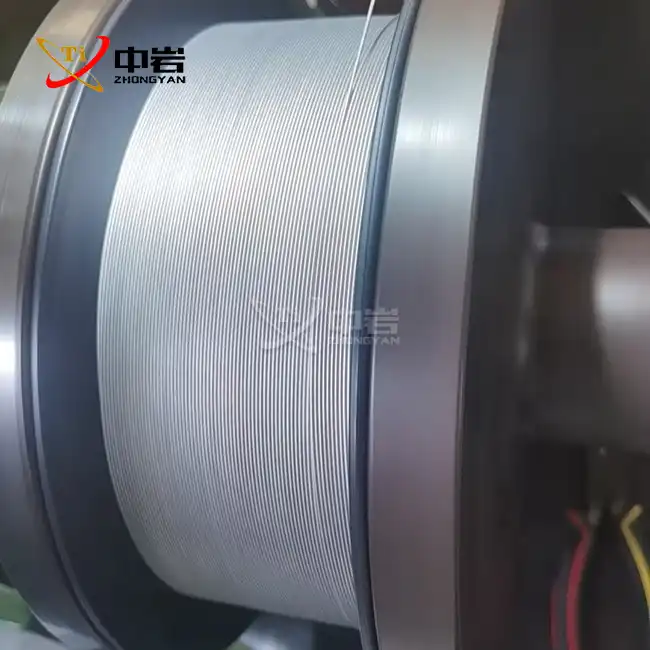
To find the best supplier of titanium metal wire for industrial use, you need to carefully consider a number of factors that will have a direct effect on your production methods and the quality of the finished product. Titanium wire used in industry is very important in fields like aircraft, medicine, electronics, and chemical processing, where accuracy and dependability are very important. When making a purchase choice, you have to look at the licenses, quality control systems, production skills, and expert support services of each provider. Knowing these selection factors helps procurement managers keep their competitive edge in their markets while securing reliable supply lines. Because processing titanium is so complicated, providers need to have both proven knowledge and advanced industrial skills.
Understanding Industrial Titanium Wire and Its Applications
Defining Industrial Titanium Wire Properties
Industrial titanium wire is made from commercially pure titanium or titanium alloys and is carefully developed to meet the strict performance needs of a wide range of demanding uses. These special lines have amazing properties, like being very resistant to rust, having great strength-to-weight ratios, and being very biocompatible. These properties make them essential in important manufacturing processes.When it comes to titanium metal wire for industrial use, its tensile strengths range from 345 MPa for Grade 2 pure titanium to over 895 MPa for Grade 5 alloys. Because the material has a low density (4.51 g/cm³), great fatigue resistance, and thermal stability up to 400°C, it gives makers options that work better in tough conditions than standard materials.
Key Industrial Applications Across Sectors
For aerospace uses, titanium wire is used a lot in structural parts, fastening systems, and spring mechanisms. Less weight means better performance and fuel economy. Because the wire can keep its mechanical integrity in harsh weather and high temperature changes, it is important for making airplanes and space travel gear.The biocompatibility of titanium wire is used in medical device making for surgical implants, orthodontic uses, and artificial parts. Because the material is non-toxic and doesn't react with body fluids, it can stay compatible with human tissue for a long time. This lowers the rate of rejection and improves patient results.Titanium wire is used in sputtering targets, filter systems, and equipment that doesn't rust in the chemical processing and electronics businesses. The chemical inertness of the material keeps sensitive processes from getting messed up and keeps the structure strong in tough chemical settings.
Comparative Analysis with Alternative Materials
When it comes to corrosion protection, titanium wire is better than stainless steel wire in chloride settings and naval uses. Even though stainless steel might be cheaper at first, titanium's long life and low upkeep needs often make it a better choice for demanding uses.Nickel-based metals are resistant to corrosion in some ways, but not as well as titanium. Titanium wire is especially useful in uses that need to be light because it is very strong for its weight. Titanium is also better at being biocompatible than nickel metals, which makes it the best choice for medical uses that need to avoid allergic responses.
Key Criteria for Selecting Industrial Titanium Wire Suppliers
Certification and Quality Assurance Requirements
Professional sellers need to keep a full set of certifications, such as ISO 9001:2015 quality management systems, AS9100 aerospace standards, and FDA licenses for medical uses. These licenses show that companies in a variety of industries are committed to rigorous quality control and following all rules and regulations.When it comes to materials, certificates should say that they meet ASTM B863 standards for general industrial uses and AWS A5.16 standards for welding uses. For each output lot, suppliers must give specific material test certificates (MTCs) that show the chemical make-up, mechanical qualities, and traceability details.Advanced providers use extra quality checks like eddy current testing to find surface flaws, laser micrometer measurements to make sure the product is the right size, and inductively coupled plasma analysis to confirm the chemical makeup. These tests procedures make sure that the properties of the material stay the same and get rid of any possible failure modes in important uses.
Product Range and Customization Capabilities
Leading suppliers have wide ranges of products for different wire sizes, which are usually between 0.5mm and 3mm for common industry uses, including titanium metal wire for industrial applications. There are different grades of titanium, such as commercially pure (Grades 1-4) and mixed versions (Grade 5, Grade 7, Grade 9), which lets you choose the right material for the job. Customization options go beyond changes in size and include unique surface treatments, annealing methods, and packing arrangements. Suppliers that offer coil weights between 10 and 15 kg per spool and custom length choices give manufacturers and warehouse managers more options for meeting different production needs. By offering both annealed and straightened wire conditions, producers can choose the best material states for their unique shaping and processing needs. This makes making more efficient and lowers the costs of handling that comes after.
Supply Chain Reliability and Commercial Considerations
Metrics for delivery success, such as lead times, on-time delivery rates, and store availability, have a direct effect on how production is scheduled and how costs are managed. Reliable sellers keep smart amounts of inventory and set up strong transportation systems to make sure that materials are always available.When it comes to pricing, being clear about not only unit prices but also bulk discounts, payment terms, and the total cost of ownership is important. Suppliers should set clear prices that take into account different types of materials, breaks in number, and shipping needs while still staying competitive in the market.
Evaluating Supplier Performance and Reliability
Reputation Assessment and Industry Standing
The first step in figuring out a supplier's credibility is to look at their overall image in the industry. This can include reading customer reviews, case study paperwork, and third-party quality audits. Established providers show steady performance through long-term ties with customers and recorded success stories in a number of different industries.Professional organizations and industry qualifications are more proof that a company is qualified and dedicated to always getting better. Being a part of groups like the International Titanium Association (ITA) and helping to make industry standards shows that you are technically knowledgeable and interested in the market.
Performance Metrics and Compliance Verification
As part of a quantitative performance review, shipping reliability data, quality rejection rates, and customer service responsiveness measures should be looked at. Leading providers keep performance dashboards and regularly report on key performance factors to show that they are working to make things better all the time.Verification of compliance goes beyond initial certifications and includes regular check plans, methods for corrective action, and procedures for keeping up with new regulations. Suppliers must show that they can handle compliance proactively and move quickly when rules change that affect product specs or manufacturing processes.
Customer Support and Technical Services
Technical support services like application engineering, material selection advice, and fixing help add a lot of value on top of just supplying products. For better manufacturing results, suppliers with expert teams that are full of experience can help you find the best material specs and processing factors.Support services after the sale, such as guarantee terms, return policies, and replacement processes, lower the risk for important applications. Clear service level agreements and reporting processes make sure that problems in the supply chain or with quality are fixed quickly.
Comparing Industrial Titanium Wire Options and Supplier Solutions
Grade Selection for Specific Applications
Commercially pure titanium types are very good at resisting rust and being able to be shaped, making them useful for situations where strength is not the most important factor. Grade 2 titanium metal wire for industrial applications provides tensile strengths of 345 MPa, and it is very flexible, making it ideal for difficult shaping and welding tasks.Titanium alloys, such as Grade 5 (Ti-6Al-4V), have better strength qualities, with a tensile strength of up to 895 MPa, and they also resist rust well. This grade works great for aircraft structure parts and high-stress mechanical tasks where reducing weight is still important.Specialized grades, like Grade 7 (Ti-0.15Pd), are better at resisting corrosion in settings with less acid. This makes them good for chemical processing equipment and marine uses where normal grades might experience localized rust.
Manufacturing Capabilities and Custom Solutions
Advanced providers can do a wide range of industrial processes, such as drawing wire, heating it, straightening it, and applying special finishes to the surface. These built-in features make sure that quality control is always the same and make the supply chain simpler for customers who need more than one handling step.OEM and ODM solutions let providers create custom specs for specific uses, such as metal compositions, non-standard measurements, and surface treatments that aren't available anywhere else. This adaptability helps with new ideas and standing out from the competition in tough market segments.For high-volume uses or needs that need to be scaled up quickly, production capability and scalability become very important. Suppliers should show that they have enough extra capacity and the ability to grow to meet the needs of growing customers without lowering quality or service standards.
Cost-Benefit Analysis and Value Optimization
A total cost of ownership study needs to look at more than just the prices of the materials. It also needs to look at the costs of processing, keeping inventory, and improving application performance. Titanium metal wire for industrial uses often has better lifetime economics, even though it costs more at first, because it lasts longer and needs less upkeep.By choosing the right materials and working with the right suppliers, you can improve performance and get big benefits like shorter handling times, better quality products, and more reliable service. These perks often make it worth paying more for better goods and services from suppliers.
Conclusion
When looking for the best titanium metal wire for industrial use, it's important to carefully consider things like approval compliance, manufacturing skills, quality systems, and business terms. Costs and performance needs must be balanced in a procurement strategy that also makes sure the supply chain is reliable and expert help is available. Because producing and using titanium is so complicated, providers need to have a lot of experience and be able to offer a wide range of services. Strategic relationships with suppliers give companies access to new technologies, custom solutions, and ways to keep making things better, all of which give them a long-term edge in tough industrial markets.
FAQ
What certifications should I require from titanium wire suppliers?
As a minimum, reputable providers must keep their ISO 9001:2015 quality management license. Certifications related to the industry, like AS9100 for aerospace uses, FDA registration for medical devices, and NADCAP approval for specialized processes, show that a seller is qualified in even more ways. Certifications for materials must include ASTM B863 compliance for general industry use and AWS A5.16 compliance for welding.
How does titanium wire compare to stainless steel in corrosion resistance?
Titanium metal wire for industrial applications demonstrates superior corrosion resistance compared to stainless steel, particularly in chloride environments and marine applications. In harsh conditions, stainless steel can get pitting and crevice rust, but titanium keeps its protected oxide layer and doesn't break down. The longer service life and lower upkeep needs often make up for the higher original cost of the better corrosion protection.
What customization options are available for industrial titanium wire?
Professional sellers let you make a lot of changes, like choosing a width between 0.5 mm and 3 mm, different titanium grades (CP Grades 1-4 and alloys), different surface treatments, and unique ways to package your order. Custom annealing methods, length standards, and coil weights can be made to fit the needs of a particular production process. According to the complexity and amount of the order, lead times for custom specs are usually between 4 and 8 weeks.
What quality control measures should I expect from suppliers?
Laser micrometers are used to check the sizes of things, inductively coupled plasma testing is used to look at the chemicals, and tension testing is used to check the mechanical properties. Advanced suppliers use eddy current testing to find flaws on the surface and give thorough material test papers so that the products can be tracked. Statistical process control and constant tracking make sure that the quality of the result is the same from batch to batch.
Partner with Zhongyan for Premium Industrial Titanium Wire Solutions
Zhongyan stands as a leading titanium metal wire for industrial use maker, delivering certified solutions that meet the strictest needs of aerospace, medical, and chemical processes. Our ISO 9001:2015-certified factory in Baoji, China's Titanium Valley, uses cutting-edge manufacturing tools and thorough quality control systems to make sure that all of our products are always the best. We are experts in CP Grade 2 titanium wire that comes in Ø0.8mm ×500m coils and has tensile strengths of at least 345 MPa, which meets ASTM B863 standards for important industry uses.Our technical know-how goes beyond standard goods and includes custom diameter choices from 0.5mm to 3mm, special surface treatments, and custom ways to package your order. Get in touch with our engineering team at sales@titaniumstudy.com to talk about your specific needs and discover the benefits of working with a reputable titanium metal wire for industrial provider that is dedicated to providing high quality products and dependable service.
References
1. American Society for Testing and Materials. "Standard Specification for Titanium and Titanium Alloy Wire." ASTM International Committee B10 on Reactive and Refractory Metals and Alloys, 2019.
2. Boyer, Rodney, et al. "Materials Properties Handbook: Titanium Alloys." ASM International Handbook Committee, Materials Park, Ohio, 2018.
3. International Titanium Association. "Titanium Industrial Applications and Market Analysis." ITA Technical Report Series, Denver, Colorado, 2020.
4. Leyens, Christoph and Peters, Manfred. "Titanium and Titanium Alloys: Fundamentals and Applications." Wiley-VCH Materials Science and Engineering Series, Weinheim, Germany, 2021.
5. Peters, M., et al. "Structure and Properties of Titanium and Titanium Alloys." Journal of Materials Science and Engineering Review, Volume 42, Issue 3, 2019.
6. Welsch, Gerhard, Boyer, Rodney, and Collings, E.W. "Materials Properties and Selection Guidelines for Titanium Wire Products." ASM Specialty Handbook on Titanium Materials, Materials Park, Ohio, 2020.
_1755591941325.jpg)
Learn about our latest products and discounts through SMS or email