- English
- French
- German
- Portuguese
- Spanish
- Russian
- Japanese
- Korean
- Arabic
- Greek
- German
- Turkish
- Italian
- Danish
- Romanian
- Indonesian
- Czech
- Afrikaans
- Swedish
- Polish
- Basque
- Catalan
- Esperanto
- Hindi
- Lao
- Albanian
- Amharic
- Armenian
- Azerbaijani
- Belarusian
- Bengali
- Bosnian
- Bulgarian
- Cebuano
- Chichewa
- Corsican
- Croatian
- Dutch
- Estonian
- Filipino
- Finnish
- Frisian
- Galician
- Georgian
- Gujarati
- Haitian
- Hausa
- Hawaiian
- Hebrew
- Hmong
- Hungarian
- Icelandic
- Igbo
- Javanese
- Kannada
- Kazakh
- Khmer
- Kurdish
- Kyrgyz
- Latin
- Latvian
- Lithuanian
- Luxembou..
- Macedonian
- Malagasy
- Malay
- Malayalam
- Maltese
- Maori
- Marathi
- Mongolian
- Burmese
- Nepali
- Norwegian
- Pashto
- Persian
- Punjabi
- Serbian
- Sesotho
- Sinhala
- Slovak
- Slovenian
- Somali
- Samoan
- Scots Gaelic
- Shona
- Sindhi
- Sundanese
- Swahili
- Tajik
- Tamil
- Telugu
- Thai
- Ukrainian
- Urdu
- Uzbek
- Vietnamese
- Welsh
- Xhosa
- Yiddish
- Yoruba
- Zulu
How Does GR36 Titanium Bar Compare to Other Titanium Grades?
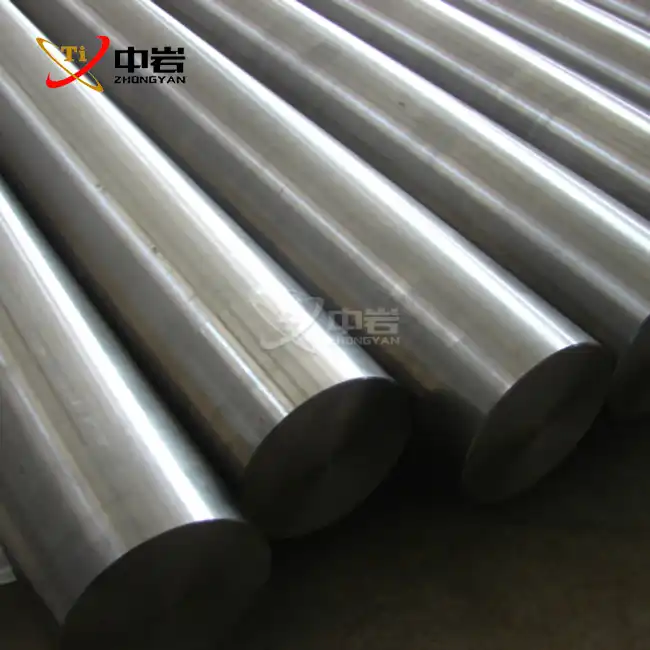
When evaluating titanium materials for high-performance applications, the GR36 titanium bar stands out as a specialised alpha-beta alloy offering exceptional mechanical strength and corrosion resistance. Unlike common commercial-grade titanium, this material—technically identified as Ti-6Al-2Sn-4Zr-6Mo—delivers superior high-temperature performance and fatigue resistance, making it indispensable for aerospace engine components, medical surgical instruments, and chemical processing equipment. Understanding how this grade compares to alternatives helps procurement managers make informed decisions that balance performance requirements with budget constraints.
Understanding GR36 Titanium Bar: Specifications and Properties
Chemical Composition and Alloying Elements
The GR36 titanium bar from Baoji Zhongyan Titanium Industry has an exact alloy composition of 6% molybdenum, 2% zirconium, 2% tin, and 2% aluminium. The combination of these two properties produces an alpha-beta microstructure that is both strong and workable. Molybdenum fortifies the beta phase while increasing corrosion resistance, zirconium stabilises the alpha phase, tin improves creep resistance, and aluminium increases strength and decreases density. Consistent chemical purity and traceability are guaranteed by our goods, which conform to ASTM B348 requirements through strict quality control methods.
Mechanical Performance Characteristics
Our GR36 titanium bar delivers exceptional mechanical properties that exceed many conventional titanium grades. With a tensile strength of at least 900 MPa and yield strength reaching 850 MPa, this material maintains structural integrity under extreme loads. The modulus of elasticity is 114 GPa, providing excellent stiffness, while elongation exceeds 10%, ensuring adequate ductility for fabrication processes. Hardness reaches HRC 36, striking an optimal balance between wear resistance and machinability. These properties are achieved through cold-drawn manufacturing processes followed by annealing, resulting in a uniform microstructure with a polished, bright surface finish.
Corrosion Resistance and Heat Treatment
Operating environments in marine, aerospace, and chemical processing require materials that withstand harsh conditions without degradation. The GR36 titanium bar exhibits outstanding resistance to oxidising and chloride-rich environments, outperforming stainless steel in seawater and acidic atmospheres. Heat treatment protocols can be tailored to optimise their properties for specific applications. Annealing at controlled temperatures relieves internal stresses and enhances ductility, while solution treatment followed by ageing can further increase strength. Our facility in Baoji—known as China's Titanium Valley—leverages advanced furnaces and precise temperature control to deliver bars with predictable, repeatable performance characteristics.
Industry Applications and Benefits
Due to its exceptional property profile, the GR36 titanium bar is highly desirable in several high-performance industries. Compressor blades, engine mounts, and structural fasteners are some of the aerospace components that use this grade. These parts have a direct impact on fuel efficiency and payload capacity due to their strength-to-weight ratio. The material's resistance to corrosion in biological fluids and its biocompatibility make it ideal for use in orthopaedic implants and surgical tools. This grade serves heat exchangers and reactor vessels in chemical processing plants that are exposed to hostile chemicals at high temperatures. For apAutomotive racing teams recommend GR36 titanium bars for applications that require high-temperature strength retention to avoid early failure, such as in valve springs and exhaust systems.Automotive racing teams recommend GR36 Titanium Bar to Other Titanium Grades
GR36 Versus GR2: Strength and Application Scope
Grade 2 titanium represents commercially pure titanium with excellent formability and moderate strength. When comparing the GR36 titanium bar to the GR2, the differences become immediately apparent. GR2 offers tensile strength around 340 MPa—less than half that of GR36—making it suitable for moderate-stress applications like architectural cladding and basic chemical processing equipment. The GR36 titanium bar delivers nearly three times the strength, enabling engineers to reduce component weight while maintaining load-bearing capacity. However, GR2 proves more cost-effective for applications not requiring extreme mechanical performance. Procurement managers should select GR2 for corrosion-resistant applications with minimal mechanical stress and reserve GR36 titanium bars for high-stress, elevated-temperature environments.
GR36 Compared to GR5: Trade-offs in Performance
The world's most popular grade of titanium, Grade 5 (Ti-6Al-4V), is in high demand for its exceptional versatility. Although both the GR36 titanium bar and GR5 are alpha-beta alloys, there are significant differences between the two. GR5 is perfect for structural aircraft parts and medical implants due to its high tensile strength (about 895 MPa) and excellent cold workability and welding properties. In comparison to GR5, the creep resistance and strength retention of GR36 titanium bars remain stable at temperatures close to 540°C, while GR5 performance begins to decline at temperatures higher than 400°C. Tin and zirconium, when added to GR36, make it more resistant to heat and maintain its dimensions even after being heated for a long time. Because of its superior high-temperature capabilities and unique processing needs, GR36 titanium bar usually costs 15-25% more than a GR5.
GR36 Against GR9: Specialized Niche Comparison
Grade 9 (Ti-3Al-2.5V) offers an intermediate option between commercially pure titanium and higher-strength alloys. With tensile strength approximately 620 MPa, GR9 excels in applications requiring better strength than GR2 while maintaining excellent cold formability. The GR36 titanium bar provides substantially higher strength and temperature resistance but sacrifices some formability. Tubing manufacturers often prefer GR9 for bicycle frames and sporting goods where moderate strength suffices. Aerospace and medical device manufacturers select GR36 titanium bar when components must endure sustained mechanical loads at elevated temperatures. The decision hinges on whether application requirements prioritise formability and cost or maximum strength and thermal stability.
Titanium Versus Stainless Steel: Material Category Comparison
When evaluating a GR36 titanium bar against stainless steel bars like 316L, several critical differences emerge. Stainless steel offers lower material costs and easier machinability but carries significantly higher density (approximately 8.0 g/cm³ versus 4.43 g/cm³ for GR36). This weight penalty becomes prohibitive in aerospace applications where every gram impacts fuel consumption. The gr36 titanium bar demonstrates superior corrosion resistance in chloride environments and biocompatibility for medical implants, areas where stainless steel suffers pitting and potential allergic reactions. Stainless steel maintains advantages in thermal and electrical conductivity for specific industrial applications. Lifecycle analysis reveals that despite higher initial costs, GR36 titanium bars often deliver a lower total cost of ownership through extended service life and reduced maintenance requirements.
Procurement Insights: How to Source GR36 Titanium Bars Effectively
Vetting Manufacturers and Certification Requirements
Find providers with strong quality management systems if you want to buy a GR36 titanium bar successfully. From the procurement of raw materials until the final inspection, Baoji Zhongyan Titanium Industry follows established processes that are guaranteed by their ISO 9001:2015 accreditation. Make sure that for every batch of products, your suppliers give you material test reports (MTRs) that detail the chemical make-up, mechanical characteristics, and heat treatment settings. It is essential to certify the GR36 titanium bar to ASTM B348 and ISO 5832-2 standards and to be able to trace it back to its initial melt batches. Get third-party inspection reports or facility audits to prove you can make what you say you can. Quick material verification and technical help, inaccessible from faraway distributors, are advantages of our Baoji location due to its closeness to titanium smelters and research institutes.
Managing MOQs and Custom Specifications
Standard production runs of GR36 titanium bar typically involve minimum order quantities that balance manufacturing efficiency with customer needs. Our facility accommodates orders ranging from prototype quantities to high-volume production, with custom diameters available beyond the standard 10mm size. When specifying GR36 titanium bar requirements, please provide clear documentation on diameter tolerance (we maintain H9 precision), length requirements (standard 1000 mm with custom cuts available), surface finish (polished bright or as-machined), and heat treatment condition (annealed or solution-treated). Lead times vary based on specification complexity and order volume—standard configurations ship within 3-4 weeks, while custom heat treatments may extend delivery by 2-3 weeks. Establishing blanket purchase orders with scheduled releases helps maintain inventory levels while avoiding excess working capital commitment.
Quality Assurance and Material Testing
To prevent using inferior GR36 titanium bar materials, stringent quality checks must be put in place. Check for surface blemishes, compare measurements to specifications, and make sure markings are accurate upon receiving. Certified test reports demonstrating chemical analysis, hardness (HRC 36), and tensile (minimum 900 MPa tensile, 850 MPa yield) testing are required. In order to ensure microstructure homogeneity, our lab uses metallographic examination and optical emission spectroscopy (OES) to check the amounts of alloying elements. When you're shopping for critical-application GR36 titanium bar, think about getting it tested by an independent lab. The use of ultrasonic technology allows for the detection of any potential performance-reducing interior voids or inclusions. In order to find quality trends and encourage ongoing development with your GR36 titanium bar supplier, it is helpful to establish incoming inspection processes and keep supplier scorecards.
Key Factors to Consider When Choosing Between Titanium Grades?
Application-Specific Performance Requirements
A comprehensive evaluation of operating circumstances should be conducted prior to making a material decision for a GR36 titanium bar vs alternatives. Crucial considerations include temperature exposure; the GR36 titanium bar's better creep resistance is useful for components working continuously over 400°C, but the additional price may not be justified for uses at ambient temperature. There is similar importance to mechanical load profiles. The alpha-beta microstructure of the GR36 titanium bar makes it an ideal material for cyclically loaded components that are fatigued and need materials with high fracture toughness. To find out if commercially pure grades are enough or if the increased resistance of the alloyed GR36 titanium bar is needed, corrosion environment assessments are conducted. Due to weight restrictions in aircraft assembly, GR36 titanium bar's density of 4.43 g/cm³ is frequently considered a reasonable compromise when compared to heavier, higher-strength materials.
Balancing Performance With Budget Constraints
Thanks to its complicated alloying, manufacturing, and quality testing, the GR36 titanium bar is an expensive material. Depending on market conditions and order volumes, raw material expenses can be anywhere from 15-25% more than GR5 and 40-60% more than commercially pure GR2. The low cycle durations and high machinability of the GR36 titanium bar offset the material premium, although machining labour remains part of the overall acquisition cost. The whole landed cost, including shipping and inventory-carrying expenses, should be calculated by procurement managers. Our bars have a diameter of 10 mm and weigh about 2.5 kg/m, which allows for economical freight. Although a GR36 titanium bar is more expensive up front, its longer lifespan and fewer maintenance needs result in lower lifecycle costs, according to long-term value analysis. Optimal performance and cost-effectiveness are achieved through strategic alliances with manufacturers such as Zhongyan, which allow for bulk pricing and technical cooperation.
Regulatory Compliance and Standards Alignment
Different industries impose specific material standards that influence grade selection. Aerospace applications often mandate AMS specifications, where a GR36 titanium bar must meet AMS 4982 requirements for chemistry and mechanical properties. Medical device manufacturers require ISO 5832-2 compliance for implantable materials, ensuring biocompatibility and consistency. Our GR36 titanium bar production maintains dual certification to both ASTM B348 and ISO standards, thereby satisfying global regulatory requirements. Chemical processing equipment may specify NACE MR0175 compliance for sour service environments. Verify that your GR36 titanium bar supplier maintains documentation systems that support regulatory audits and provide chain-of-custody traceability. Non-compliance can result in costly component recalls and liability exposure that far exceed any procurement savings from uncertified materials.
Summary and Practical Recommendations for B2B Buyers
The GR36 titanium bar delivers exceptional high-temperature strength, corrosion resistance, and mechanical reliability for demanding industrial applications. Compared to GR2, GR5, and GR9 alternatives, this alpha-beta alloy provides superior creep resistance and temperature capability, justifying its premium positioning for aerospace engines, medical instruments, and chemical processing equipment. Successful procurement requires partnering with certified manufacturers who maintain rigorous quality systems and provide comprehensive material documentation. Baoji Zhongyan Titanium Industry combines 15 years of manufacturing expertise with strategic location advantages in China's Titanium Valley, delivering a GR36 titanium bar that meets ASTM B348 and ISO 5832-2 standards. Strategic material selection aligned with application requirements, coupled with supplier collaboration on specifications and delivery schedules, maximizes return on investment through extended component lifecycles and operational reliability.
FAQ
What distinguishes the gr36 titanium bar chemically from other grades?
The GR36 titanium bar contains 6% aluminium, 2% tin, 4% zirconium, and 6% molybdenum, creating an alpha-beta alloy structure. This is very different from commercially pure grades (GR1-4), which have only a few alloying elements, and from GR5 (Ti-6Al-4V), which does not have the tin and zirconium that improve creep resistance.
Can a GR36 titanium bar be welded effectively?
Yes, the GR36 titanium bar exhibits good weldability using TIG or electron beam processes under inert atmosphere protection. Preheating and controlled cooling rates prevent cracking, though post-weld heat treatment may be required to restore optimal mechanical properties in critical applications.
How do I verify supplier authenticity for a GR36 titanium bar?
Request ISO 9001 certification, facility inspection reports, and material test reports with traceability to original melt batches. Legitimate GR36 titanium bar manufacturers like Zhongyan provide comprehensive documentation, including chemical analysis, mechanical testing results, and compliance certificates for ASTM B348 and ISO 5832-2 standards.
Contact Zhongyan for Premium GR36 Titanium Bar Supply
Zhongyan stands ready to support your GR36 titanium bar procurement needs with manufacturing capabilities that combine precision, quality, and reliable delivery. As an established GR36 titanium bar manufacturer operating from Baoji's Titanium Valley, we offer custom OEM/ODM solutions including specialised diameters, heat treatments, and surface finishes tailored to your exact specifications. Our engineering team provides technical consultation to optimise material selection and processing parameters for your application requirements. We maintain an extensive inventory of standard configurations while accommodating prototype and high-volume production orders with competitive pricing and flexible MOQs. Request your customised quote today by contacting sales@titaniumstudy.com or visiting www.titaniumstudy.com to explore our complete range of titanium bars, plates, tubes, and CNC-machined components. Experience the difference that 15 years of titanium expertise and commitment to customer success delivers for aerospace, medical, and industrial manufacturing projects.
References
1. Boyer R, Welsch G, Collings EW. Materials Properties Handbook: Titanium Alloys. ASM International, 1994.
2. Donachie MJ. Titanium: A Technical Guide, 2nd Edition. ASM International, 2000.
3. ASTM International. ASTM B348-13: Standard Specification for Titanium and Titanium Alloy Bars and Billets. West Conshohocken, PA, 2013.
4. Lütjering G, Williams JC. Titanium, 2nd Edition. Springer-Verlag Berlin Heidelberg, 2007.
5. International Organization for Standardisation. ISO 5832-2: Implants for Surgery - Metallic Materials - Part 2: Unalloyed Titanium. Geneva, Switzerland, 2018.
6. Peters M, Kumpfert J, Ward CH, Leyens C. Titanium Alloys for Aerospace Applications. Advanced Engineering Materials, Vol 5, Issue 6, 2003.
Learn about our latest products and discounts through SMS or email