- English
- French
- German
- Portuguese
- Spanish
- Russian
- Japanese
- Korean
- Arabic
- Greek
- German
- Turkish
- Italian
- Danish
- Romanian
- Indonesian
- Czech
- Afrikaans
- Swedish
- Polish
- Basque
- Catalan
- Esperanto
- Hindi
- Lao
- Albanian
- Amharic
- Armenian
- Azerbaijani
- Belarusian
- Bengali
- Bosnian
- Bulgarian
- Cebuano
- Chichewa
- Corsican
- Croatian
- Dutch
- Estonian
- Filipino
- Finnish
- Frisian
- Galician
- Georgian
- Gujarati
- Haitian
- Hausa
- Hawaiian
- Hebrew
- Hmong
- Hungarian
- Icelandic
- Igbo
- Javanese
- Kannada
- Kazakh
- Khmer
- Kurdish
- Kyrgyz
- Latin
- Latvian
- Lithuanian
- Luxembou..
- Macedonian
- Malagasy
- Malay
- Malayalam
- Maltese
- Maori
- Marathi
- Mongolian
- Burmese
- Nepali
- Norwegian
- Pashto
- Persian
- Punjabi
- Serbian
- Sesotho
- Sinhala
- Slovak
- Slovenian
- Somali
- Samoan
- Scots Gaelic
- Shona
- Sindhi
- Sundanese
- Swahili
- Tajik
- Tamil
- Telugu
- Thai
- Ukrainian
- Urdu
- Uzbek
- Vietnamese
- Welsh
- Xhosa
- Yiddish
- Yoruba
- Zulu
How Do Titanium Flanges Improve System Longevity?
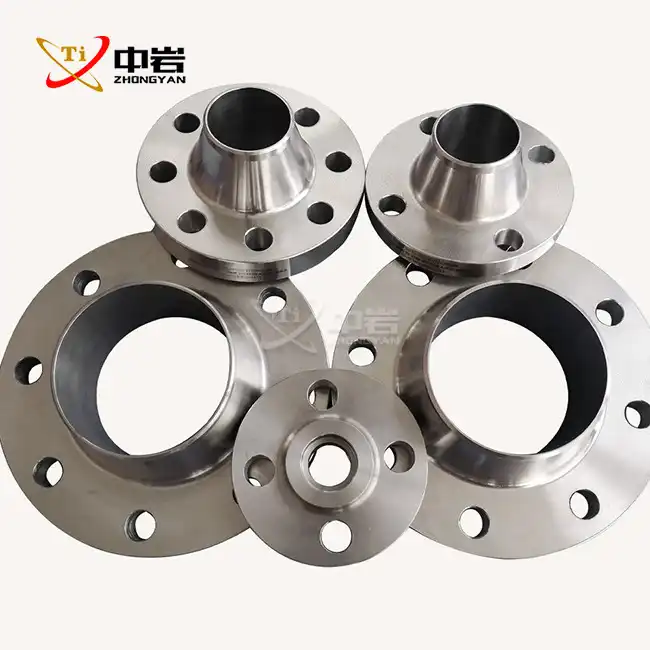
Titanium flanges make systems last a lot longer because they are very resistant to rust, have a high strength-to-weight ratio, and last a long time in harsh settings. Unlike other types of steel, these special parts create an inactive oxide layer that keeps them from breaking down in harsh chemical and marine environments. Its technology has natural qualities that make it last three to five times longer than standard materials. This means that less upkeep is needed and systems don't have to be shut down as often, which saves money in uses like aerospace and chemical processing.
Understanding Titanium Flanges and Their Role in Enhancing System Longevity
Titanium flanges are a huge step forward in the technology of pipe systems. They were designed to solve the problems of corrosion, weight, and longevity that plague traditional metal parts. The unique metallic qualities of titanium are used by these specialized joining parts to provide unmatched performance in harsh industrial settings.
Material Grades and Their Performance Characteristics
The quality of titanium used for pipe parts has a big effect on how well they work. Grade 2 titanium, which meets ASTM B363 standards, is very flexible and doesn't rust, which makes it perfect for moderate-pressure uses where chemical compatibility is very important. This commercially pure grade is very resistant to chloride stress corrosion cracking, which is a typical way for things to break in chemical processes and marine settings.
Grade 5 titanium metal (Ti-6Al-4V) has better mechanical qualities, with tensile strengths of up to 895 MPa, while still having the great corrosion resistance that makes titanium parts unique. This alpha-beta alloy structure has better wear resistance, which is important for systems that are loaded and unloaded over and over again, like those used in aircraft and power generation.
Comparison with Traditional Materials
Titanium parts are fundamentally different from other materials because of how they react to rust. Stainless steel is protected by chromium oxide, but titanium naturally forms a solid titanium dioxide layer that fixes itself when it gets broken, giving it constant defense against environmental attack.
Even though carbon steel flanges are cheaper at first, they break down quickly in acidic settings and need to be replaced often and maintained in a thorough way. When looking at the whole system's lifecycle, including costs for downtime, replacement, and upkeep work, the total cost of ownership study always favors titanium solutions.
Evaluating Titanium Flanges vs. Alternative Materials for Longer-lasting Systems
The choice of flange material has a big effect on the total reliability and cost of running the system. By learning about the performance traits of different materials, procurement workers can make smart choices that maximize long-term value instead of minimizing initial costs.
Corrosion Resistance Performance Analysis
Titanium is very resistant to rust because it can make a protective oxide film that doesn't change when the pH level changes. Even when chloride levels are higher than 10,000 parts per million, this inactive layer is very resistant to pitting and crevice corrosion. NACE International's independent testing shows that titanium keeps its structural integrity in places where stainless steel 316L is severely attacked in specific areas.
Ocean water, high temperatures, and pressure make marine uses especially difficult because normal materials break down faster when they are exposed to these circumstances. Titanium parts used in desalination plants have been shown to last more than 25 years without major rust damage. This is compared to the 5 to 8 years that super duplex stainless steel parts usually last in the same situations.
Economic Analysis and Return on Investment
The total cost of ownership study shows that titanium flanges save a lot of money over the life of the system, despite the higher original investment. Over the course of 15 years, a full study of chemical processing plants found that using titanium piping systems cut down on repair costs by 60% and got rid of the need for unexpected shutdowns caused by flange failures.
Titanium parts are also very light, which lowers the cost of installation because smaller cranes and other handling tools are needed for placing and putting them together. This edge in weight is especially important for offshore uses, where every kilogram affects the cost of building a platform and transporting it.
The Manufacturing Process and Specifications That Ensure Optimal Performance
Several steps are needed to make precision-engineered flanges from raw titanium. Each step is important for getting the great performance qualities that these parts are known for. When procurement workers understand these steps, they can better understand the value and quality standards that come with properly making titanium goods.
Forging and Heat Treatment Processes
The process of making something starts with choosing the titanium ingot. The chemistry and texture of the material have a direct effect on the qualities of the finished part. When metal is hot-forged at temperatures between 900°C and 1050°C, the grain structure of the metal lines up with the shape of the plate. This makes the best spread of strength and gets rid of any possible stress concentration points.
After forging, the heat treatment steps are carefully planned to get the desired mechanical qualities while keeping the resistance to rust. Annealing processes at 700°C to 750°C remove any remaining pressures and improve the structure of the alpha phase. This makes sure that the component works the same way across its entire cross-section.
Quality Control and Certification Standards
During the whole production process, strict quality control measures make sure that international standards are met. These include ASTM B381 for cast titanium parts and ASME B16.5 for size requirements. Ultrasonic screening, liquid penetrant testing, and X-rays are all examples of non-destructive testing methods that check for internal soundness and surface stability.
Material tracking systems keep track of every part from the time the raw materials are certified until they are inspected for quality control. They do this by keeping full records of the chemicals used, their mechanical properties, and the history of their production. This thorough approach to quality makes sure that performance is always the same and allows for root cause research in the rare event that service problems happen.
Customization Capabilities and Engineering Support
Modern companies that make titanium flanges can make a lot of changes to them to fit the needs of any purpose. Custom metal compositions, specialized surface processes, and non-standard measurements can be used to adapt to different working situations while still retaining the main benefits of titanium technology.
Engineering support services help with choosing the right materials, designing joints, and putting things together by giving advice that is specific to the application. This technical knowledge is very helpful for making sure that the system works well and that it fits in with other tools and pipe systems.
Procurement Insights: How to Source Titanium Flanges That Maximize System Life
To buy titanium parts successfully, you need to know about the global supply chain, quality standards, and seller skills that make up this niche market. Strategic decisions about where to get materials have a big effect on both how well the parts work and how much the whole project costs.
Global Supply Chain Considerations
There are a lot of suppliers in the titanium business, and most of the factories that make titanium products are in places that can get the raw materials and have the right skills to handle them. Baoji, China's titanium valley, has become a major production hub thanks to its easy access to sponge titanium and advanced manufacturing skills that allow it to serve markets around the world.
Instead of just looking at price, when evaluating a supplier, you should look at their production skills, quality systems, and expert support services. Companies that have been around for a long time and have experience with chemical processing and aircraft usually have the strictest quality standards and the best technical knowledge.
Lead Time Management and Inventory Strategies
When buying titanium flanges, you have to wait longer than with other materials because they need to be made in a special way and are harder to find. Standard setups usually take 8 to 12 weeks to deliver, while custom standards can take up to 16 to 20 weeks, based on how complicated they are and how many are needed.
One way to handle your inventory strategically is to keep a safety stock of common sizes and set up framework deals for special needs. Bulk buying often gets you better prices and makes sure that you have the materials you need for planned repair tasks.
Certification and Documentation Requirements
Each shipment should come with a full material approval package that includes records on chemical analysis, mechanical testing, and dimensional inspection. Third-party inspection services add another layer of security to important applications where a failed part could have major safety or business effects.
Traceability paperwork lets you keep track of parts throughout the lifecycle of a system and makes it easier to plan maintenance based on real service history instead of general suggestions.
Practical Benefits: Improving System Longevity with Titanium Flanges
Using titanium flanges makes a noticeable difference in how reliable a system is, how efficiently it works, and how much upkeep it needs in a wide range of industry settings. As a direct result, these benefits lead to higher profits and lower business threats.
Maintenance Frequency Reduction
Thanks to its extreme longevity, titanium doesn't need as much regular upkeep as other flange materials. Chemical processing plants say that switching to titanium parts cuts down on flange-related repair tasks by 70%, which leads to higher system uptime and higher production throughput.
Getting rid of corrosion-related failures also cuts down on the need for emergency fixes and unplanned shutdowns, which makes operations much more predictable and lowers the cost of upkeep.
Enhanced Safety Performance
The better mechanical qualities and resistance to corrosion of titanium parts make systems safer by lowering the chance of breakdowns that come up out of the blue. The material's high resistance to wear under cyclic loading conditions adds to its safety in dynamic settings like airplane systems and offshore platforms.
Titanium is biocompatible, which makes it a great material for processing food, making medicines, and systems that handle drinkable water, all of which need materials that are compatible with the process medium.
Operational Efficiency Improvements
Titanium parts are very light, which makes them easier to handle during installation and upkeep and lowers the load on supporting systems. In aerospace uses, where every kilogram saved helps improve fuel economy and payload capacity, this weight benefit is especially useful.
When maintenance needs are lower, resources can be used more efficiently, and plants are available more of the time, which improves total operating performance and profits.
Conclusion
Titanium flanges are an investment in the long-term success of a system because they are highly resistant to corrosion, have great strength-to-weight ratios, and last a long time in harsh conditions. Titanium components require a higher original investment, but they pay for themselves many times over through lower upkeep needs, longer service life, and higher operating efficiency. Titanium flanges are becoming more widely available for important uses where performance and dependability are crucial, thanks to modern production techniques and global supply chains.
FAQ
What factors determine the lifespan of titanium flanges in industrial systems?
There are a lot of important things that affect how long titanium flanges last, such as the working temperature, chemical exposure, pressure cycling, and the quality of the fitting. In marine settings, Grade 2 titanium flanges can last more than 20 to 25 years, and Grade 5 parts can work effectively for 15 to 20 years in high-stress aircraft uses. Long-term performance is greatly affected by using the right fitting methods and choosing gaskets that are suitable.
How do wait times for titanium flanges compare to those for other types of metals?
Getting a titanium flange usually takes 8–12 weeks for normal sizes, while getting a stainless steel version only takes 4–6 weeks. This longer schedule is because of the complex ways the product is made and the small number of suppliers available. Depending on how complicated they are and how many are needed, custom designs may take 16 to 20 weeks.
What are the differences in cost between special and normal titanium flanges?
Standard titanium flanges that meet ASME B16.5 standards usually cost 15 to 25 percent less than special designs because they are easier to make and use existing tools. If you need custom flanges with particular specs, special alloys, or non-standard surface treatments, the price may go up by 40 to 60 percent, but they will work better in certain situations.
Partner with Zhongyan for Premium Titanium Flange Solutions
Zhongyan Titanium is very good at making precision-engineered titanium flanges that make systems last longer by using high-quality materials and advanced processing techniques. Our wide range of products includes ones with diameters from 1" to 24" made of Grade 2 ASTM B363 material. They come in thicknesses of 10mm to 40mm and ANSI 150-600 pressure ratings, so they can be used in temperatures ranging from -196°C to 400°C. We are in Baoji's titanium valley, which means we have access to a lot of raw materials and the latest production technology. This lets us make parts of the highest quality that meet the strictest requirements. Our titanium flange options are very good at resisting corrosion in seawater and working with butt welds. This makes them perfect for use in marine, chemical processing, and aircraft applications. Get in touch with our technical team at sales@titaniumstudy.com to talk about your needs and find out why top makers trust Zhongyan as their provider.
References
1. ASTM International. "Standard Specification for Titanium and Titanium Alloy Forged Flanges." ASTM B381/B381M-22, 2022.
2. NACE International. "Corrosion Performance of Titanium Alloys in Marine and Chemical Processing Environments." NACE Technical Report, 2021.
3. American Society of Mechanical Engineers. "Pipe Flanges and Flanged Fittings: NPS 1/2 through NPS 24 Metric/Inch Standard." ASME B16.5-2020.
4. Materials Technology Institute. "Guidelines for Selection of Titanium Alloys in Chemical Process Industries." MTI Publication No. 89, 2020.
5. Offshore Technology Conference. "Titanium Components Performance in Subsea Applications: 25-Year Service Experience Analysis." OTC-31847-MS, 2021.
6. International Titanium Association. "Titanium Design Guidelines for Industrial Applications." ITA Technical Manual, 3rd Edition, 2022.
_1755652624199.jpg)

Learn about our latest products and discounts through SMS or email