- English
- French
- German
- Portuguese
- Spanish
- Russian
- Japanese
- Korean
- Arabic
- Greek
- German
- Turkish
- Italian
- Danish
- Romanian
- Indonesian
- Czech
- Afrikaans
- Swedish
- Polish
- Basque
- Catalan
- Esperanto
- Hindi
- Lao
- Albanian
- Amharic
- Armenian
- Azerbaijani
- Belarusian
- Bengali
- Bosnian
- Bulgarian
- Cebuano
- Chichewa
- Corsican
- Croatian
- Dutch
- Estonian
- Filipino
- Finnish
- Frisian
- Galician
- Georgian
- Gujarati
- Haitian
- Hausa
- Hawaiian
- Hebrew
- Hmong
- Hungarian
- Icelandic
- Igbo
- Javanese
- Kannada
- Kazakh
- Khmer
- Kurdish
- Kyrgyz
- Latin
- Latvian
- Lithuanian
- Luxembou..
- Macedonian
- Malagasy
- Malay
- Malayalam
- Maltese
- Maori
- Marathi
- Mongolian
- Burmese
- Nepali
- Norwegian
- Pashto
- Persian
- Punjabi
- Serbian
- Sesotho
- Sinhala
- Slovak
- Slovenian
- Somali
- Samoan
- Scots Gaelic
- Shona
- Sindhi
- Sundanese
- Swahili
- Tajik
- Tamil
- Telugu
- Thai
- Ukrainian
- Urdu
- Uzbek
- Vietnamese
- Welsh
- Xhosa
- Yiddish
- Yoruba
- Zulu
How Do GR5 Titanium Bars Support Long-Term Reliability?
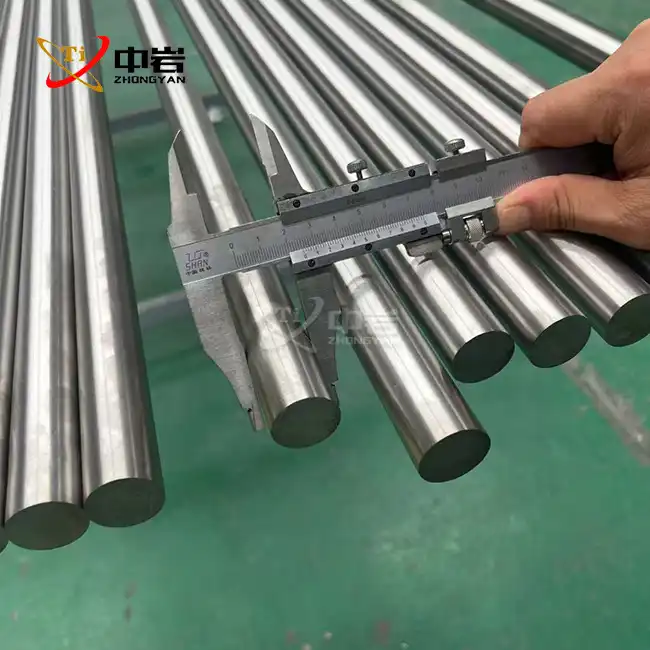
When purchasing managers and engineers look at materials for mission-critical uses, they ask one basic question: Will this material work reliably for years of hard work? The Ti-6Al-4V makeup of GR5 titanium bars gives a clear answer. It carefully mixes 6% aluminum and 4% vanadium with titanium to make an alloy with high tensile strength (>900 MPa), yield strength (>850 MPa), and resistance to wear. Because of this exact chemical balance, these bars will not break down much in harsh environments and will keep their shape even when they are loaded and unloaded many times. This makes them essential for parts of aerospace turbines, medical implants, and chemical processing equipment that can go wrong and cause terrible results.
Understanding the Core Properties That Ensure Long-Term Reliability
Ti-6Al-4V is known as the main titanium alloy because of the way its chemicals were designed to work together. Baoji Zhongyan Titanium Industry Co., Ltd. makes bars that meet ASTM B348 and ISO 5832-2 standards. The bars have an aluminum content of 5.5-6.75% and a vanadium content of 3.5-4.5%. This isn't just random chemistry; aluminum stabilizes the alpha phase while lowering its density, and vanadium increases the beta phase. Together, they make a dual-phase microstructure that has mechanical benefits that neither element could achieve by itself.
Superior Mechanical Properties Compared to Alternatives
Our 10mm circular bars show this technical benefit with specs that can be measured. These bars are 160% stronger than Grade 2 commercially pure titanium, with a tensile strength of 900 MPa and a yield strength of 850 MPa. They can be used in situations where pure titanium would break when put under stress. At 114 GPa, the modulus of elasticity is very close to that of human bone. This means that stress protection in hip implants is lessened, which is an important thing for medical device makers to think about if they want their implants to last a long time.
When the elongation number is ≥10%, it means that the material is still flexible even though it is very strong. This keeps it from breaking easily when it hits something. The hardness rating of HRC 36 means that the material is resistant to surface wear and can still be machined with carbide tools. These qualities stay the same at temperatures ranging from very cold (cryogenic) to very hot (400°C). This makes them useful for parts of jet engines that are heated and cooled thousands of times over the course of their life.
Corrosion Resistance in Aggressive Environments
Titanium naturally makes an oxide layer (TiO2) that sticks to itself and heals itself when it gets scratched in air. The addition of aluminum and vanadium to Grade 5 makes this passive film more stable in chloride-rich environments. This is why naval fasteners and offshore drilling equipment made from these bars have very little pitting or rust after decades of being exposed to seawater. The Ti-6Al-4V alloy stays strong in chemical processing plants that use nitric acid, organic solvents, and weak mineral acids, but stainless steel 316 rusts in seawater that doesn't move.
Manufacturing and Heat Treatment Approaches That Enhance GR5 Titanium Bars
We use vacuum arc remelting (VAR) at our Baoji plant, which is in China's Titanium Valley, to get rid of flaws and make sure that the ingot is chemically uniform throughout. This two-melt process makes a fine microstructure that is important for uses that need to be resistant to wear. Hot forging the ingots at temperatures between 900°C and 1050°C breaks up the cast structure and aligns the grain flow along the bar's lengthwise axis, which makes it tougher across the width.
Cold Drawing and Surface Finishing Techniques
For many uses, our cold-drawn bars can meet h9 accuracy levels (±0.025 mm for 10 mm diameter), so they don't need to be machined again. Adding cold work during drawing raises the yield strength by multiplying dislocations. However, heating later reduces leftover stresses while keeping most of the strength gain. The polished bright surface finish (Ra < 0.8µm) gets rid of the alpha case layer, which is a zone of oxygen-rich material that forms during hot working and can cause fatigue cracks to start if left alone.
Heat Treatment for Optimized Mechanical Properties
The ASTM B348 mill-annealed state is reached by heating the metal to 700–800°C for one to two hours and then cooling it in air. This treatment strikes a good mix between strength and ease of machining, making it perfect for parts that need a lot of CNC work. To do solution treatment and aging (STA), the material is heated to 950°C to dissolve the beta phase, quickly cooled, and then aged at 540°C to form tiny alpha lamellae inside the beta matrix. This process raises the tensile strength to 1100 MPa but lowers the ductility to 8% elongation. This is a fair trade-off for aircraft fasteners where final strength controls the design.
Comparing GR5 Titanium Bars With Alternative Alloys for Informed Procurement
When engineers choose materials that will last for a long time, they have to deal with a lot of different qualities, costs, and supply chain factors. Knowing how Ti-6Al-4V stacks up against other options makes it clear when the higher price is worth it for the better performance. GR5 titanium bars provide the necessary strength-to-weight ratio for most mission-critical systems.
Grade 5 Versus Other Titanium Alloys
Grade 2 commercially pure titanium is very resistant to rust and costs about 20% less per kilogram than Grade 5. Its yield strength of 275 MPa is enough for heat exchangers and tanks used in chemical processing, where rust is more important than mechanical loading. But aircraft structural parts and medical implants that carry weight need the 850 MPa yield strength that only alloyed types can provide.
Grade 9 (Ti-3Al-2.5V) is in the middle. It has a yield strength of 620 MPa and costs 15% less than Grade 5. This makes it a good choice for sports goods and bicycle frames. Grade 23 (Ti-6Al-4V ELI, Extra Low Interstitials) has less oxygen and iron, which makes it better for surgical implants in terms of how hard it is to break and how easily it can be shaped. However, the material costs 30% more because of tighter chemistry rules. When procurement teams have to balance performance needs with budget limits, they should check to see if the application really needs Grade 5's full strength or if a cheaper grade meets the needs.
Titanium Alloy Versus Steel and Aluminum
Titanium is better than other metals when density-normalized qualities are compared. Specific strength (strength/density) is a number that aerospace engineers use to find the lightest possible airframe. Grade 5 has a density of 4.43 g/cm³, while steel has a density of 7.85 g/cm³. It also has a specific strength of 203 kN·m/kg, while high-strength steel only has a specific strength of 140 kN·m/kg. Over the 30-year working life of an airplane, this 45% improvement immediately lowers the amount of fuel it uses.
Even though aluminum 7075-T6 has a yield strength of 572 MPa and a mass of only 2.81 g/cm³, it corrodes when mixed with metals that are not the same and cannot handle high temperatures. Manufacturers of airplanes learned many years ago that aluminum parts need to be inspected and replaced all the time, while titanium landing gear parts can usually handle 20,000 or more landing rounds with little wear and tear. The higher cost of the material at first (Grade 5 costs $35–45/kg on average, compared to $8–12/kg for aluminum 7075) is spread out over a longer working life and less upkeep.
Supply Chain Considerations for B2B Procurement
Minimum order numbers (MOQ) have a big effect on the total cost of buying something. Standard mill runs for special metals like Ti-6Al-4V usually need at least 500 kg of material. Zhongyan can do smaller special runs starting at 100 kg by using our local network of titanium sponge suppliers. However, the cost per kilogram goes up by 15-20% for orders that are less than the minimum order quantity (MOQ). Lead times change with the seasons. Standard diameters (10 mm, 16 mm, and 25mm) ship within 4 to 6 weeks, but special diameters or unusual surface styles take 8 to 12 weeks because they need to be made in large batches.
Those in charge of purchasing and just-in-time inventory systems should make multi-year framework deals with suppliers to lock in prices while still allowing for freedom in call-off amounts. Our sales team (sales@titaniumstudy.com) sets up deals that allow for quarterly releases and yearly contracts. This keeps your material costs stable and makes sure you have access when supplies are low.
Real-World Applications Demonstrating Long-Term Reliability of GR5 Titanium Bars
Material standards are more reliable when they have been proven to work in demanding businesses for decades. The following uses show how GR5 titanium bars provide real benefits in terms of stability and performance.
Aerospace Structural and Engine Components
Each commercial airplane engine has more than 1,500 kg of titanium alloys in it. Grade 5 bars are made into the compressor blades, turbine disks, and bolts. Over the life of the engine, these parts will be heated and cooled 15,000 to 25,000 times, going from -55°C at cruise altitude to 400°C near the combustion chamber. Testing Grade 5's fatigue at 110% of its design stress shows that it can go through more than 10^7 cycles without cracking, which is longer than aluminum and nickel metals of the same weight.
Ti-6Al-4V is used by aircraft makers to make landing gear parts and wing attachment pieces. When a big airframer found wear cracks in aluminum wing spars after 35,000 flight hours, they replaced the fittings with titanium ones, which fixed the problem. The parts have now been used for over 90,000 hours without any crack growth being seen. This record of success in the field gives procurement managers peace of mind when they are choosing materials for planes that will be used for 25 to 30 years.
Medical and Dental Implant Longevity
In the United States, orthopedic doctors put in more than a million hip and knee prostheses every year, and patients expect them to last 20 years or more. These goals for long-term use are met by femur stems that have Grade 5 bars made into them. This is because they are biocompatible and mechanically compatible. When compared to cobalt-chrome alloys (230 GPa modulus), this material's 114 GPa modulus lowers stress shielding. This keeps bone density around the implant high and lowers the rate of aseptic release.
Dental implant makers make abutments out of bars with a width of 8 to 12mm and thread them so they can hold ceramic caps. Studies that followed implants for 15 years found that 96–98% of them survived when titanium abutments were used. This is compared to 89–92% for other materials that are more likely to rust or break. The oxide layer's ability to stay stable in the mouth, where it is subject to germs, acidic foods, and repeated loading, shows that the material is suitable for long-term human use.
Marine and Chemical Processing Equipment
After looking at how often they failed, offshore oil platforms switched from 17-4PH stainless steel screws to Grade 5 titanium fasteners in high-stress subsea uses. In sour gas settings (H2S present), stainless screws showed stress corrosion cracking and needed to be replaced every 24 to 36 months. Titanium screws now usually last longer than 10 years between services. This lowers the cost of upkeep and gets rid of the risk of leaks at important flanged connections.
Chemical companies that work with chlorine solvents found that Grade 2 titanium tanks sometimes cracked from stress corrosion at weld heat-affected areas. When high-stress parts like agitator shafts and pump cases were upgraded to Ti-6Al-4V, cracking stopped happening because the alloy's higher strength lowers working stress levels below the level needed for environmental cracking. These tests done in the real world show that the choice of material has a direct effect on operating efficiency and the total cost of ownership.
Procuring GR5 Titanium Bars – Best Practices for B2B Buyers
It's not enough to just compare price quotes; you also need to look at the skills of the suppliers, how strict their certifications are, and whether they offer value-added services that lower project risks. Managing the supply of GR5 titanium bars effectively ensures that project timelines and quality standards are maintained.
Evaluating Supplier Certifications and Traceability
Every bar package should have an EN 10204 3.1 Mill Test Certificate that shows the chemical make-up using optical emission spectroscopy and the mechanical qualities obtained by tensile testing of real production material. Each bar has a heat tracking code stamped on it that lets it be linked to a specific ingot lot. This is very important if testing after delivery finds problems. Our quality management system meets foreign standards because Zhongyan keeps its ISO 9001:2015 certification and goes through yearly audits.
Negotiating Custom Specifications and Volume Pricing
Standard mill limits for width are usually within ±0.5mm, which is fine for most tasks that need to be machined later. Cold-drawn precision bars can meet h9 standards (±0.025mm for 10mm diameter), but they cost 25–35% more because they need to be processed more. Check to see if your CNC processes can handle standard specs. Save precision grades for parts that need very little stock removal.
Managing Delivery Timelines and Inventory Strategies
Global supply lines are sometimes interrupted by things like pandemic-related delays in transportation and geofeedstock supply limits. These risks can be lessened by using safety stocks and a variety of suppliers in smart buying strategies. Keeping 60 to 90 days' worth of critical-path materials, like titanium bars, in stock saves production schedules in case of sudden demand spikes that make supplier wait times go from 6 weeks to 12 weeks.
Conclusion
For engineering materials to be reliable over time, they need to have proven chemistry, strict production controls, and performance that has been tested in the field across a wide range of difficult uses. GR5 titanium bars are reliable because they have the best mix of strength, resistance to rust, and endurance over time. Other materials can't match this at the same weight. It's helpful to know not only the qualities of the material but also the skills of the seller, the licensing standards, and strategic sourcing methods that keep the total cost of ownership as low as possible when making purchasing choices. This metal is used in the aircraft, medical, and chemical processing industries because it has been reliable for decades, and failure is not an option.
FAQ
What distinguishes GR5 titanium from commercially pure grades?
Grade 5 is an alpha-beta titanium alloy (Ti-6Al-4V) that has aluminum and vanadium added to it. These metals raise the tensile strength to 900+ MPa, which is almost three times the yield strength of Grade 2 titanium, which is only 345 MPa. Because GR5 titanium bars are stronger, they can be used for solid aircraft parts and load-bearing medical implants where pure titanium would deform when put under stress.
Can these bars be joined together without making them less strong?
When welding Ti-6Al-4V, an inert gas covering (argon or helium) must be used throughout the join zone and while the metal is cooling to keep oxygen and nitrogen from absorbing and weakening it. When TIG, electron beam, or friction welding is done correctly, the joints reach 85-95% of the strength of the base metal. Controlling heat input stops grains from getting bigger, which lowers fatigue resistance.
What effect does surface finish have on performance over time?
The alpha case layer that forms during hot working has high levels of oxygen (0.5-0.8%), which makes the surface weak and easy for wear cracks to start. By centerless grinding or chemical milling this layer off, the homogeneous metal below can be seen. This increases the fatigue life by 30-50% in high-cycle uses like turbine blades and landing gear.
How do inspections make sure that the quality inside is good?
Ultrasonic testing finds holes, inclusions, or laminations inside materials that are bigger than 0.5mm in diameter and could cause stress cracks. Near-surface flaws can be found with eddy current inspection, and surface-breaking cracks can be found with fluorescent penetrant tests. Most of the time, aerospace and medical uses need 100% volumetric ultrasonic inspection, which is spelled out in quality certificates.
Partner With a Trusted GR5 Titanium Bar Supplier for Your Critical Applications
Zhongyan is located in Baoji, which is the center of China's titanium industry. This gives them direct access to high-quality titanium sponge and state-of-the-art working facilities. Our vertically integrated processes include vacuum arc remelting, rotary forging, cold drawing, and precise CNC machining. This lets us customize materials completely, from the ingot to the finished part. Whether you need 10mm diameter bars that meet ISO 5832-2 for medical devices or large-diameter stock for aerospace structural parts, our engineering team works together to come up with specs that will give you the best performance for your needs. Contact our purchasing agents at sales@titaniumstudy.com to talk about your needs, ask for Mill Test Certificates for recent production lots, or set up plant checks to prove that we can make what you need. As the top company that makes GR5 titanium bars, we're dedicated to helping your project succeed by providing high-quality materials and quick expert support.
References
1. Boyer, R., Welsch, G., & Collings, E. W. (1994). Materials Properties Handbook: Titanium Alloys. ASM International, Materials Park, Ohio.
2. Lütjering, G., & Williams, J. C. (2007). Titanium (2nd Edition). Springer-Verlag, Berlin, Heidelberg.
3. Donachie, M. J. (2000). Titanium: A Technical Guide (2nd Edition). ASM International, Materials Park, Ohio.
4. Peters, M., Kumpfert, J., Word, C. H., & Leyens, C. (2003). Titanium Alloys for Aerospace Applications. Advanced Engineering Materials, 5(6), 419-427.
5. Niinomi, M. (2008). Mechanical Biocompatibilities of Titanium Alloys for Biomedical Applications. Journal of the Mechanical Behaviour of Biomedical Materials, 1(1), 30-42.
6. ASTM International. (2022). ASTM B348-22: Standard Specification for Titanium and Titanium Alloy Bars and Billets. West Conshohocken, Pennsylvania.
(1)_1755587348264.jpg)
Learn about our latest products and discounts through SMS or email