- English
- French
- German
- Portuguese
- Spanish
- Russian
- Japanese
- Korean
- Arabic
- Greek
- German
- Turkish
- Italian
- Danish
- Romanian
- Indonesian
- Czech
- Afrikaans
- Swedish
- Polish
- Basque
- Catalan
- Esperanto
- Hindi
- Lao
- Albanian
- Amharic
- Armenian
- Azerbaijani
- Belarusian
- Bengali
- Bosnian
- Bulgarian
- Cebuano
- Chichewa
- Corsican
- Croatian
- Dutch
- Estonian
- Filipino
- Finnish
- Frisian
- Galician
- Georgian
- Gujarati
- Haitian
- Hausa
- Hawaiian
- Hebrew
- Hmong
- Hungarian
- Icelandic
- Igbo
- Javanese
- Kannada
- Kazakh
- Khmer
- Kurdish
- Kyrgyz
- Latin
- Latvian
- Lithuanian
- Luxembou..
- Macedonian
- Malagasy
- Malay
- Malayalam
- Maltese
- Maori
- Marathi
- Mongolian
- Burmese
- Nepali
- Norwegian
- Pashto
- Persian
- Punjabi
- Serbian
- Sesotho
- Sinhala
- Slovak
- Slovenian
- Somali
- Samoan
- Scots Gaelic
- Shona
- Sindhi
- Sundanese
- Swahili
- Tajik
- Tamil
- Telugu
- Thai
- Ukrainian
- Urdu
- Uzbek
- Vietnamese
- Welsh
- Xhosa
- Yiddish
- Yoruba
- Zulu
GR2 Titanium Round Bar: Excellent Weldability and Formability Explained
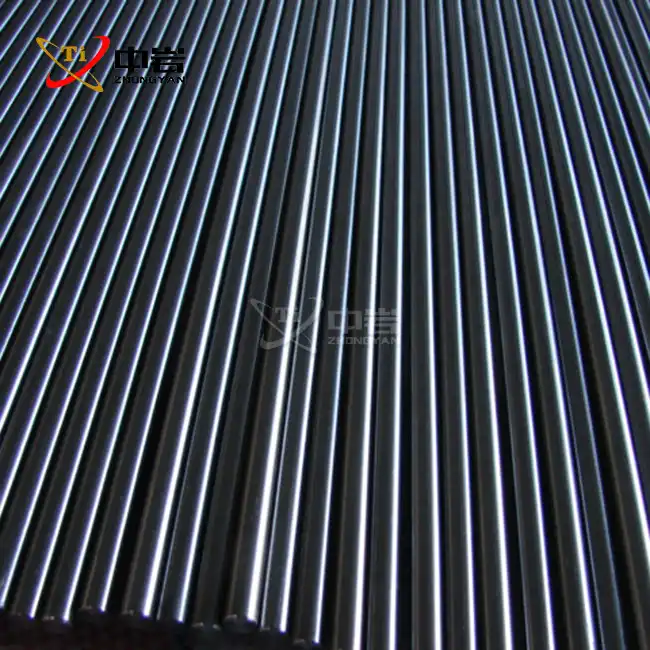
Gr2 titanium round bar: commercially pure titanium round bars are always the best choice when engineers and purchasing managers are looking for materials that can stand up to harsh conditions. These bars are very valuable because they are very easy to weld and shape, which are two important factors that directly affect how well they are made and how long they last. Zhongyan has spent years improving the process of making ASTM B348 Grade 2 titanium round bars. We now offer goods that meet strict international standards and are still affordable. When buying teams know about the technical benefits of Grade 2 titanium, they can make choices that meet both performance needs and economic limits.
Understanding GR2 Titanium Round Bar Properties
Chemical Composition and Purity Standards
Chemicals are very important for making sure that any high-quality Grade 2 titanium round bar works well. Zhongyan's production process makes sure that every bar meets the requirements of ASTM B348 and is mostly made of pure titanium with carefully controlled stray elements. Oxygen levels stay below 0.25%, iron levels stay below 0.30%, carbon levels stay below 0.08%, and nitrogen levels stay below 0.03%. This careful control over makeup ensures consistent performance in a wide range of settings. The high level of purity directly leads to better rust resistance, especially when parts are exposed to oxidising acids, chloride solutions, or marine settings. We use Optical Emission Spectroscopy (OES) and Inert Gas Fusion (IGF) tests to make sure that hydrogen levels stay below 0.015% as part of our quality control process. This is a very important level that stops cracks from happening later on during service.
Mechanical Performance Characteristics
When made at our Baoji plant, Grade 2 titanium round bars have tensile strengths of at least 900 MPa and yield strengths of more than 850 MPa. Because of these mechanical qualities, the material is a great choice for structural uses that need to be able to reliably hold loads. A stretch percentage of at least 10% means that the material is flexible enough to be shaped, and a hardness grade of HRC 36 means that it won't wear down easily in tough working conditions. Our cold-drawn and annealed bars keep their dimensions within h9 error levels, which is exactly what CNC cutting operations need. The density of 4.43 g/cm³ supports designs that need to be light, and the elastic stiffness of 114 GPa makes sure that the dimensions stay stable when the material is stressed. With these qualities together, you get a material that works the same way in cold temperatures as it does in hot temperatures.
Corrosion Resistance in Industrial Environments
One of the main reasons buying teams choose Grade 2 titanium round bars is that they are very resistant to chemical attack. The substance creates a solid, adhesive oxide layer that fixes itself when it gets broken, keeping it safe from chemical breakdown. In places where stainless steels and other alloys break down quickly, like the ocean, high amounts of nitric acid, and wet chlorine atmospheres, these metals have performed exceptionally well. This protection from rust means that the product will last longer and cost less to maintain. Parts made from our titanium round bars are often used in chemical processing equipment, heat exchangers, and marine buildings for decades without any problems. The fact that the material doesn't mix with anything else makes it good for making medicines and processing food, where contamination is a big problem.
Comparing GR2 Titanium Round Bar with Other Materials
GR2 Versus GR5 Titanium Alloys
One of the main reasons buying teams choose GR2 titanium round bar is that they are very resistant to chemical attack. The substance creates a solid, adhesive oxide layer that fixes itself when it gets broken, keeping it safe from chemical breakdown. In places where stainless steels and other alloys break down quickly, like the ocean, high amounts of nitric acid, and wet chlorine atmospheres, these metals have performed exceptionally well. This protection from rust means that the product will last longer and cost less to maintain. Parts made from our titanium round bars are often used in chemical processing equipment, heat exchangers, and marine buildings for decades without any problems. The fact that the material doesn't mix with anything else makes it good for making medicines and processing food, where contamination is a big problem.
Stainless Steel and Aluminum Comparisons
When you compare titanium round bars to other materials, you can see that they have clear lifecycle benefits. Even though 316 stainless steel is cheaper at first, it can't hold up against rust as well as Grade 2 titanium in places that are high in salt or acidic. The titanium option stops pitting and pocket rust, which is a common problem in stainless steel systems that leads to early component replacement. When compared to aluminium, titanium keeps its strength better at high temperatures and is less likely to crack from stress or rust. Our titanium bars have a mass that is in the middle of aluminium and steel. This makes them a good choice for designs that want to save weight. When you add up the total cost of ownership, which includes installation, upkeep, and repair costs, Grade 2 titanium round bars are often cheaper in the long run than choices that seemed cheaper at first.
Certification and Quality Assurance Considerations
When choosing a provider, you need to look at certifications that prove the materials are compliant and the manufacturing is consistent. Our factory keeps its ISO 9001:2015 certification, which shows that we handle quality in a planned way throughout the whole production process. Material test records (MTRs) are sent with every package of titanium round bars. These reports show the bars' chemical make-up, mechanical qualities, and heat treatment conditions. We follow the rules set by ASTM B348 and ISO 5832-2, and we can track our products all the way back to the source of the titanium sponge. This paperwork is very important if your parts need to be qualified for use in aircraft (AMS standards), medical devices (ASTM F67), or pressure vessels (ASME SB-348). Managers in charge of buying things should make sure that sellers give them real certifications instead of general paperwork that hasn't been checked by a third party.
Machining, Welding, and Fabrication of GR2 Titanium Round Bars
Optimising Machining Parameters
To machine commercially pure titanium round bars, you need to know that the material tends to work-harden and doesn't conduct heat very well. We at Zhongyan have created CNC cutting protocols that take these features into account. These protocols use sharp carbide or polycrystalline diamond (PCD) tools with positive rake angles. Cutting speeds stay modest, usually between 50 and 80 meters per minute, and there is a steady flow of coolant to keep the machine from getting too hot.
Titanium deforms more easily than steel during cutting because it has a low amount of elasticity. This means that the work must be held rigidly and the leftover lengths must be cut. Our machinists use climb grinding to keep the surface from getting too hard from use, which keeps the measurements accurate. Our cold-drawn bars have an H9 tolerance, which means that less material needs to be removed. This cuts down on production processes and increases tool life.
To keep rust protection, it is important to avoid pollution during cutting. We use special tools for working with titanium and make sure that the cutting fluids don't contain any chlorine chemicals. Cleaning after cutting with alkaline solutions and then acid pickling gets rid of any smeared metal layer and restores the protective oxide film that keeps the metal from rusting.
Welding Techniques and Quality Control
Grade 2 titanium round bars are very easy to weld, which is a big benefit for production. The best way to weld is still with tungsten inert gas (TIG), which allows for exact heat control and a low risk of contamination. We use 99.99% pure argon shielding gas on both the weld face and the root side to keep air and nitrogen from picking up and weakening the joint.
In our welding processes for GR2 titanium round bar, the temperatures between passes must be less than 150°C to keep the grain growth in the heat-affected zone from getting too big. When joining bars to make longer pieces or putting together parts, it's very important to keep things clean. Before welding can start, the surface must be cleaned chemically or mechanically to get rid of any oils, fingerprints, or metal layers that are on it.
During the post-weld check, the welds are looked at visually for discolouration. Welds that have been properly protected have a silver to light straw colour, while blue or grey tones show contamination that needs to be cleaned up. We use directed bend tests according to ASTM E190 to make sure the joints are flexible. The tests must be able to bend 180 degrees without cracking. Radiographic or ultrasound testing can find internal breaks in serious situations where the quality of the weld directly affects safety.
Enhancing Formability Through Temperature Control
Grade 2 titanium round bars are very easy to weld, which is a big benefit for production. The best way to weld is still with tungsten inert gas (TIG), which allows for exact heat control and a low risk of contamination. We use 99.99% pure argon shielding gas on both the weld face and the root side to keep air and nitrogen from picking up and weakening the joint.
In our welding processes, the temperatures between passes must be less than 150°C to keep the grain growth in the heat-affected zone from getting too big. When joining bars to make longer pieces or putting together parts, it's very important to keep things clean. Before welding can start, the surface must be cleaned chemically or mechanically to get rid of any oils, fingerprints, or metal layers that are on it.
During the post-weld check, the welds are looked at visually for discolouration. Welds that have been properly protected have a silver to light straw colour, while blue or grey tones show contamination that needs to be cleaned up. We use directed bend tests according to ASTM E190 to make sure the joints are flexible. The tests must be able to bend 180 degrees without cracking. Radiographic or ultrasound testing can find internal breaks in serious situations where the quality of the weld directly affects safety.
Procurement Guide for GR2 Titanium Round Bars
Evaluating Supplier Capabilities and Standards
Assessing a supplier's manufacturing skills and quality processes is the first step in a successful buying process. Being close to China's main titanium resources helps our Baoji plant be vertically integrated from getting raw materials to delivering produced goods. This geographical benefit cuts down on wait times and makes sure that materials are always available, even when there are problems in the supply chain.
When looking at possible providers, make sure they follow international standards like ASTM B348 for guidelines on size and makeup and ISO 5832-2 for medical-grade uses. As part of our production tools, we have precise cold drawing machines that keep the dimensions of each bar within h9 limits along its whole length. With our bright, shiny surface finish, you don't have to do any extra work, which lowers the total cost of production.
Understanding Pricing Models and MOQ Requirements
Titanium round bar prices depend on many things, such as the cost of raw materials, how hard the production process is, and how many bars are ordered. Because of the savings of scale in manufacturing and transportation, Zhongyan's price system gives better deals for larger orders. Based on current market rates, the fact that 10mm diameter bars weigh about 2.5 kg per metre helps you figure out how much the materials will cost.
There are different minimum order amounts based on the size and finish needs. Standard sizes, like our 10mm circle by 1000mm length bars, have lower MOQs than special sizes, which need specific production runs. We keep a stock of widely requested sizes so that we can ship quickly for pressing needs and have the ability to make custom sizes for unique uses.
Customisation Options and Technical Support
Beyond standard dimensions, we offer extensive customisation to meet specific application requirements. Our CNC machining capabilities enable production of complex geometries directly from round bar stock, including threaded sections, reduced diameter areas, and precision-turned surfaces. This integrated manufacturing approach reduces your supply chain complexity by providing finished or semi-finished components rather than raw material requiring extensive secondary processing.
Surface treatment options extend beyond the standard bright finish to include chemical milling for weight reduction, anodising for colour coding, or specialised coatings for enhanced performance. Our engineering team collaborates with your designers during the specification phase, offering material selection guidance and manufacturing feasibility assessments that optimise both performance and cost.
Applications and Future Trends of GR2 Titanium Round Bar
Aerospace and Defense Applications
The aerospace industry represents a major consumer of GR2 titanium round bar, utilising the material in airframe components, hydraulic system fittings, and fastener production. The combination of low density, corrosion resistance, and reliable mechanical properties makes these bars ideal for weight-critical applications where performance cannot be compromised. Our manufacturing processes meet the rigorous quality standards required for aerospace suppliers, with full traceability and documentation supporting component qualification. Recent developments in commercial space exploration have expanded demand for titanium components capable of withstanding extreme temperature cycling and corrosive propellant exposure. The excellent weldability of Grade 2 material facilitates fabrication of complex assemblies including propellant tanks, pressure vessels, and structural brackets. We've supported several aerospace manufacturers in transitioning from machined forgings to fabrications using our welded titanium round bars, reducing both material waste and production timelines.
Medical and Dental Device Manufacturing
Biocompatibility makes Grade 2 titanium the material of choice for surgical instruments, orthopaedic implants, and dental applications. Our bars conform to ASTM F67 specifications for surgical implant materials, with controlled interstitial content ensuring osseointegration compatibility. The non-magnetic characteristic proves essential for instruments used in MRI environments, while the corrosion resistance withstands repeated sterilisation cycles without degradation. Dental milling centres increasingly specify our precision-drawn round bars for producing custom implant abutments and prosthetic frameworks. The combination of machinability and biocompatibility enables same-day restorations that meet both functional and aesthetic requirements. We work closely with medical device manufacturers to provide material certifications satisfying FDA regulatory submissions and international medical device standards.
Chemical Processing and Marine Engineering
Chemical processing facilities rely on Grade 2 titanium round bars for fabricating corrosion-resistant components including pump shafts, valve stems, and heat exchanger tubes. The material's immunity to chloride stress corrosion cracking prevents the catastrophic failures common with stainless steels in these environments. Our bars enable fabrication of replacement parts that extend equipment service life far beyond original designs, justifying the material investment through reduced maintenance costs. Marine engineering applications benefit from titanium's resistance to seawater corrosion and biofouling. Propeller shafts, rudder stocks, and subsea fasteners manufactured from our round bars deliver decades of reliable service without the galvanic corrosion issues plaguing dissimilar metal assemblies. The growing offshore renewable energy sector increasingly specifies titanium components for wave energy converters and tidal turbines where maintenance access is limited and reliability paramount.
Emerging Trends in Sustainable Manufacturing
Environmental considerations drive growing interest in titanium's recyclability and lifecycle sustainability. Grade 2 titanium round bars can be fully recycled without property degradation, supporting circular economy initiatives in manufacturing. We've implemented scrap recovery programs that return machining chips and defective parts to the production cycle, reducing raw material consumption and environmental impact.
Advances in additive manufacturing create hybrid opportunities where our round bars serve as feedstock for wire-arc additive processes, building large structures with reduced material waste compared to subtractive machining. This technology particularly suits low-volume, high-complexity components in aerospace and medical applications. We're actively developing material specifications optimised for these emerging fabrication methods while maintaining the quality standards expected from traditionally manufactured products.
Conclusion
Grade 2 titanium round bars represent a strategic material choice for applications demanding exceptional weldability, formability, and corrosion resistance. The combination of commercially pure composition, precisely controlled mechanical properties, and manufacturing versatility enables solutions across diverse industries from aerospace to chemical processing. Understanding the technical characteristics, fabrication requirements, and procurement considerations outlined here empowers engineering and purchasing teams to specify these materials confidently. As manufacturing trends emphasise sustainability and lifecycle cost optimisation, the inherent advantages of Grade 2 titanium position it for expanding adoption. Partnering with experienced manufacturers who maintain rigorous quality standards and provide comprehensive technical support ensures successful implementation of titanium solutions in your critical applications.
FAQ
What makes GR2 titanium round bars easier to weld than other titanium grades?
Grade 2 commercially pure titanium contains minimal alloying elements compared to grades like Ti-6Al-4V, eliminating concerns about intermetallic phase formation during welding. This compositional simplicity allows welding with standard TIG equipment and argon shielding, without requiring complex post-weld heat treatments. The resulting joints exhibit ductility matching the base material, supporting applications where weld integrity is critical.
How can I verify the authenticity of supplier certifications for titanium round bars?
Authentic material certifications include specific heat lot numbers, detailed chemical composition analysis from accredited laboratories, and mechanical test results from samples taken during production. Request certifications bearing laboratory accreditation marks (ISO 17025) and verify heat numbers match markings on the material. Reputable suppliers like Zhongyan provide traceable documentation extending back to the original titanium sponge producer, with third-party verification available upon request.
What customisation options are available for GR2 titanium round bars?
Customisation extends beyond standard dimensions to include precision machining, custom length cutting, specialised surface finishes, and heat treatment modifications. Our facility produces bars from 3mm to 300mm diameter with lengths up to 6000mm, accommodating both prototype quantities and production volumes. We offer turned, ground, or polished surfaces depending on your application requirements, with dimensional tolerances tightened to h8 or h7 when specified.
Partner with Zhongyan for Your GR2 Titanium Round Bar Requirements
Zhongyan stands ready to support your titanium procurement needs with manufacturing expertise rooted in China's premier titanium production region. Our advanced CNC machining capabilities, rigorous quality control systems, and commitment to international standards make us the reliable GR2 titanium round bar supplier your projects demand. We understand that successful partnerships extend beyond material delivery to encompass technical collaboration, responsive communication, and flexible solutions addressing your unique requirements.
Located in Baoji—the heart of China's titanium industry—we leverage regional advantages in raw material access and specialised manufacturing knowledge to deliver competitive pricing without compromising quality. Our engineering team provides application-specific guidance, helping optimise material selection and fabrication approaches that reduce your total production costs. Contact our sales team at sales@titaniumstudy.com to discuss your specifications, request detailed technical datasheets, or arrange sample shipments for evaluation. We look forward to demonstrating how our gr2 titanium round bar for sale programs can enhance your product performance and manufacturing efficiency.
References
1. American Society for Testing and Materials. (2021). Standard Specification for Titanium and Titanium Alloy Bars and Billets (ASTM B348). West Conshohocken: ASTM International.
2. Donachie, M.J. (2000). Titanium: A Technical Guide (2nd Edition). Materials Park: ASM International.
3. International Organisation for Standardisation. (2018). Implants for Surgery – Metallic Materials – Part 2: Unalloyed Titanium (ISO 5832-2). Geneva: ISO.
4. Leyens, C. & Peters, M. (2003). Titanium and Titanium Alloys: Fundamentals and Applications. Weinheim: Wiley-VCH.
5. Lutjering, G. & Williams, J.C. (2007). Engineering Materials and Processes: Titanium (2nd Edition). Berlin: Springer-Verlag.
6. Schutz, R.W. & Watkins, H.B. (1998). Recent developments in titanium alloy application in the energy industry. Materials Science and Engineering A, 243(1-2), 305-315.
Learn about our latest products and discounts through SMS or email