- English
- French
- German
- Portuguese
- Spanish
- Russian
- Japanese
- Korean
- Arabic
- Greek
- German
- Turkish
- Italian
- Danish
- Romanian
- Indonesian
- Czech
- Afrikaans
- Swedish
- Polish
- Basque
- Catalan
- Esperanto
- Hindi
- Lao
- Albanian
- Amharic
- Armenian
- Azerbaijani
- Belarusian
- Bengali
- Bosnian
- Bulgarian
- Cebuano
- Chichewa
- Corsican
- Croatian
- Dutch
- Estonian
- Filipino
- Finnish
- Frisian
- Galician
- Georgian
- Gujarati
- Haitian
- Hausa
- Hawaiian
- Hebrew
- Hmong
- Hungarian
- Icelandic
- Igbo
- Javanese
- Kannada
- Kazakh
- Khmer
- Kurdish
- Kyrgyz
- Latin
- Latvian
- Lithuanian
- Luxembou..
- Macedonian
- Malagasy
- Malay
- Malayalam
- Maltese
- Maori
- Marathi
- Mongolian
- Burmese
- Nepali
- Norwegian
- Pashto
- Persian
- Punjabi
- Serbian
- Sesotho
- Sinhala
- Slovak
- Slovenian
- Somali
- Samoan
- Scots Gaelic
- Shona
- Sindhi
- Sundanese
- Swahili
- Tajik
- Tamil
- Telugu
- Thai
- Ukrainian
- Urdu
- Uzbek
- Vietnamese
- Welsh
- Xhosa
- Yiddish
- Yoruba
- Zulu
GR5 Titanium Foil vs Pure Titanium: What’s the Difference?
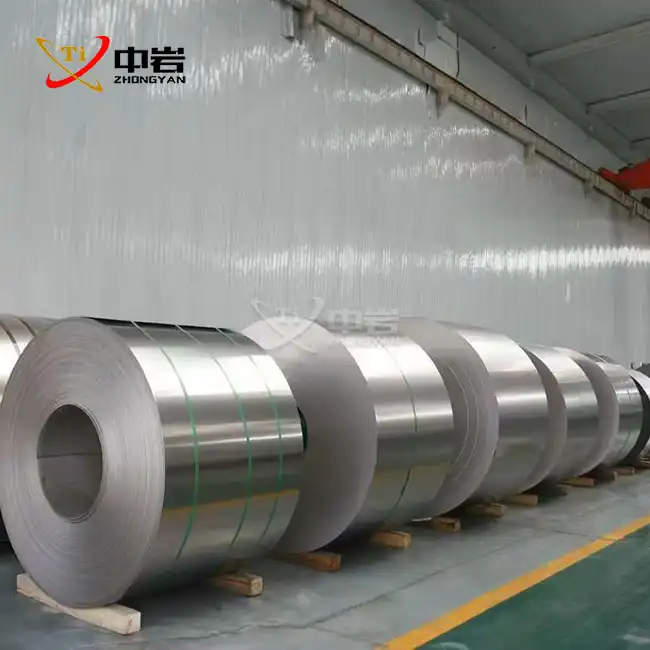
Because they are made of different chemicals, GR5 titanium foil and pure titanium are not at all the same when it comes to how well they work. One more name for GR5 titanium foil is Ti-6Al-4V. It is an alpha-beta metal that is made up of 6% aluminum and 4% vanadium. It's very strong for how light it is, and it can handle tension forces of over 895 MPa. Even though Grades 1-2 pure titanium foils are better at not rusting and being made, they are not as strong mechanically (usually between 240 and 345 MPa). GR5 is best for high-stress applications in airplanes and medicine, where structural integrity is very important. Pure titanium, on the other hand, works best in chemically aggressive environments, where rust protection is very important.
Understanding GR5 Titanium Foil and Pure Titanium Foil
Titanium foils are important building materials that are used in medicine, cars, and businesses because they are light and don't rust. It's important to know the difference between GR5 titanium foil and pure titanium foil when buying workers have to make decisions about where to get things that meet application needs and price limits.
Chemical Composition and Metallurgical Properties
GR5 titanium foil, whose formal name is Ti-6Al-4V, is made up of a lot of different metals. Titanium is the main metal, and copper, aluminum, and vanadium make it up. These elements make the metal harder and last longer when mixed together. They form an alpha-beta structure. The aluminum in the solid solution makes it stronger while also making it less dense. The beta phase is kept stable by the vanadium, which makes it easy to harden and keep its power at high temperatures.When people say "pure titanium foil," they usually mean varieties that are sold in stores and are very pure, like Grade 1 or Grade 2. These varieties have very few alloying elements. These types always have more than 99% titanium. They also have small amounts of iron, oxygen, nitrogen, and hydrogen. It is more immune to rust than GR5 types because it doesn't have any important alloying elements. However, it is not as strong mechanically.
Physical and Mechanical Property Differences
When the chemicals in a substance change, their physical and mechanical properties also change. This impacts the materials that can be used. Most pure titanium types have tensile strengths between 240 and 345 MPa. GR5 has tensile strengths between 895 and 930 MPa, which is a lot higher. Engineers can ask for smaller foil sizes while still making the building strong because of this difference in strength. The parts are lighter and the cost of the materials goes down.Between 0.025mm and 0.5mm thick, both materials can meet a lot of different needs in different industries. On the other hand, it's harder to make GR5 titanium foil because the metal is harder to form and rolls hard faster. These problems with working make prices go up, but they make things work better in tough scenarios.
Performance Comparison: GR5 Titanium Foil vs Pure Titanium Foil
The most important things that decide the choice of material for many uses in business are how well it works. When people who work in buying know about these changes in performance, they can choose the best materials for the job and the environment.
Mechanical Performance Under Stress
GR5 titanium foil demonstrates exceptional performance in demanding environments, particularly within aerospace and medical device applications where strength-to-weight ratios become critical design parameters. The metal doesn't lose its shape even after being loaded and unloaded many times, and it stays strong longer than pure titanium choices. It is necessary to use GR5 for high-frequency shaking, heat cycling, and focusing mechanical stress because it is stronger.Another great thing about GR5 titanium foil is that it protects against high temperatures. It can work at temperatures of up to 400°C without changing its mechanical features. Pure titanium grades might lose some of their qualities at high temperatures, but this type of titanium stays stable. It can be used in heat shields, engine parts, and high-temperature processing equipment.
Corrosion Resistance and Environmental Durability
Pure titanium foil excels in highly corrosive environments, maintaining exceptional integrity against oxidation, acidic exposure, and chemical attack. The absence of alloying elements eliminates potential galvanic corrosion sites, making pure grades ideal for chemical processing equipment, marine applications, and biomedical implants requiring maximum biocompatibility.To make these two materials, they go through many steps, such as rolling in a controlled atmosphere, cooling in a vacuum, and controlling the width very precisely. By following the ASTM B265 rules, you can be sure that all of your output runs will work the same way every time. Standardization of materials is made sure of with quality control methods such as chemical analysis, surface inspection, and mechanical testing.In the end, the environment, the specifics of the job, and how long the application needs to last determine whether GR5 or pure titanium foil is better. Cost-benefit studies need to look at more than just the materials' original price. They also need to look at how well they work over time, how often they need to be changed, and how much maintenance they need.
Application-Based Selection: Which Titanium Foil Suits Your Needs?
It's important to think about all of the goals, performance standards, and costs of the product when choosing which materials to use. To decide between GR5 titanium foil and pure titanium types, you need to carefully look at what the final product needs and how it will be used.
Aerospace and High-Performance Applications
Materials used in space need to be able to withstand tough conditions without losing too much weight. They can make structure parts, heat shields, and engine parts that are smaller without dropping safety standards because GR5 is harder than other materials. Because the metal is very strong for its weight, it is used in honeycomb structures on airplanes, where a failure of the material could be very bad.Satellite thermal barriers represent another critical application where GR5 titanium foil provides essential performance advantages. The cloth can handle quick changes in temperature from being in the sun to being in the shade and still keep its shape and size. Even though it costs more at first, GR5 is the best choice because of these things.
Medical Device and Biomedical Applications
Medical device manufacturing requires materials demonstrating exceptional biocompatibility, corrosion resistance, and mechanical reliability. GR5 titanium foil finds extensive use in implantable device casings, pacemaker housings, and neurostimulator shielding applications. The material's strength allows for thinner wall sections, reducing overall device volume while maintaining hermetic sealing capabilities essential for patient safety.Pure titanium grades excel in dental applications, surgical instrument manufacturing, and prosthetic components where maximum biocompatibility takes precedence over mechanical strength. The material's superior formability enables complex shaping operations required for anatomically matched implant surfaces.
Cost Assessment and Return on Investment
Economic evaluation must consider total lifecycle costs rather than initial material pricing alone. While GR5 commands premium pricing due to processing complexity, the material often delivers superior return on investment through extended service life, reduced maintenance requirements, and enhanced performance characteristics.Procurement professionals should evaluate factors including material utilization efficiency, processing yields, secondary operations requirements, and long-term reliability when comparing alternatives. Our experience demonstrates that aligning foil grade selection with both technical and financial considerations consistently optimizes client outcomes across diverse industrial contexts.
Procurement Guide for GR5 Titanium Foil and Pure Titanium Foil
If you want to buy titanium foil, you need to work with smart, qualified companies that can offer a wide range of services, quality certifications, and reliable supply chain management. Titanium is very hard to work with, so sources need to be carefully checked to make sure that the products are always of the same quality and that shipping times are always the same.
Supplier Qualification and Quality Assurance
People who make GR5 titanium foil should have advanced rolling skills, tools for processing in a controlled atmosphere, and full quality control methods in order to give you high-quality foil. Providers must follow international rules like ASTM B265, AMS specs, and ISO 9001:2015 quality control systems.Manufacturing areas like Baoji, which is known as China's Titanium Valley, are good places to buy things because of their location. There are a lot of experts there, raw materials are easy to get, and there are good places to handle the goods. There is better value for money in these specialized industrial areas because they have easier supply lines, technical help, and production sizes that are good.Protocols for quality assurance should include ways to check materials as they come in, make sure they've been approved, and confirm test results from outside sources. Suppliers you can trust will give you full test results on the material that explain its chemical make-up, mechanical properties, and surface quality needs. Third-party testing services give important apps that need higher quality assurance extra checks.
Technical Specifications and Customization Requirements
In the purchase specs, it must be clear what thickness limits, surface finish standards, and dimensional factors are needed for the product to work well. It is possible to work with GR5 titanium foil in thicknesses ranging from 0.025mm to 0.5mm, and the tolerance can be controlled to within 0.005mm through exact rolling methods.It is very important to know the specifications for the surface finish when it comes to direct contact with a patient, optical properties, or glue bonding. Suppliers who give customized surface treatments like passivation, electrolytic lightening, and mechanical cleaning are more valuable because they can carry out more tasks at once.Services that cut, pack, and protect things make it easier to buy things and reduce the amount of work that needs to be done later. With the help of OEM relationships, you can make specs, try prototypes, and figure out how to make goods that work best for certain uses.
Supply Chain Management and Logistics Considerations
It is important to keep track of minimum order amounts, wait times, and shipping plans so that you can balance the cost of goods with the safety of your supply. To make titanium foil, you need special tools and controlled working conditions, which change how capacity is used and how output is planned.Clear prices, good big deals, and flexible payment terms all help you save money while still getting more. Supply deals that last a long time keep prices fixed and make sure that capacity is used properly for high-volume uses that need to make sure materials are always available.Making sure all the right paperwork is filled out and the right packaging is used when sending things internationally is important to keep the items clean and dry during transit. Providers with a lot of experience give full transportation support, which keeps goods safe all along the supply chain.
Conclusion
The distinction between GR5 titanium foil and pure titanium grades fundamentally stems from their chemical composition and resulting performance characteristics. GR5 offers superior mechanical strength, temperature resistance, and durability ideal for aerospace and high-performance applications, while pure titanium provides maximum corrosion resistance and biocompatibility suited for chemical processing and medical device applications. Successful material selection requires comprehensive evaluation of application demands, environmental conditions, and economic considerations. Partnering with qualified suppliers offering quality certifications, customization capabilities, and reliable supply chain management ensures optimal procurement outcomes across diverse industrial applications.
FAQ
What makes GR5 titanium foil more expensive than pure titanium?
GR5 titanium foil commands premium pricing due to several manufacturing complexities. The alloy's reduced formability and higher work-hardening rates require specialized rolling equipment, frequent intermediate annealing cycles, and controlled atmosphere processing. These additional processing steps, combined with more expensive raw materials containing aluminum and vanadium, significantly increase production costs compared to pure titanium grades.
Can GR5 titanium foil be formed at room temperature?
Room temperature forming of GR5 titanium foil presents significant challenges due to the material's limited ductility and high springback characteristics. Cold forming operations are typically restricted to shallow draws and simple bending operations. Complex forming requirements usually necessitate elevated temperature processing or specialized tooling designs to compensate for springback and prevent cracking during deformation.
What thickness ranges are available for both materials?
Pure titanium foils can be produced in thicknesses ranging from 0.005mm to 0.5mm, with excellent thickness control throughout this range. GR5 titanium foil production typically begins at 0.025mm minimum thickness due to processing limitations, extending to 0.5mm maximum. Ultra-thin GR5 gauges below 0.025mm require specialized rolling techniques and command premium pricing.
How do I verify material quality upon delivery?
You should look at the test papers that the seller gives you when you check the material. These papers should list the material's chemical make-up, its mechanical qualities, and its measurements. To figure out how good something is, you should first look at the surface to see if it has any flaws, colors, or contamination. When the quality needs to be higher assured for important uses, independent testing services can do more tests, like checking the chemical makeup, tension testing, and microstructural examination.
Partner with Zhongyan for Premium GR5 Titanium Foil Solutions
If you need GR5 titanium foil, you can trust Zhongyan Titanium. They offer high-quality products that meet the strict needs of uses in medicine, industry, and airplanes. In Baoji, China's Titanium Valley, our cutting-edge plant has both high-tech tools for making things and strict quality control systems that make sure materials always work well and can be trusted. We can make a lot of changes to fit your needs, like controlling the thickness precisely, cutting to your specifications, and packing your order in a way that suits your needs. We test and approve all of our products that meet ASTM B265 standards many times. This gives you the peace of mind you need for important uses. Talk to our helpful staff at sales@titaniumstudy.com about your needs as a GR5 titanium foil supplier, and enjoy the benefits of working with a top titanium expert who is committed to getting the job done right.
References
1. Boyer, R. R., & Briggs, R. D. (2005). The use of β titanium alloys in the aerospace industry. Journal of Materials Engineering and Performance, 14(6), 681-685.
2. Donachie, M. J. (2000). Titanium: A Technical Guide, 2nd Edition. ASM International Materials Park.
3. American Society for Testing and Materials. (2019). ASTM B265-15 Standard Specification for Titanium and Titanium Alloy Strip, Sheet, and Plate. ASTM International.
4. Lütjering, G., & Williams, J. C. (2007). Titanium Engineering Materials and Processes, 2nd Edition. Springer Science & Business Media.
5. Rack, H. J., & Qazi, J. I. (2006). Titanium alloys for biomedical applications. Materials Science and Engineering: C, 26(8), 1269-1277.
6. Peters, M., Kumpfert, J., Ward, C. H., & Leyens, C. (2003). Titanium alloys for aerospace applications. Advanced Engineering Materials, 5(6), 419-427.
_1755591941325.jpg)
Learn about our latest products and discounts through SMS or email