- English
- French
- German
- Portuguese
- Spanish
- Russian
- Japanese
- Korean
- Arabic
- Greek
- German
- Turkish
- Italian
- Danish
- Romanian
- Indonesian
- Czech
- Afrikaans
- Swedish
- Polish
- Basque
- Catalan
- Esperanto
- Hindi
- Lao
- Albanian
- Amharic
- Armenian
- Azerbaijani
- Belarusian
- Bengali
- Bosnian
- Bulgarian
- Cebuano
- Chichewa
- Corsican
- Croatian
- Dutch
- Estonian
- Filipino
- Finnish
- Frisian
- Galician
- Georgian
- Gujarati
- Haitian
- Hausa
- Hawaiian
- Hebrew
- Hmong
- Hungarian
- Icelandic
- Igbo
- Javanese
- Kannada
- Kazakh
- Khmer
- Kurdish
- Kyrgyz
- Latin
- Latvian
- Lithuanian
- Luxembou..
- Macedonian
- Malagasy
- Malay
- Malayalam
- Maltese
- Maori
- Marathi
- Mongolian
- Burmese
- Nepali
- Norwegian
- Pashto
- Persian
- Punjabi
- Serbian
- Sesotho
- Sinhala
- Slovak
- Slovenian
- Somali
- Samoan
- Scots Gaelic
- Shona
- Sindhi
- Sundanese
- Swahili
- Tajik
- Tamil
- Telugu
- Thai
- Ukrainian
- Urdu
- Uzbek
- Vietnamese
- Welsh
- Xhosa
- Yiddish
- Yoruba
- Zulu
Can Titanium Blocks Be Used for Structural Load-Bearing Components?
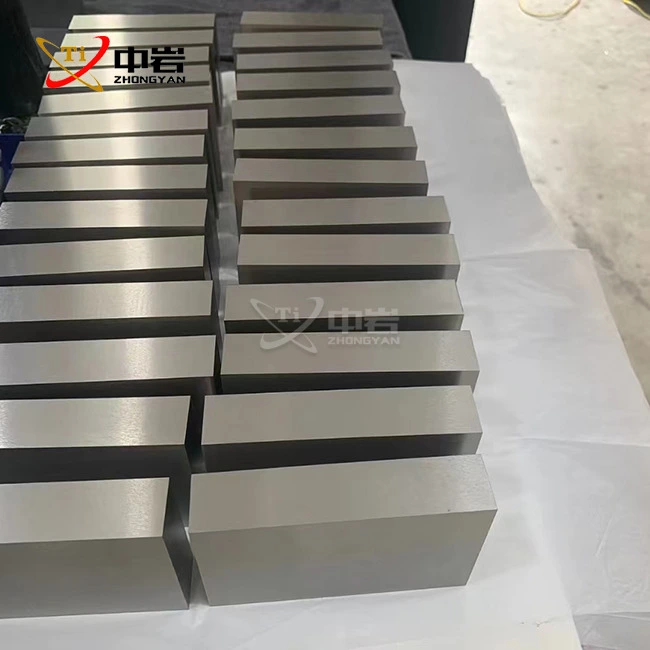
Titanium blocks work really well for structural load-bearing tasks in the medical, industrial, and aerospace environments. These dense, forged metal sections are stronger than steel for their weight, won't rust in harsh settings, and won't wear down over time, which is important for safety-critical parts. By using vacuum arc remelting and multi-directional forging, titanium blocks get a grain flow orientation that gets rid of internal holes. This solves important engineering problems where the failure of the material or casting porosity is too dangerous. Their successful use in wing extensions, orthopedic implants, and underwater pipelines shows that they can be used as high-quality building materials.
Introduction
Engineers and procurement specialists want sturdy, efficient materials. Aircraft fuselage nodes, medical implant frames, and chemical processing equipment are heavily used, and the raw material you pick affects their durability, safety, and cost. We recognize that selecting materials for load-bearing constructions requires consideration of mechanical properties, regulatory compliance, and supply chain reliability. High-tech titanium blocks solve industrial issues. Unlike steel billets, which are too heavy, or aluminum stock, which doesn't resist corrosion, forged titanium sections offer several benefits. Made from vacuum arc remelted ingots via controlled forging. They enable purchasing teams to reduce part weight by 40–50% compared to steel while maintaining strength. This tutorial addresses a key B2B buyer question: Do forged titanium pieces replace conventional load-bearing materials? How does processing affect cost and wait time? How do you verify supplier abilities and qualifications? Industry standards and re
Understanding Titanium Blocks and Their Structural Properties
What Defines High-Performance Titanium Blocks
Hot forging or rolling remelted ingots repeatedly creates a thick, square or rectangular, almost-finished titanium block. Unlike plate stock cut from rolled sheets, these forged pieces undergo multi-directional compression distortion at high temperatures. This produces uniform grain flow with predicted stress patterns. This method eliminates centerline porosity and segregation in cast alternatives. This gives sections that handle repetitive loads or pressure confinement material consistency.
Chemical Composition and Grade Selection
Commercial Grade 2 titanium has 99.2% titanium and 0.25% oxygen. Its 345 MPa yield strength is average and corrosion-resistant. This grade is suitable for maritime gear and chemical processes when environmental resistance trumps strength. Grade 5 (Ti-6Al-4V) mixes aluminum and vanadium, increasing yield strength to 880 MPa and maintaining a density of 4.43 g/cm³, half that of steel. Aerospace structural hubs and landing gear components leverage this increased strength-to-weight ratio to save fuel and maximize capacity. Extra-low interstitial control decreases oxygen and iron in Grade 23 (Ti-6Al-4V ELI), making it stronger and less likely to break than Grade 5. This biocompatible variant is used for orthopedic implants and spinal cages since it won't break within the body.
Comparative Material Performance Analysis
Buying teams must evaluate performance aspects of the application demands while evaluating building materials. Aluminum, stainless steel, and carbon steel cannot match the qualities of titanium machined blocks. Although lightweight aluminum alloys like 7075-T6 are robust (503 MPa yield) at 2.81 g/cm³, they corrode in seawater and need costly and time-consuming treatments for safety. Stainless steel 316 resists rust, although salt and high temperatures may cause minor fractures and corrosion. Carbon steel is cheaper than titanium, but it must be 2-3 times heavier to be as strong. The benefits from cheaper shipping and structural support are negated. Titanium blocks' stable oxide layer prevents corrosion, offsetting these trade-offs. They retain strength and form at 400°C. Forged titanium pieces avoid galvanic corrosion and hydrogen embrittlement that damage high-strength steels under hydrogen sulfide-rich operating conditions in underwater blowout preventer frames at 3,000 meters.
Machining and Processing Titanium Blocks for Structural Components
CNC Machining Best Practices
To make finished parts from forged titanium sections, you need to know how to deal with the material's low heat conductivity and chemical reaction at high temperatures. When compared to steel grinding, the cutting speeds of our carbide tools with polycrystalline diamond finishes are slower (18–25 m/min). Work hardening and edge buildup that make it hard to keep to standards are stopped by flood cooling systems. Multi-axis CNC milling centers remove material in a planned way, keeping chip loads between 0.05-0.10 mm/tooth to keep output and tool life in balance. Grade 2 machines more readily than Grade 5 due to lower strength and work hardening tendency, allowing tighter tolerance achievement without specialized fixturing. After rough milling, stress-relief annealing at 650–750°C is good for Grade 5 parts because it keeps them from warping during finishing operations. This heat treatment also evens out the differences in the grain that happened during forging, making sure that the final part has the same mechanical properties all the way through.
Certification Standards and Compliance Framework
When structural parts are made from forged metal, they have to follow strict tests and material tracking rules. ASTM B381 sets the rules for forgings made of Titanium blocks and titanium alloys. It says what the minimum mechanical properties should be and how they should be inspected. For aerospace uses, AMS 4928 (Grade 5 forgings) or AMS 4967 (Grade 23) are used. These standards have tighter rules on interstitial elements and flaw acceptance criteria than commercial standards. Each lot of forged blocks must come with a material certificate that shows the heat number, the results of a chemical analysis using optical emission spectroscopy, the results of a tensile test, and records of an ultrasonic inspection that confirms the blocks are sound inside. ISO 9001:2015 certification shows that a supplier has a quality management system in place, and AS9100D certification is specific to the aerospace industry and its needs for controlling configurations and treating nonconforming materials. European markets might need proof of EN compliance and RoHS limits on restricted substances, especially for parts that go into the supply chains of semiconductors or medical devices. Specifications for purchases should clearly list any relevant standards and ask for independent test reports from recognized labs to make sure the materials are compliant before committing to production.
Surface Treatment and Finishing Considerations
Load-bearing parts often need surface changes that go beyond the way they were made in order to improve their fatigue life or make certain building methods possible. Shot peening adds leftover compressive stresses to the surface layers. This delays the start of fatigue cracks in areas with a lot of stress, such as bolt holes or fillet radii. Anodizing makes a controlled oxide layer (Type II for aesthetics, Type III for durability) that can be colored for identification or left alone for the best protection against rust. Chemical milling removes exact amounts of material while keeping the dimensions the same. This is useful for lowering the weight of aircraft parts, where every gram affects how much fuel they use. Electropolishing reduces surface roughness to less than 0.4 μm, which is very important for medical implants because the surface finish affects how bacteria stick to them and how well they integrate with the bone. We customize surface processes based on the needs of the product, weighing the cost effects against the performance gains.
Evaluating the Suitability of Titanium Blocks in Load-Bearing Structures
Strength and Weight Optimization Benefits
Forged titanium sections have a high specific strength, or tensile strength to mass ratio, making them suitable for construction. The specific strength of Grade 5 material is 198 kN·m/kg, much greater than aluminum 7075-T6 (179 kN·m/kg) and steel 4340 (133 kN·m/kg). In circumstances where mass influences system performance, this metric leads to lighter components. Aerospace engineers employ this feature to lower the weight of wing attachment parts and aircraft frames by 45–50% compared to steel, allowing them to carry more weight or fly further. A 34-kg steel landing gear beam is replaced with an 18-kg titanium beam. This reduces unsprung mass, improving brakes and tire life. Every 100 kg of structural mass reduced reduces fuel usage by 0.8 to 1.2% throughout the aircraft. Medical implant makers need a modulus of stiffness match between titanium (110 GPa) and human cortical bone (15–20 GPa). Stress buffering occurs when the bone tissue surrounding 200 GPa steel implants shrinks when loaded less. Stresses are distributed more uniformly throughout the body when titanium blocks are formed into hip stems or spinal fusion cages. This helps implants merge with bone and stabilize.
Corrosion Resistance in Harsh Operating Environments
Titanium's passivation makes it corrosion-resistant in many conditions. Breaking the naturally occurring TiO₂ oxide coating causes immediate healing, preventing localized corrosion in chloride conditions where stainless steels pit and crevice. Heat exchangers in desalination facilities, offshore oil production equipment, and marine propulsion systems exposed to saltwater need this characteristic. Forged block subsea pipes can withstand high hydrostatic pressure, hydrogen sulfide pollution, and temperatures from 4°C to 120°C. Inconel 625 and Duplex stainless steels may assist, but they require corrosion protection and frequent inspection. Titanium is inherently stable and doesn't require maintenance. This decreases the total cost of ownership despite a larger material investment. Titanium resists oxidizing acids, organic acids, and chlorine solutions, making it useful in chemical operations. Grade 2 block valve bodies and reactor vessel interiors resist 10% hydrochloric acid at 100°C. Pharmaceutical businesses create active medicinal compounds using titanium instruments to fulfill FDA purity criteria. Metal ion contamination must be below PPB.
Fatigue Performance and Long-Term Reliability
Structural pieces are repeatedly loaded and unloaded, causing deterioration that eventually breaks. Titanium alloys have fatigue strength ratios of 0.50-0.55, similar to high-strength steels and better than aluminum alloys' 0.35-0.40. Correct forging creates a fine-grain structure that eliminates fractures. This extends high-cycle wear life. During 30 years of operation, aircraft engine pylons undergo 10⁷-10⁸ loading cycles due to thrust fluctuations, wind loads, and pressurization cycles. ASTM E647 crack growth tests demonstrate that Grade 5 forged parts exceed safe-life standards. This indicates that inherent faults remain subcritical throughout design. Fracture toughness values of 75-85 MPa√m provide damage tolerance, enabling inspection intervals and operational anomalies without catastrophic failure. ISO 7206 fatigue testing is required for medical implant clearance. This testing mimics millions of loading cycles, equivalent to decades of patient activity. Titanium hip stems from Grade 23 blocks effectively withstand 10⁷ cycles of stress, indicating their safety for lifelong implant.
Cost Considerations and Economic Justification
Titanium blocks forged sections usually cost between USD 35 and USD 65 per kilogram, based on grade, shape, and order number. This is 4 to 8 times more than stainless steel. This difference in the original cost often turns off procurement teams that don't know much about lifetime economics and the cost drivers at the system level. For a proper evaluation, weight savings that lower the need for structural support, corrosion resistance that removes the need for maintenance intervals, and longevity that increases the number of times a component needs to be replaced must all be taken into account. A subsea valve manifold made of Super Duplex stainless steel needs complicated cathodic protection systems, to be inspected every two years, and to have a new surface treatment put on it every five to seven years. The comparable titanium assembly works without any maintenance for more than 25 years in the same climate, giving a better net present value even though it costs three times as much to make. Titanium is used in aerospace because it saves fuel over the life of an airplane—a 300 kg structural weight drop saves about USD 450,000 in fuel costs over 30 years at the current price of jet fuel. Material choice is also affected by the supply chain. The world's largest producers of titanium sponge are in China, Russia, Japan, and Kazakhstan. Suppliers from these countries and the US also make most of the mill products. Lead times for custom-forged blocks are usually between 16 and 24 weeks from the time an order is placed. This means that procurement planning needs to be coordinated with production plans. Grades 2 and 5 that are used a lot are more likely to be in stock, while unique mixtures may need at least 500 to 1,000 kg for an order.
Real-World Application Case Studies
Aerospace manufacturers have replaced steel wing attachment lugs with Grade 5 forged parts. This resulted in a 48% weight reduction while maintaining ultimate strength margins over 1.5× limit loads. To achieve FAA certification criteria, the revised design underwent full-scale testing and finite element analysis validation. Because it consumed less gasoline throughout the fleet, it saved the corporation money over time. Using multi-axis machining Grade 23 blocks, medical equipment firms build patient-specific spinal fusion cages. Complex grid structures allow bone development while maintaining cage mechanical integrity. Topology optimization methods and CNC programming remove 60–70% of block volume during manufacture. The biocompatible, lightweight implants sustain weight better than traditional PEEK polymer designs. Offshore drilling firms use forged titanium blowout preventer parts for ultra-deepwater operations deeper than 3,000 meters, when standard materials are nearing their limitations. Stress corrosion cracking occurrences that caused unexpected shutdowns and regulatory proceedings were eliminated by the new material. This boosted the annual operating uptime by 8–12%.
Procurement Guide for Titanium Blocks in Structural Applications
Supplier Qualification and Evaluation Criteria
To identify excellent titanium block material suppliers, evaluate their technical expertise, quality management systems, and supply chain stability. We recommend exploring many partners to reduce procurement risks and ensure material conformity. A company's manufacturing capability can be determined by inspecting its facilities or obtaining third-party audit reports that confirm it has vacuum arc remelting furnaces, forging presses that can handle at least 1,000 tons for structural-grade blocks, and heat treatment equipment that evenly distributes heat. Suppliers should provide control charts demonstrating how mechanical qualities and sizes of manufacturing batches are distributed to demonstrate statistical process control. ISO 9001:2015 certification sets standards for written procedures, internal audits, and remedial action. AS9100D accreditation proves aerospace businesses implement configuration management and first item inspection standards. ISO 13485 compliance is required for biocompatibility testing and FDA Quality System Regulation-compliant design control in medical devices. A material test laboratory accredited by ISO/IEC 17025 ensures that chemical and mechanical test results exceed regulatory measurement error criteria. Check that providers calibrate and track testing equipment to national standards bodies. They should also participate in interlaboratory comparison projects to validate their test procedures. Raw material diversity and manufacturing capacity reserves determine supply chain resilience for titanium blocks production. During demand spikes or supply interruptions, suppliers with strategic vacuum arc remelted ingot inventories in popular grades may minimize lead times. Toll processing agreements offer backup forging capacity during equipment maintenance or production delays.
Certification Documentation and Material Traceability
Each package of forged blocks must include a full material certification that lists the blocks' makeup, properties, and inspection results that can be linked to specific production heats. Mill test reports should include the following basic details and cite any relevant ASTM or AMS standards:
- Heat number and manufacturer information, making it possible to track back to the sponge sources and see melting records.
- Chemical composition results showed that all elements requested were analyzed using optical emission spectroscopy or X-ray fluorescence, with values found to be within the acceptable ranges.
- Mechanical property data from tension testing per ASTM E8, including yield strength, ultimate tensile strength, elongation, and reduction of area, are reported with test temperature and specimen orientation relative to the forging direction.
- Nondestructive examination records show that the ultrasonic inspection according to ASTM E2375 did not find any indications that went beyond the acceptable levels set by the reference standard.
- For critical aerospace applications, magnetic particle inspections according to AMS 2303 and penetrant inspection reports according to AMS 2644 to verify surface integrity.
Independent testing labs that do third-party checking add extra security to high-value purchases or the initial qualification of suppliers. Witness requests allow your quality staff or chosen agents to watch as materials are tested and inspected before they are accepted for shipment. Material review boards, which are set up by both the buyer and the seller, provide a way for nonconforming materials to be handled in a way that keeps production plans on track while maintaining quality standards.
Pricing Structures and Order Optimization
Tiers of titanium forged blocks are priced depending on material quality, size, quantity, and any further processing. Knowing what drives cost changes lets you negotiate better contracts that fulfill technical and financial demands. Base material prices vary by grade. Grade 2, which is commercially pure, costs the least (USD 35–45/kg), Grade 5 is in the middle (USD 45–55/kg), and Grade 23 costs the most (USD 55–70/kg) due to tougher interstitial space regulations and low production. Dimensional variables affect pricing since larger cross-sections need larger presses and lengthier forging procedures. Because they need specific techniques and generate less from ingot conversion, blocks wider than 500 mm or thicker than 300 mm cost 15–25% extra. Non-standard sizes may need 500-kilogram purchases to justify special forging die development and setup. Volume commitments enable cheaper costs via annual purchase agreements that reveal suppliers' manufacturing intentions. Committed volumes of 5,000 to 10,000 kg per year may cut market pricing by 8–12% per kilogram. Savings are simpler with larger contracts. Consignment inventory agreements, where sellers hold local stock, reduce purchasers' working capital needs and speed production releases. Rough machining to virtually net dimensions, heat treatment to particular temper conditions, and non-destructive testing beyond mill inspection might offset the increased expenditures by reducing internal part handling costs. Consider the entire cost of buying rather than material pricing when comparing supplier offers. This lets you account for freight, customs duties, inspection fees, and supply chain inventory costs.
Customization and OEM Partnership Models
Complex structural applications often need collaborative engineering beyond common materials. Zhongyan offers OEM/ODM models that integrate material knowledge and application-specific development. This maximizes component cost and performance while speeding product marketing. During design, our engineering team recommends material grades, forging orientations, and allowance distributions that balance cost and mechanical performance. A finite element analysis assessment identifies stress spots that require grain flow alignment or surface treatment. Design for manufacturability assessments recommend form adjustments to improve cutting efficiency or reduce material waste. Custom forging dies provide near-net-shape preforms with minimal material removal and machining. Special hot isostatic pressing removes centerline porosity in sections thicker than 200 mm. This allows sections to be pushed together for monolithic forgings instead of bonded units. Value engineering initiatives save expenses by 15–25% compared to cutting from rectangular stock. Flexible manufacturing cells that can accommodate tiny lot sizes without high setup costs speed up prototype and low-volume production runs. Rapid prototype programmes provide initial products to clients in 8–10 weeks, meeting design validation and regulatory application requirements. Production scaling adjusts seamlessly as demand grows, maintaining configuration control and supply. Non-disclosure agreements and restricted document management systems protect proprietary designs and process parameters. Quality agreements include application-specific acceptance standards, sampling procedures, and corrective action processes that exceed corporate expectations.
Conclusion
Titanium blocks forged sections have been shown to work well in load-bearing structural applications where other materials make too many compromises. Their high strength-to-weight ratio, resistance to corrosion, and resistance to fatigue make them ideal for use in the aerospace, medical, subsea, and chemical processing industries. Lifecycle economics, not just initial material costs, should be used to make purchasing choices. It's important to remember that weight savings, maintenance elimination, and longer service life often justify premium pricing. For implementation to go well, it needs to be partnered with qualified providers who can show they can manufacture, have a mature quality system, and offer expert support. Verification of material certification, proof of standard compliance, and supply chain resilience assessment all help protect investments made in buying things and keeping production going. Engineers and buyers can safely choose forged titanium sections for tough structural uses by using the evaluation frameworks and buying strategies described in this guide.
FAQ
Can titanium blocks completely replace steel in load-bearing structures?
Forged titanium sections can be used instead of steel in many construction situations where lower weight, better resistance to corrosion, or better fatigue performance are reasons to pay more for the material. Complete replacement depends on the load conditions of the product, the exposure to the environment, and the cost. The aerospace and medical industries use titanium extensively when weight and biocompatibility are critical. On the other hand, the building and heavy equipment industries continue to use steel when mass is a benefit or cost is the most important factor in choosing a material.
What titanium grade works best for structural components?
Grade 5 (Ti-6Al-4V) is the most popular choice for structural load-bearing uses because it has the best mix of strength, flexibility, and availability. Grade 2 is best for low-stress uses that value corrosion protection over pure strength. Grade 23 (Ti-6Al-4V ELI) is used for medical devices and cryogenic applications that need better biocompatibility and fracture toughness. When choosing materials, you should look at their tensile strength needs, their working temperature ranges, how much corrosion they are likely to get, and their fracture toughness gaps compared to loading scenarios that are specific to the application.
How does titanium pricing compare to aluminum and stainless steel?
Titanium is 4–8 times more expensive per kilogram than stainless steel and 8–12 times more expensive than aluminum. Through weight-based fuel savings, corrosion-related maintenance reduction, and longer service life, lifecycle cost analysis often turns this relationship around. Applications that support using titanium show measurable economic benefits that are greater than the original material prices when looking at 20–30 year operating horizons that are common in aerospace and industrial infrastructure.
Partner with Zhongyan for Certified Titanium Block Solutions
Zhongyan can meet your needs for structural parts by providing approved, high-performance Titanium blocks made in China's Titanium Valley. We have ISO 9001:2015-certified facilities that use vacuum arc remelting, precision forging, and advanced CNC machining to deliver material solutions meeting ASTM, AMS, and ISO specifications. We offer forged sections in Grade 2, Grade 5, and Grade 23, and the sizes can be changed to fit your production needs and cutting limits. As a well-known company that makes titanium blocks, we maintain a strategic inventory of commonly specified sizes, reducing lead times to 8 to 12 weeks for standard configurations. Our technical team provides application engineering support throughout design, prototype, and production phases, optimizing material selection and processing parameters to balance performance with cost efficiency. Quality documentation includes full material certification with third-party test verification and batch traceability supporting your regulatory compliance requirements. Contact our procurement specialists at sales@titaniumstudy.com to discuss your structural component needs and request material certifications demonstrating our capability to deliver reliable, quality-focused titanium blocks for your critical applications.
References
1. Boyer, R., Welsch, G., & Collings, E.W. (1994). Materials Properties Handbook: Titanium Alloys. ASM International, Materials Park, Ohio.
2. Donachie, M.J. (2000). Titanium: A Technical Guide, 2nd Edition. ASM International, Materials Park, Ohio.
3. Lutjering, G. & Williams, J.C. (2007). Titanium, 2nd Edition. Springer-Verlag, Berlin Heidelberg.
4. Peters, M., Kumpfert, J., Ward, C.H., & Leyens, C. (2003). Titanium Alloys for Aerospace Applications. Advanced Engineering Materials, Volume 5, Issue 6, pages 419-427.
5. ASTM International. (2021). ASTM B381-21: Standard Specification for Titanium and Titanium Alloy Forgings. West Conshohocken, Pennsylvania.
6. Froes, F.H. (2015). Titanium: Physical Metallurgy, Processing, and Applications. ASM International, Materials Park, Ohio.
(1)_1755652858819.jpg)
Learn about our latest products and discounts through SMS or email