- English
- French
- German
- Portuguese
- Spanish
- Russian
- Japanese
- Korean
- Arabic
- Greek
- German
- Turkish
- Italian
- Danish
- Romanian
- Indonesian
- Czech
- Afrikaans
- Swedish
- Polish
- Basque
- Catalan
- Esperanto
- Hindi
- Lao
- Albanian
- Amharic
- Armenian
- Azerbaijani
- Belarusian
- Bengali
- Bosnian
- Bulgarian
- Cebuano
- Chichewa
- Corsican
- Croatian
- Dutch
- Estonian
- Filipino
- Finnish
- Frisian
- Galician
- Georgian
- Gujarati
- Haitian
- Hausa
- Hawaiian
- Hebrew
- Hmong
- Hungarian
- Icelandic
- Igbo
- Javanese
- Kannada
- Kazakh
- Khmer
- Kurdish
- Kyrgyz
- Latin
- Latvian
- Lithuanian
- Luxembou..
- Macedonian
- Malagasy
- Malay
- Malayalam
- Maltese
- Maori
- Marathi
- Mongolian
- Burmese
- Nepali
- Norwegian
- Pashto
- Persian
- Punjabi
- Serbian
- Sesotho
- Sinhala
- Slovak
- Slovenian
- Somali
- Samoan
- Scots Gaelic
- Shona
- Sindhi
- Sundanese
- Swahili
- Tajik
- Tamil
- Telugu
- Thai
- Ukrainian
- Urdu
- Uzbek
- Vietnamese
- Welsh
- Xhosa
- Yiddish
- Yoruba
- Zulu
Can Custom Shaped Titanium Targets Be Designed for Rotatable Systems?
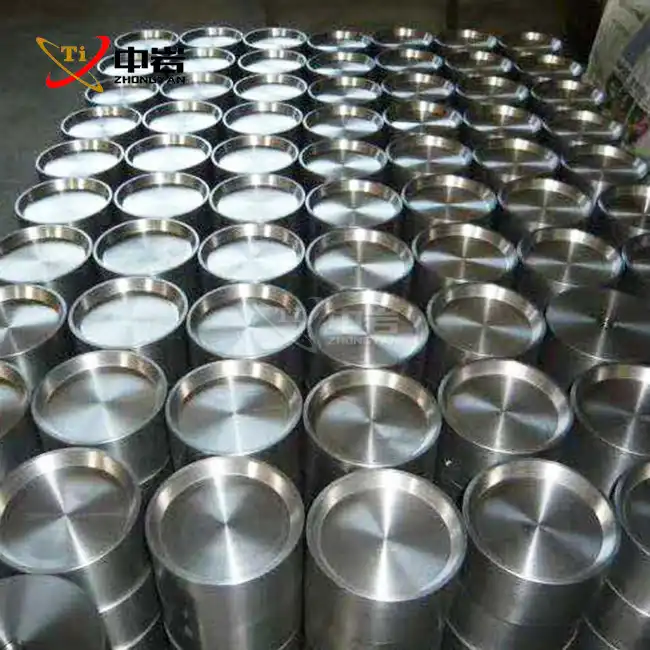
Yes, titanium targets with any form can be skillfully made for movable sputtering systems. We at Baoji Zhongyan Titanium Industry Co., Ltd. are experts at making these precise parts with shapes like tubular, cylindrical, and conical profiles that fit the mechanical needs of rotary cathode systems perfectly. Our Custom Shaped Titanium Target solutions use high-purity Grade 1 and Grade 2 titanium, CNC machining with tolerances as tight as ±0.05mm, and a deep understanding of magnetron configurations to make targets that make the best use of material, improve coating uniformity, and extend operational life in harsh industrial settings.
Understanding Custom Shaped Titanium Targets for Rotatable Systems
The invention of rotatable sputtering devices is a big step forward in physical vapor deposition technology, especially for filling large areas. In contrast to fixed planar targets, which have the well-known "racetrack effect" where only 20–30% of the target material is used, rotatable setups use cylinder or tube-shaped targets that move constantly while they are in use. This spinning spreads erosion out evenly over the whole surface, which greatly increases the rate of material utilization to 80% or higher while keeping the film thickness the same on all surfaces.
What Makes Custom Shaped Titanium Targets Different
Rotatable magnetron systems need technological objectives beyond square or circular. Custom-shaped titanium target sources need mounting interfaces, cooling channel forms, and dimensional profiles that match the spinning cathode assembly. Our proprietary manufacturing approach tackles these issues by constructing targets with particular flange connections, wall thicknesses that control heat, and forms that provide balanced magnetic field interaction during rotation. Titanium is ideal for these difficult applications due to its unique properties. With a melting temperature of 1668°C and high heat conductivity, titanium targets can withstand the powerful plasma onslaught without bending or breaking. Our manufacturing technique ensures grains under 30 µm and a density over 99.7% of the theoretical value. These parameters prevent micro-arcing and particle production during high-power sputtering.
Key Performance Characteristics
Selecting titanium targets for spinning systems requires certain technical criteria. Purity ratings of 99.5% to 99.995% affect film quality. Ultra-high purity grades are essential for semiconductors, where even a little amount of contamination might affect performance. The microstructure must contain small, uniformly spaced grains with a regulated crystalline pattern to maintain sputter yield while the target passes through the plasma zone. Our titanium sputtering targets are made from ASTM B348 Grade 1–5 titanium. Application needs determine material choice. Grade 1 provides the finest corrosion protection for chemical processing, while Grade 2 provides the best purity and mechanical strength for thin-film coatings. When complex geometries need greater strength, aerospace and medical device manufacturers utilize Grade 5 (Ti-6Al-4V).
The Manufacturing Process of Custom Shaped Titanium Targets
It takes advanced manufacturing skills to make high-performance targets for rotating systems. At our factory in Baoji, China's Titanium Valley, we've created a vertically integrated production system that oversees the whole manufacturing process, from checking the quality of the raw materials to making sure the finished product meets all standards.
Raw Material Selection and Preparation
The trip starts with a thorough review of all the materials that come in. Titanium sponge, ingots, and forgings are all bought from approved sellers who give us full paperwork on the chemical makeup and material traceability. Spectrographic analysis is done on each lot to make sure that the purity levels are correct and that the amounts of oxygen, nitrogen, and iron impurities are within accepted limits. It is very important that the oxygen level is less than 500 ppm, because too much interstitial oxygen makes things brittle, which can cause targets to crack during heat cycles. To improve the grain structure and get rid of casting flaws, material preparation includes hot forging or hot rolling. This thermomechanical process breaks down the nanoscale of the as-cast material, making the fine-grained material needed for even sparking. After that, annealing processes improve the crystallographic texture and get rid of any remaining stresses that might make the shape unstable during service or cutting.
Advanced Fabrication Techniques
Our CNC cutting skills are the foundation of our special target production. We use 5-axis CNC milling centers that have special titanium tools, like carbide end mills with the right rake angles and flood cooling systems that keep the work from getting too hard and the tools from wearing out. To program complicated cylindrical shapes, you need advanced CAD/CAM software that can make tool paths that keep the wall thickness constant and take into account mounting points and cooling channels inside the tube. For Custom Shaped Titanium Targets, machining margins for movable targets are usually between ±0.05mm and ±0.10mm. To keep the spinning from being uneven, the outside diameter must stay tightly concentrical, and the cooling tunnels inside must be placed precisely to get the best thermal management. Surface finish requirements of Ra ≤ 0.4µm shorten the "burn-in" time when fitting the target for the first time. This cuts down on covering flaws and speeds up the start of production. In addition to normal cutting, we use hot pressing for targets that need the most density. To do this, titanium powder or pressed blanks are heated to 900–1200°C under controlled pressure. This makes the material dense enough (above 99.8%) while limiting grain growth. Hot isostatic pressing (HIP) gets rid of any remaining holes even more, making targets that are completely dense and have qualities that are the same everywhere. These are perfect for tough military and medical coating uses.
Customization for Rotatable System Requirements
To make targets for certain movable systems, you need to know a lot about how the cathode assembly works. We work together closely with both equipment makers and end users to get important information like:
• Specifications for the width and length of the cathode tube
• Different types of mounting flanges and bolt shapes
• Flow rates and places of connections for cooling water
• Profiles of the size spread of magnetic fields
• Distance needs between the target and the base
These standards guide our design process and make sure that every Custom Shaped Titanium Target works with the other tools without any problems. Differential thermal expansion is a problem that we solve by adding the right gaps and choosing flange materials with expansion coefficients that are suitable. When maximum thermal conductivity is needed, diffusion bonding is used at mounting surfaces. Mechanical fastening methods are used when targets will need to be replaced on a regular basis.
Comparing Custom Shaped Titanium Targets with Standard and Other Metal Targets
When procurement teams look at sputtering goal possibilities, they have to make important choices that will affect both short-term costs and long-term operating efficiency. To make smart buying decisions, you need to know the performance differences between custom and standard setups as well as the different types of materials that are available.
Custom Versus Standard Target Configurations
Basic flat titanium targets are cheaper and created faster—two to three weeks for most sizes. In this scenario, practical economists disagree. Material consumption rates between 25 and 30% mean that 70% of the titanium is wasted when the racetrack wears down to a depth that cannot be utilized. Frequent goal modifications boost labor costs, interrupt production, and waste many resources. Custom moveable targets cost extra upfront and take 4–6 weeks to arrive while tools and software are set up. This investment reduces cost-per-coating-hour by using over 80% of the material. Production cycles endure weeks or months, increasing productivity and reducing quality fluctuations caused by shifting targets. Repeat order wait times are 3–4 weeks since the tools are there.
Material Comparison: Titanium, Aluminum, and Copper
Material selection affects coating quality and system performance. Aluminum targets are cheaper and sputter faster, making them ideal for high-throughput creative coating. Aluminum is reactive and has a lower melting point (660°C), hence it can't be utilized in reactive blasting or high-power circumstances where titanium works better. Copper is used to metallize semiconductors because it conducts heat well. Copper films aren't as robust or rust-resistant as titanium's, and their flexibility may cause material to build up on chamber parts. Medical gadgets require titanium for safe coatings, while airplanes need it for lightness and high-temperature mechanical properties. A Custom Shaped Titanium Target is especially valuable in applications that demand precise coating distribution and complex substrate compatibility. Titanium targets sputter correctly at several power levels and reactive gas circumstances. Oxides form from reactively sputtered oxygen or nitrogen. These layers provide hard, protective coatings (TiO₂, TiN) beneficial for optical coatings, wear-resistant surfaces, and art. Titanium is ideal for coatings that do more than metalize because of its versatility.
Shape Optimization and Rotatable System Compatibility
Spinning targets form affects coating regularity and system efficiency. For ordinary coating jobs, cylindrical targets with uniform wall thickness perform well, although curved or stepped forms are ideal for some scenarios. We created thicker targets in erosion-prone locations. They last 30–50% longer than conventional profiles. Conical targets cover complicated substrate shapes more uniformly than cylindrical targets because they modify plasma distribution. Our engineers apply finite element analysis to anticipate plasma interactions, heat distribution, and magnetic field effects for each shape. Simulations determine the optimal goal design before production, ensuring the part functions as planned. Semiconductor factory case studies demonstrate that improved tubular target designs increase 300mm wafer thickness uniformity from ±8% to ±3%, thus impacting device production.
Practical Applications and Benefits for B2B Procurement
Learning about how handmade Custom Shaped Titanium Target solutions are used in real life helps procurement managers understand the value of these targets and find ways to make their operations run more smoothly.
Industry Applications and Performance Requirements
Making semiconductors is the most difficult setting for titanium targets to be used in. Custom Shaped Titanium Target Titanium binding layers, and diffusion barriers with thickness control measured in angstroms are needed for advanced logic and memory devices. Specifications for contamination say that metallic flaws can't be more than 10²⁰ atoms/cm². This means that ultra-high purity goals (99.995%+) and cleanroom handling procedures are needed. In these situations, rotatable targets cover 200–300 mm wafers evenly, with requirements of ±2% or better, and can work nonstop for 500 hours or more between maintenance rounds. Titanium oxide layers are used in optical coatings to make coatings that don't reflect light on things like solar panels, decorative glass, and precise lenses. Large-area building glass lines use rotatable targets that are longer than 3 meters and cover long bands of glass at speeds of 10 to 15 meters per minute. Rotatable configurations make it possible to stretch the goal life and apply the coating evenly, which directly leads to lower coating costs and better product consistency. Titanium nitride layers are put on turbine blades, bolts, and structural parts by companies that make aerospace parts. These coatings protect against wear, stop galling, and extend fatigue life in tough work settings. Titanium is added to orthopedic implants and surgical tools by medical device companies to make them more biocompatible and help them fuse with bone. Both AS9100 and ISO 13485 quality standards must be met, and all materials must be strictly tracked. We meet these standards through thorough recording and certification processes.
Cost-Effectiveness and Return on Investment
The economic benefits of unique movable targets can be seen by looking at the total cost of ownership. The cost of buying a single target may be two to three times higher than buying standard planar targets, but the cost of coating an area is cut by forty to sixty percent because of better usage and longer operating life. Production managers say that payback times are between 6 and 12 months, and savings keep adding up over the target's multi-year operating life. Bulk shopping programs can save you even more money. If you buy three or more targets, you can usually get a bulk discount of 10-15%. Also, if you sign a yearly supply agreement, you can be sure of stable prices and a priority production schedule. We work with buying teams to predict how things will be used and set up kanban inventory systems that balance the cost of holding on to items with the chance that production will stop because of a lack of target items.
Supplier Selection and OEM Partnerships
When looking for a trusted Custom Shaped Titanium Target maker, you need to look at more than just price. Material certifications that show they meet ASTM standards, measurement reports that show the dimensions are correct, and ISO 9001:2015 certifications for quality management systems give buyers trust in the supplier's skills. We keep full records of all materials, from the heat numbers of the raw materials to the serial numbers of the finished products. This way, if there are any problems with performance, we can fully take responsibility. In this specialized market, providers are set apart by their technical help skills. Our applications engineering team helps improve target designs, suggests processing settings for new coating recipes, and fixes problems with deposition. This way of working together helps customers get the most out of their tools and meet their coating goals, especially when they are moving into new application areas or going from research and development (R&D) to production numbers.
How to Procure Custom Shaped Titanium Targets for Rotatable Systems
In order to get custom targets, you need to know how to deal with technical requirements, wait times, and quality control methods. Our sales process is set up to make these tasks easier and make sure that every order meets customer needs.
Preparing Detailed Specifications
First, complete technical documents to buy a Custom Shaped Titanium Target. Plans or 3D CAD models with all relevant sizes, specifications, and surface finishes are needed. The mounting interface details must match for the cathode assembly to perform properly. This contains bolt hole locations, flange size, and cooling port parameters. Material requirements should include titanium grade, purity, and special approvals. Materials must be approved to AMS 4928 for aircraft usage and ASTM F67 or F136 for medical devices. Each package includes a chemical composition analysis and a material test certificate. Quality control systems need these papers. Since not all customers have completely defined requirements, our sales engineering staff at sales@titaniumstudy.com may help with design. We assist you in determining the optimum target shape and material according to your coating objectives, equipment, and application demands. Dozens of clients have switched to or improved their rotatable sputtering systems using this strategy.
Lead Times, Quantities, and Cost Structures
Customized target prices include material costs, manufacturing challenges, and order volume. Materials account for about 40–50% of the desired cost, depending on titanium prices worldwide. Machining and manufacturing add 30–40%. Quality control, paperwork, and overhead take up the remainder. Complex forms and stringent standards cost more to produce and have a higher scrap rate. One item is normally the minimum order, although you may receive a price for more than three. Engineering approval, grade-compliant raw materials, and manufacturing planning take 4–6 weeks for first-time unique orders. Repeat sales of the same configuration reduce wait times to 3–4 weeks by presetting the tools and software. International shipment procedures must be carefully arranged to preserve the object's integrity. The surface is protected against corrosion and damage by specialized crating and vacuum packaging. Air freight takes 5–7 days worldwide, whereas ocean freight takes 3–5 weeks, depending on the destination. varying nations have varying import tariffs and clearances. Our logistics staff provides landing cost estimates and customs documentation assistance to prevent delays.
After-Sales Support and Technical Assistance
Our commitment to customer satisfaction extends beyond deadlines. Installation assistance includes recommended mounting torque levels, cooling system setup, and initial conditioning measures to reduce contamination and promote target break-in. We recommend process parameters for the Custom Shaped Titanium Target coating to help you get started. Power, gas flows, and pressure may be adjusted depending on objective size and composition. If performance issues arise throughout the target life, our skilled support staff will investigate immediately. We examine coating faults, determine why the formation rate is changing, and offer process adjustments to improve performance. This is very helpful when adjusting target geometries or scaling up testing to production. The guarantee covers manufacturing defects, including wrong measurements, contaminants, or premature failure due to holes or improper gluing. Standard warranties extend 90 days from installation or first usage. High-volume accounts might get longer coverage. Proof of working circumstances and the failed objective for failure analysis are needed to support claims. This detects and fixes process issues.
Conclusion
Custom Shaped Titanium Target solutions made for rotatable sputtering systems provide measurable performance and cost benefits in a wide range of industry settings. When you combine optimized shape, high-purity materials, and precision production, you get parts that make the best use of materials, improve coating consistency, and last longer in use. As a Custom Shaped Titanium Target company based in Baoji's Titanium Valley, we use the area's abundant material supplies and cutting-edge manufacturing skills to provide products that meet the highest standards in the industry. Rotatable targets that are properly built are the building blocks for reliable, high-quality thin-film deposition. This is true whether you are making semiconductor devices, optical coatings, aircraft parts, or the surfaces of medical implants.
FAQ
What purity levels are available for custom rotatable titanium targets?
We have different grades of titanium targets, from industrial grade (99.5% purity) that can be used for protective and artistic coatings to ultra-high purity (99.995% or 4N5+) that is needed for semiconductor uses. Most uses Grade 1 and Grade 2 titanium that meet ASTM B348 standards are fine, but special grades for semiconductors are refined even more to get rid of oxygen, iron, and other intermediate elements.
How does target geometry affect sputtering uniformity in rotatable systems?
Cylindrical geometry allows movement in all directions, which spreads erosion equally and gets more than 80% of the material used. Changes in wall thickness, curved shapes, and end-cap designs all have an effect on how plasma interacts and where the magnetic field is distributed. Through simulations and tests, we find the best values for these geometric factors so that the coating thickness is the same over large parts of the substrate within ±2-3%.
What lead times should we expect for custom rotatable target orders?
Initial custom orders usually take between 4 and 6 weeks because we have to do a technical study, find materials that meet the grade requirements, program CNC machining sequences, and check the quality. Since tools and methods are already set up, wait times are cut to 3–4 weeks for repeat sales of the same configurations. We keep popular types of titanium in stock so that we can speed up production when needed right away.
Partner with Zhongyan for Your Custom Shaped Titanium Target Needs
Zhongyan can help you with your rotatable sputtering system needs by providing Custom Shaped Titanium Target options that are carefully designed. From handling raw materials to precise CNC machining and strict quality control, all of our production capabilities work together to make sure that every target meets your exact requirements and performs reliably. We are in China's Titanium Valley and use our knowledge of materials and cutting-edge manufacturing technology to serve customers all over the world in coating uses for semiconductors, aerospace, medicine, and industry. You can talk to our technical sales team at sales@titaniumstudy.com about your project needs, get specific quotes, or set up sample goal production. As a Custom Shaped Titanium Target provider with a lot of experience, we offer the quality, accuracy, and support that engineers and procurement workers need for mission-critical tasks.
References
1. Davis, J.R. (2006). Handbook of Materials for Medical Devices. ASM International, Materials Park, OH.
2. Mattox, D.M. (2010). Handbook of Physical Vapor Deposition (PVD) Processing (2nd ed.). Elsevier Science, Amsterdam.
3. Ohring, M. (2001). Materials Science of Thin Films: Deposition and Structure (2nd ed.). Academic Press, San Diego.
4. Leyens, C., & Peters, M. (Eds.). (2003). Titanium and Titanium Alloys: Fundamentals and Applications. Wiley-VCH, Weinheim.
5. Bunshah, R.F. (Ed.). (2001). Handbook of Hard Coatings: Deposition Technologies, Properties and Applications. Noyes Publications, Park Ridge, NJ.
6. Schuegraf, K.K. (Ed.). (1988). Handbook of Thin-Film Deposition Processes and Techniques: Principles, Methods, Equipment and Applications. Noyes Publications, Park Ridge, NJ.
_1755652433231.jpg)
Learn about our latest products and discounts through SMS or email