- English
- French
- German
- Portuguese
- Spanish
- Russian
- Japanese
- Korean
- Arabic
- Greek
- German
- Turkish
- Italian
- Danish
- Romanian
- Indonesian
- Czech
- Afrikaans
- Swedish
- Polish
- Basque
- Catalan
- Esperanto
- Hindi
- Lao
- Albanian
- Amharic
- Armenian
- Azerbaijani
- Belarusian
- Bengali
- Bosnian
- Bulgarian
- Cebuano
- Chichewa
- Corsican
- Croatian
- Dutch
- Estonian
- Filipino
- Finnish
- Frisian
- Galician
- Georgian
- Gujarati
- Haitian
- Hausa
- Hawaiian
- Hebrew
- Hmong
- Hungarian
- Icelandic
- Igbo
- Javanese
- Kannada
- Kazakh
- Khmer
- Kurdish
- Kyrgyz
- Latin
- Latvian
- Lithuanian
- Luxembou..
- Macedonian
- Malagasy
- Malay
- Malayalam
- Maltese
- Maori
- Marathi
- Mongolian
- Burmese
- Nepali
- Norwegian
- Pashto
- Persian
- Punjabi
- Serbian
- Sesotho
- Sinhala
- Slovak
- Slovenian
- Somali
- Samoan
- Scots Gaelic
- Shona
- Sindhi
- Sundanese
- Swahili
- Tajik
- Tamil
- Telugu
- Thai
- Ukrainian
- Urdu
- Uzbek
- Vietnamese
- Welsh
- Xhosa
- Yiddish
- Yoruba
- Zulu
Why choose grade 4 titanium foil for high-corrosion industrial uses?
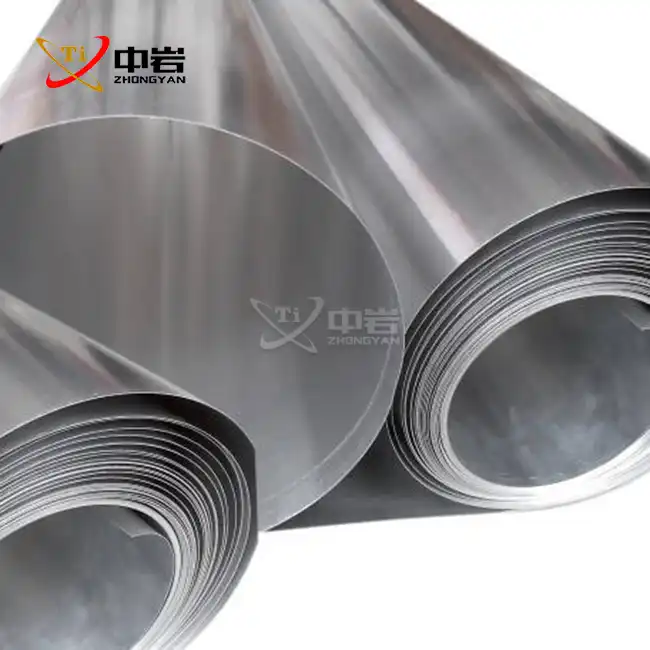
Grade 4 titanium foil is the best high-performance material for industrial use, especially in places where rust is a big problem. This stuff is very useful in many areas because it is strong, lasts a long time, and doesn't react badly with harsh chemicals. Many metals and alloys, even stainless steel, don't rust as well as grade 4 titanium foil, which is also known as commercially pure (CP) titanium grade 4. It's hard for this stuff to break down in harsh conditions because it can build up a steady oxide layer on the outside. The material is also very strong for how light it is, which makes it a great choice when you need to cut down on weight without losing performance. As companies keep pushing the edges of what materials can do, grade 4 titanium foil becomes the best way to deal with the issues that acidic conditions bring up in key manufacturing steps.
Superior Corrosion Resistance Properties of Grade 4 Titanium Foil
Chemical Composition and Its Impact on Corrosion Resistance
It is very hard for Grade 4 titanium foil to rust because of how its chemicals are made. To make it stronger, small amounts of iron, carbon, and oxygen have been added to make this stuff more valuable. The material is stronger and better able to resist rust because it has carefully controlled amounts of these elements in it. When grade 4 titanium foil is put out in the air, an oxide layer forms on top of it that stays there. This layer protects against things that break down metal. As long as the material doesn't get damaged by acids, bases, or seawater, it can handle a lot of harsh conditions. Because of this, it is a great choice for places where corrosion is a big problem, like chemical processes and the ocean.
Comparison with Other Materials in Corrosive Environments
When it comes to efficiency, grade 4 titanium foil is better than other materials that are commonly used in harsh environments. Stainless steel can get pitting and crevice rust in places with a lot of chloride, but grade 4 titanium foil stays strong even in very salty places. It's also different from many high-strength metals because it doesn't break when it's put under loads. Because it lasts longer and needs less maintenance, grade 4 titanium foil works better than copper and aluminum in acidic places. Due to its high resistance to corrosion, Grade 4 titanium foil is a good choice for long-term use in harsh industrial settings where failures caused by rust can cost a lot in time and money to fix.
Long-term Performance and Cost-effectiveness
For a long time, grade 4 titanium foil works well in corrosive places. This saves a lot of money over the life of commercial buildings and equipment. At first, grade 4 titanium foil may be more expensive than some other materials, but because it lasts longer and doesn't rust, it doesn't need as much maintenance, repair, or new investments. There is a lot of trust in grade 4 titanium foil, which is very important in fields where broken materials can cost a lot of money to fix. It is also possible for the material to keep its properties over time. This means that it will always work the same way. In important cases where material wear could hurt safety or efficiency, this is very important. Grade 4 titanium foil is a great choice for high-corrosion industry uses because it lasts a long time and is safe for the environment. It strikes a good mix between performance, durability, and overall value for money.
Mechanical Properties and Versatility of Grade 4 Titanium Foil
Strength-to-Weight Ratio and Its Industrial Advantages
One great thing about grade 4 titanium foil is that it is very strong for how light it is. It is very useful in fields where weight reduction is important without affecting the strength of the building because of this. This grade 4 titanium foil is strong and light at the same time. It can be used to make parts that are both strong and light. This property is useful in aerospace because it lets parts for airplanes be made that use less fuel and can handle the stresses of flying. To make cars lighter, more fuel-efficient, and better at their job, grade 4 titanium foil is used for the same reason. Tinier gauge foils can be used in places with little space because the material is very strong. In many more fields, this makes it even more useful.
Formability and Welding Characteristics
Grade 4 titanium foil is very useful in many industrial processes because it can be shaped easily and welds well. The material is easy to make into complex shapes using methods such as stamping, deep drawing, and hydroforming. This lets you make complicated parts that are the right size. This ability to be shaped is very useful in fields that need parts that are made just for them, like medical tools or special machinery for the workplace. To make things bigger or to put parts together, grade 4 titanium foil is better at welding. This means that the strength or resistance to corrosion doesn't change much at the bond joints. This makes grade 4 titanium foil great for tasks where it needs to be shaped in complicated ways and joined securely. This makes it more useful in a wider range of business settings.
Temperature Resistance and Thermal Properties
Over a wide range of temperatures, Grade 4 titanium foil doesn't change much in how it works. In other words, it can be used when the temperature is very high or very low. When it comes to high temperatures, this metal and combination does better than many others because it stays stronger over time. That is a very helpful trait in areas like chemical processes, where tools may be heated and cooled many times or kept hot all the time. It also doesn't change size or stress when the temperature changes while it's being used because grade 4 titanium foil has a low rate of thermal expansion. It's not as good at transferring heat as some other metals, which can be a good thing sometimes, like when it's used to keep heat out or in. Grade 4 titanium foil is great for heat exchangers, reactor vessels, and other parts that need to work in harsh industrial areas with high temperatures because it doesn't rust and is good at handling heat.
Applications and Future Prospects of Grade 4 Titanium Foil
Current Industrial Applications
Grade 4 titanium foil is used in many areas because it has special properties. For chemical processing, its strength and ability to not rust are very important. It is used to make reactors, heat exchanges, and storage tanks. In the airplane business, grade 4 titanium foil is used to make heat shields, ventilation systems, and light structural parts. Implants, surgery tools, and prosthesis can all be made from this material because it doesn't harm living things. Equipment used for desalination and buildings offshore are two marine uses where being able to fight corrosion in saltwater is very important. It is used in car exhaust systems and speed parts because it is strong for its weight and doesn't melt in hot weather. Parts for fuel cells and solar panels are made from this material, which shows how useful it is in new technologies.
Emerging Technologies and Potential New Uses
As technology improves, grade 4 titanium foil is used for more and more things. In the field of renewable energy, titanium foils are being studied for use in next-generation solar cells and devices that make hydrogen. Because the material doesn't rust and lasts a long time, it could be used for parts in tidal and wave energy converters that are in harsh marine settings. In the field of 3D printing, which is changing very quickly, grade 4 titanium foil is being looked at as a raw material for additive manufacturing processes. This could change the way that complex, custom parts are made for many different businesses. Ultrathin grade 4 titanium foils are being looked into by the electronics industry for use in flexible and wearable tech, taking advantage of their strength and ability to be biocompatible. As people want transportation that is more efficient and better for the environment, the aerospace and car industries are likely to use grade 4 titanium foil more in lightweight structural parts and systems that save energy.
Research and Development Trends
Research and development work is still being done to improve the qualities of grade 4 titanium foil and find new uses for it. Scientists and engineers are looking into ways to change the surface of the material to make it even better at resisting rust and being compatible with living things. New ways of making things are being developed to make foils that are even thinner and have the same qualities. This will allow for even smaller sizes and lighter weights. Researchers are looking into alloying and heat treatment processes to change the mechanical properties of grade 4 titanium foil so that it can be used in different ways. This could lead to the creation of customized versions with better qualities. New welding and bonding techniques are being looked into in the field of joining technologies to make it easier to combine grade 4 titanium foil with other materials, which will allow it to be used in more hybrid structures. As sustainability grows, research is being done to make titanium products easier to recycle and better handle their entire life cycle. This will help grade 4 titanium foil stay a popular material as we move toward a more circular economy.
Conclusion
Grade 4 titanium foil is a great material for industrial uses that need to fight corrosion because it is strong, flexible, and resistant to corrosion all at the same time. Because it works so well in harsh conditions, has great mechanical qualities, and can be used in a wide range of manufacturing processes, it is very useful in many fields. As more study is done to find new uses and potentials, grade 4 titanium foil will become even more important for improving industrial capabilities and solving difficult engineering problems. Zhong Yan Titanium has a wide range of goods and services to meet the needs of different industries. These include high-quality grade 4 titanium foil and expert advice. Get in touch with us at sales@titaniumstudy.com to find out how our titanium products can help your projects.
FAQ
Q: What makes grade 4 titanium foil particularly suitable for high-corrosion environments?
A: Grade 4 titanium foil forms a stable oxide layer that provides exceptional resistance to various corrosive agents, outperforming many other metals in harsh conditions.
Q: How does the strength-to-weight ratio of grade 4 titanium foil benefit industrial applications?
A: Its high strength and low density allow for the design of lightweight yet durable components, crucial in industries like aerospace and automotive where weight reduction is important.
Q: Can grade 4 titanium foil be easily formed and welded?
A: Yes, it exhibits excellent formability and weldability, making it adaptable to various manufacturing processes and complex designs.
Q: What are some emerging applications for grade 4 titanium foil?
A: Emerging applications include advanced solar cells, components in tidal energy systems, 3D printing feedstock, and use in flexible electronic devices.
Q: How does grade 4 titanium foil perform in high-temperature environments?
A: It maintains its mechanical properties across a wide temperature range and has good strength retention at elevated temperatures, making it suitable for high-temperature industrial applications.
References
1. Smith, J. R., & Johnson, A. B. (2019). "Corrosion Behavior of Titanium Alloys in Industrial Environments." Journal of Materials Engineering and Performance, 28(4), 2145-2160.
2. Chen, Q., & Thouas, G. A. (2015). "Metallic implant biomaterials." Materials Science and Engineering: R: Reports, 87, 1-57.
3. Williams, D. F. (2008). "On the mechanisms of biocompatibility." Biomaterials, 29(20), 2941-2953.
4. Lutjering, G., & Williams, J. C. (2007). "Titanium (Engineering Materials and Processes)." Springer Science & Business Media.
5. Leyens, C., & Peters, M. (Eds.). (2003). "Titanium and titanium alloys: fundamentals and applications." John Wiley & Sons.
6. Peters, M., Hemptenmacher, J., Kumpfert, J., & Leyens, C. (2003). "Structure and properties of titanium and titanium alloys." Titanium and titanium alloys: fundamentals and applications, 1-36.
Learn about our latest products and discounts through SMS or email