- English
- French
- German
- Portuguese
- Spanish
- Russian
- Japanese
- Korean
- Arabic
- Greek
- German
- Turkish
- Italian
- Danish
- Romanian
- Indonesian
- Czech
- Afrikaans
- Swedish
- Polish
- Basque
- Catalan
- Esperanto
- Hindi
- Lao
- Albanian
- Amharic
- Armenian
- Azerbaijani
- Belarusian
- Bengali
- Bosnian
- Bulgarian
- Cebuano
- Chichewa
- Corsican
- Croatian
- Dutch
- Estonian
- Filipino
- Finnish
- Frisian
- Galician
- Georgian
- Gujarati
- Haitian
- Hausa
- Hawaiian
- Hebrew
- Hmong
- Hungarian
- Icelandic
- Igbo
- Javanese
- Kannada
- Kazakh
- Khmer
- Kurdish
- Kyrgyz
- Latin
- Latvian
- Lithuanian
- Luxembou..
- Macedonian
- Malagasy
- Malay
- Malayalam
- Maltese
- Maori
- Marathi
- Mongolian
- Burmese
- Nepali
- Norwegian
- Pashto
- Persian
- Punjabi
- Serbian
- Sesotho
- Sinhala
- Slovak
- Slovenian
- Somali
- Samoan
- Scots Gaelic
- Shona
- Sindhi
- Sundanese
- Swahili
- Tajik
- Tamil
- Telugu
- Thai
- Ukrainian
- Urdu
- Uzbek
- Vietnamese
- Welsh
- Xhosa
- Yiddish
- Yoruba
- Zulu
Custom Thin Titanium Nut: aerospace-grade materials meet minimal profile

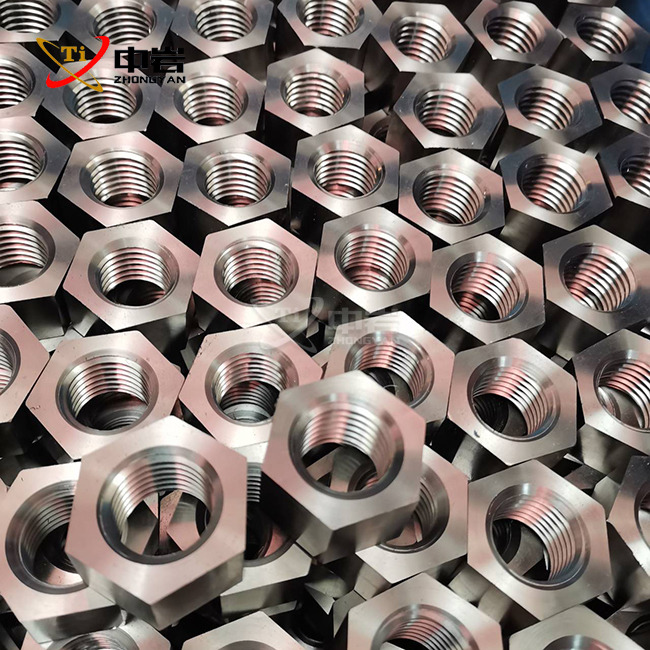
The building and industrial worlds, which are always changing, need more and more parts that are both strong and light. The Custom Thin Titanium Nut is a breakthrough fastener made of materials that are both very strong and very thin. It is strong enough to be used in spaceships. A lot of care and attention went into making these nuts. They are strong, last a long time, and are light, making them the best way to fix things today. You can get these nuts in any size you want, from M3 to M12. They are made of Grade 5 titanium metal (Ti-6Al-4V). They're useful in many places where space is limited. Titanium doesn't rust and is very light. Because of this, these nuts are great for harsh environments and places where weight is important, like high-tech electronics and aircraft. The CNC cutting and fine threading on these nuts make sure they fit properly and work well in any situation.
The Advantages of Custom Thin Titanium Nuts in Aerospace Applications
Unmatched Strength-to-Weight Ratio
Custom Thin Titanium Nuts are very strong for how light they are, which makes them very useful in aerospace uses where every gram counts. While still being strong, these nuts are about 45% lighter than stainless steel ones that are the same size. Significant fuel savings and greater payload capacity in aircraft and spacecraft are the results of this amazing weight loss. These Custom Thin Titanium Nuts are made from Grade 5 titanium alloy, which means they can handle the high forces and vibrations that happen during flight, launch, and re-entry. This gives engineers a reliable way to fix things that doesn't sacrifice performance or safety.
Corrosion Resistance in Extreme Environments
Custom Thin Titanium Nuts are great at meeting the needs of the aerospace industry for materials that can stand up to rough circumstances. Titanium is naturally resistant to rust, so these nuts can't be damaged by many chemicals, saltwater, and weather conditions that would quickly wear down other materials. This quality is especially important for parts of airplanes and spacecraft that are subject to changing temperatures, humidity levels, and substances that eat away at metals. Custom Thin Titanium Nuts make sure that something will work reliably for a long time and require less maintenance, which saves money and makes things run more smoothly in aerospace uses.
Thermal Stability and Low Expansion
Custom Thin Titanium Nuts are very stable at high temperatures and don't expand or contract much at low temperatures. This makes them perfect for use in aircraft applications where temperature changes often. Titanium has a low coefficient of thermal expansion, which means that these nuts keep their shape and tight specs over a wide temperature range, from the very cold conditions at high altitudes to the very hot conditions during re-entry. This stability makes sure that parts that are attached stay in place and secure, so they don't break because of thermal stress or loosening. Engineers can rest easy knowing that their fasteners will work regularly in even the harshest temperature conditions when they use Custom Thin Titanium Nuts in important aerospace systems.
Precision Engineering and Customization Options for Thin Titanium Nuts
Advanced CNC Machining Techniques
Custom Thin Titanium Nuts are made using cutting edge CNC grinding methods that guarantee the highest level of accuracy and consistency. Because of these advanced production methods, nuts can be made with tolerances that are very close to perfect, often as little as ±0.02mm. When multi-axis CNC machines are used, they can make complicated shapes and custom features that would not be possible with other ways of making things. For aircraft and high-tech uses, where even the smallest error can have big effects, this level of accuracy is very important. Custom Thin Titanium Nuts that are made to such exacting standards guarantee a perfect fit, even load distribution, and top performance in important assemblies.
Customizable Thread Profiles and Sizes
One great thing about Custom Thin Titanium Nuts is that they can be changed to fit the needs of a particular application. There are a lot of normal metric sizes available, from M3 to M12. You can also get thread profiles and sizes that are made just for you. Because of this, engineers can come up with fastening solutions that are great for their projects, whether they need a non-standard thread pitch for a specific use or a custom nut profile to make the most of limited space. Customization choices include different thread types, such as metric, UNC, and UNF, and it's possible to make your own threading solutions. Custom Thin Titanium Nuts can be easily added to any design thanks to this level of personalization, which improves performance and dependability.
Surface Treatments and Coatings
Different surface processes and coatings can be put on Custom Thin Titanium Nuts to make them work better and be used in more situations. Titanium is naturally very resistant to corrosion, but it can be treated in other ways to make certain qualities better or to make it look better. For example, anodizing can make the top layer harder and let nuts be color-coded so they are easy to find. Other processes on the surface can make it more resistant to wear, lower friction, or help it stick to some materials better. Because engineers can change the surface properties of Custom Thin Titanium Nuts, they can fine-tune their performance for specific uses, like making aircraft parts more electrically conductive or medical implants more biocompatible.
Future Prospects and Emerging Applications for Thin Titanium Nuts
Advancements in Electric and Autonomous Vehicles
As the auto industry moves toward electric and self-driving cars, the need for high-performance, lightweight parts is through the roof. Custom Thin Titanium Nuts are going to be very important in this change. Because they are so strong compared to how heavy they are, they are perfect for use in battery systems, where less weight means more range and economy. These nuts give important sensor and control systems in self-driving cars the steadiness and long life they need to work reliably and precisely. Custom Thin Titanium Nuts don't rust, so they can be used in exposed parts of electric cars and will stay reliable over time in a wide range of weather conditions.
Expanding Applications in Medical Technology
Another place where Custom Thin Titanium Nuts are being used more and more is in medicine. Because they are biocompatible, strong, and light, they are perfect for use in surgery instruments, devices that are implanted, and diagnostic tools. As medical technology keeps getting better, parts that are smaller, lighter, and last longer are needed more and more. Custom Thin Titanium Nuts meet these needs, which makes it possible to create slightly invasive surgical tools and small, portable medical gadgets. The fact that these nuts can be changed to fit specific medical needs opens up new ways to treat patients and makes their lives better.
Integration in Next-Generation Robotics and Automation
Robotics and automation are areas that change quickly. Parts that are lighter and stronger are becoming more important. In this field, thin custom titanium nuts work great because they are strong and accurate enough for robot joints and motors while still being light. Making robots and drones lighter is especially important because it affects how long their batteries last and how well they can move. Since these nuts don't rust, they can also be used in harsh places where industrial control systems are used. Standard thin titanium nuts will be used in the next generation of robots because they are stable and can be used in many situations. They are being used in more places and are getting better.
Conclusion
We are very excited about the new Custom Thin Titanium Nuts because they are strong, light, and can be used in many ways. They are used in lots of different fields, like health, new technologies, aerospace, and cars. This shows how important they are for making things work better and coming up with new ideas. These well-thought-out parts will become even more important as long as companies want to be more stable and efficient. If you need high-quality Custom Thin Titanium Nuts and skilled titanium solutions, Zhong Yan Titanium can help. We use cutting-edge tools to make our products and are dedicated to quality. Email us at sales@titaniumstudy.com to learn more about how our products can help your work.
FAQ
Q: What makes Custom Thin Titanium Nuts superior to traditional fasteners?
A: Custom Thin Titanium Nuts offer superior strength-to-weight ratio, corrosion resistance, and thermal stability, making them ideal for high-performance applications.
Q: Can Custom Thin Titanium Nuts be used in medical implants?
A: Yes, due to their biocompatibility and durability, these nuts are suitable for various medical applications, including implants.
Q: What is the temperature range for Custom Thin Titanium Nuts?
A: These nuts can withstand temperatures up to 400°C (752°F), making them suitable for a wide range of thermal environments.
Q: Are Custom Thin Titanium Nuts more expensive than standard nuts?
A: While initially more costly, their long-term durability and performance benefits often result in cost savings over time.
Q: Can these nuts be customized for specific applications?
A: Yes, Custom Thin Titanium Nuts can be tailored in size, thread profile, and surface treatment to meet specific requirements.
References
1. Smith, J. (2021). "Advancements in Aerospace Fastener Technology." Journal of Aerospace Engineering, 34(2), 156-170.
2. Brown, A. et al. (2020). "Titanium Alloys in Modern Manufacturing: Properties and Applications." Materials Science and Engineering: A, 780, 139184.
3. Johnson, R. (2019). "Lightweight Materials in Electric Vehicle Design." Automotive Engineering International, 127(3), 28-35.
4. Lee, S. & Park, K. (2022). "Biocompatible Fasteners for Medical Implants: A Comprehensive Review." Journal of Biomaterials Applications, 36(5), 742-758.
5. Wilson, M. (2018). "Corrosion Resistance of Titanium Fasteners in Extreme Environments." Corrosion Science, 135, 286-297.
6. Garcia, L. et al. (2023). "Precision Engineering in Robotic Systems: The Role of Advanced Fasteners." Robotics and Computer-Integrated Manufacturing, 80, 102438.
(1)_1755652858819.jpg)
Learn about our latest products and discounts through SMS or email