- English
- French
- German
- Portuguese
- Spanish
- Russian
- Japanese
- Korean
- Arabic
- Greek
- German
- Turkish
- Italian
- Danish
- Romanian
- Indonesian
- Czech
- Afrikaans
- Swedish
- Polish
- Basque
- Catalan
- Esperanto
- Hindi
- Lao
- Albanian
- Amharic
- Armenian
- Azerbaijani
- Belarusian
- Bengali
- Bosnian
- Bulgarian
- Cebuano
- Chichewa
- Corsican
- Croatian
- Dutch
- Estonian
- Filipino
- Finnish
- Frisian
- Galician
- Georgian
- Gujarati
- Haitian
- Hausa
- Hawaiian
- Hebrew
- Hmong
- Hungarian
- Icelandic
- Igbo
- Javanese
- Kannada
- Kazakh
- Khmer
- Kurdish
- Kyrgyz
- Latin
- Latvian
- Lithuanian
- Luxembou..
- Macedonian
- Malagasy
- Malay
- Malayalam
- Maltese
- Maori
- Marathi
- Mongolian
- Burmese
- Nepali
- Norwegian
- Pashto
- Persian
- Punjabi
- Serbian
- Sesotho
- Sinhala
- Slovak
- Slovenian
- Somali
- Samoan
- Scots Gaelic
- Shona
- Sindhi
- Sundanese
- Swahili
- Tajik
- Tamil
- Telugu
- Thai
- Ukrainian
- Urdu
- Uzbek
- Vietnamese
- Welsh
- Xhosa
- Yiddish
- Yoruba
- Zulu
Where Is Custom Dome Titanium Nut Most Effectively Applied?
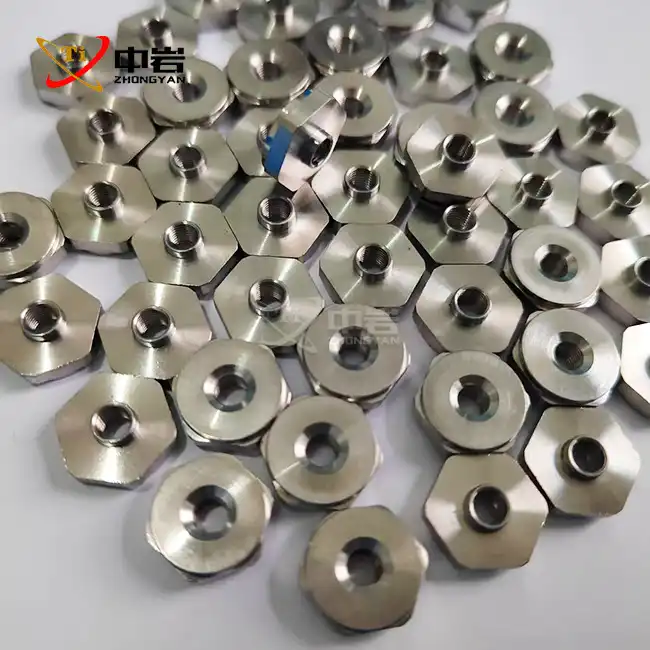
Custom dome titanium nuts excel in aerospace, automotive, marine, and medical applications that require a strength-to-weight ratio and corrosion resistance. These titanium fasteners perform well in severe settings, including aeroplane structural assemblies subjected to intense temperature cycling and offshore equipment subjected to seawater corrosion. While the smooth dome design protects exposed threads from debris and snagging by cables or humans, its lightweight qualities minimise component mass without compromising structural integrity. Grade 5 titanium fasteners are essential in racing suspension systems, chemical processing equipment, and precision industrial machinery, where steel or aluminium fasteners fail due to their high tensile strength.
Introduction
Global manufacturing sectors' key assemblies' dependability, safety, and operational lifespan depend on fastening solution choice. Custom dome titanium nuts combine the geometric benefits of a protective cap design with titanium's outstanding material qualities. These precision-engineered components address technological issues in harsh industrial conditions, unlike brass or stainless steel hex nuts or acorn-style caps.
This article informs procurement, engineering, and R&D teams where titanium dome nuts are most valuable. We evaluate their main material properties, application industries, benefits over other materials, and strategic procurement. Understanding these criteria helps buyers balance performance and affordability while meeting international quality standards, including ASTM, AMS, and ISO certifications.
Understanding Custom Dome Titanium Nuts
Structural Design and Material Foundation
Titanium dome nuts combine a unique cap shape with titanium alloy benefits. The smooth appearance of the domed top hides jagged thread ends, preventing cable abrasion and maintenance injuries. This design prevents moisture and particulate contamination at the thread contact, which is important for dusty industrial or marine systems.
Material foundations commonly use Grade 5 titanium (Ti-6Al-4V), which comprises 6% aluminium and 4% vanadium. This alloy has a tensile strength of 900-1100 MPa and a density of 4.43 g/cm³, making it 45% lighter than stainless steel. Commercially pure Grade 2 titanium is used in chemical processing and medical device assemblies that prioritise corrosion resistance above load-bearing capacity.
Manufacturing Processes and Precision Standards
Baoji Zhongyan Titanium Industry uses CNC machining to achieve ISO 965 thread tolerances. Titanium rod material selection is followed by precision turning to provide the exterior dome profile and internal thread geometry. Based on assembly needs, dome heights can be adjusted from 1.5mm to 5mm and thread sizes from M4 to M14.
Surface treatments improve performance and appearance. As-machined finishes give corrosion resistance, while Physical Vapour Deposition (PVD) coatings add colour (black, gold, and rainbow) and surface hardness to avoid galling, which occurs when titanium threads seize from cold welding under stress. While maintaining dimensional perfection for thread engagement, anodisation enables colour customisation.
Material Grade Selection Impact
Grade 5 titanium undergoes heat treatment to achieve superior mechanical properties, making it mandatory for structural applications experiencing cyclic loading or vibration. The yield strength of 830-924 MPa ensures the fastener maintains clamping force without permanent deformation under operational stresses. Temperature tolerance extends from cryogenic levels (-252°C) to elevated environments (400°C), accommodating aerospace engine compartments and industrial autoclaves.
Grade 2 titanium provides excellent formability and weldability, suitable for applications where moderate strength suffices but extreme corrosion resistance is essential. Chemical processing equipment benefits from Grade 2's immunity to chloride-induced stress corrosion cracking, a failure mode that plagues stainless steel fasteners in acidic or saltwater environments.
Primary Applications of Custom Dome Titanium Nuts
Aerospace Engineering Solutions
Aircraft structural assemblies demand fasteners that withstand extreme temperature fluctuations, vibration, and weight constraints. Titanium dome nuts secure avionics housings, control surface linkages, and engine mount points where every gram affects fuel efficiency. The non-magnetic properties prove essential near navigation equipment and flight control sensors, preventing electromagnetic interference that could compromise instrument accuracy.
Satellite systems utilize these fasteners in deployment mechanisms and antenna arrays exposed to the vacuum of space. The low outgassing characteristics of titanium prevent contamination of sensitive optical surfaces, while the material's stability across temperature extremes maintains assembly integrity during solar heating and shadow cooling cycles.
Automotive and Motorsport Performance
High-performance racing automobiles use titanium fasteners in suspension, roll cage, and exhaust manifold assemblies to save weight. A full set of titanium wheel nuts reduces unsprung mass by several hundred kilos, enhancing suspension and braking. The dome prevents thread damage during pit-stop tyre swaps on expensive carbon-fibre bodywork.
Street performance vehicles benefit from corrosion resistance in underbody applications where road salt and chemicals would erode steel hardware. For enthusiasts, polished or coloured titanium fasteners provide visual impact in engine bays and custom builds, justifying their higher cost.
Marine and Offshore Engineering
Saltwater environments represent the most corrosive operating conditions for fastener applications. Titanium's natural oxide layer provides complete immunity to chloride-induced corrosion, eliminating the pitting and crevice corrosion that destroys stainless steel fasteners within months of subsea exposure. Offshore platform operators utilise titanium dome nuts in deck equipment, riser assemblies, and instrumentation housings where maintenance access is costly and difficult.
Yacht builders specify titanium fasteners for deck fittings, mast assemblies, and underwater hull attachments. The elimination of galvanic corrosion concerns when paired with carbon fibre composite structures makes titanium the preferred material for modern high-performance sailing vessels. The smooth dome profile reduces line snag hazards during sail-handling operations.
Medical and Pharmaceutical Applications
Biocompatibility makes titanium the standard for surgical implant assemblies and prosthetic device connections. Dome nuts in external fixation systems have smooth caps that reduce tissue irritation and simplify sterilisation. Patients can have MRI scanning without fastener removal because it's non-magnetic.
Fasteners for pharmaceutical equipment must resist chemical cleaning and steam sterilisation. Titanium dome nuts resist corrosion and material degradation after thousands of autoclave cycles, ensuring that injectable medication and sterile products are free from contamination.
Industrial Machinery and Chemical Processing
Food processing equipment demands fasteners that combine corrosion resistance with hygienic design principles. The smooth dome surface eliminates crevices where bacteria could accumulate, supporting compliance with FDA sanitation requirements. Titanium's compatibility with acidic food products and alkaline cleaning solutions extends equipment service life in brewery, dairy, and beverage production facilities.
Chemical reactors handling corrosive process streams rely on titanium fasteners to maintain vessel integrity. The material's resistance to sulphuric acid, hydrochloric acid, and organic solvents prevents contamination from fastener corrosion products. Semiconductor manufacturing equipment benefits from titanium's purity and outgassing characteristics in vacuum chamber assemblies.
Comparing Custom Dome Titanium Nuts with Other Materials
Strength-to-Weight Performance Analysis
Titanium delivers the highest strength-to-weight ratio available in commercial fastener materials. A grade 5 custom dome titanium nut provides equivalent load-carrying capacity to hardened steel while weighing 45% less. This weight advantage translates directly to fuel savings in aerospace applications and performance gains in automotive racing contexts. Aluminium alloy fasteners offer lower density but sacrifice significant strength, limiting their use to non-structural applications.
The modulus of elasticity for titanium (110 GPa) differs from that of steel (200 GPa), affecting deflection characteristics under load. Engineers must account for this material property difference when substituting titanium fasteners into existing assemblies designed around steel hardware. Proper torque specifications prevent over-stressing titanium threads while maintaining adequate clamping force.
Corrosion Resistance Comparison
316 stainless steel resists general corrosion but chloride-induced pitting and crevice corrosion in maritime conditions. Titanium's passive oxide coating self-reforms when scratched, protecting against corrosion better than stainless steel. Titanium displays no corrosion after 1000 hours of salt spray exposure in 3.5% sodium chloride solution, while 316 stainless steel shows pitting.
Acidic or alkaline chemical processing conditions degrade brass and aluminium fasteners quickly. Material selection is important because electrolytes cause galvanic corrosion when different metals touch. Titanium's position in the galvanic series reduces the corrosion risk when connecting carbon fibre composites or anodised aluminium structures.
Cost-Benefit Considerations
The initial purchase price of titanium fasteners exceeds stainless steel by factors of 3-5x depending on volume and specification complexity. Lifecycle cost analysis reveals the value proposition: titanium fasteners typically outlast stainless steel by 5-10x in corrosive environments, eliminating replacement labour costs and downtime expenses. Aerospace and medical applications justify the premium through regulatory compliance advantages and performance gains impossible with alternative materials.
Procurement strategies should evaluate the total cost of ownership rather than the unit price alone. Applications requiring frequent maintenance access or operating in harsh conditions recover the titanium premium through extended service intervals and improved reliability. High-volume manufacturing benefits from our OEM pricing structures and flexible minimum order quantities tailored to production schedules.
Procurement Guide for Custom Dome Titanium Nuts
Supplier Qualification and Certification
Verifying supplier credentials and quality management systems starts successful procurement. ISO 9001:2015 certification shows process controls and continual improvement. AS9100 accreditation verifies that manufacturers meet aviation and space industry quality standards for aerospace applications. Quality management of medical device fasteners requires ISO 13485 compliance.
Material traceability is essential for purchase. Reliable vendors give mill test data for each production lot's chemical composition and mechanical properties. Positive Material Identification (PMI) using X-ray fluorescence spectroscopy checks the titanium grade, ensuring assembly safety.
In Baoji City, China's Titanium Valley, Zhongyan has direct access to quality titanium raw materials and specialised processing. To ensure every fastener meets specifications, our quality control laboratory uses coordinate measuring machines (CMM), ISO thread gauge inspection, and surface roughness testing.
Customisation Capabilities and Lead Times
Standard catalogue fasteners rarely meet advanced technical needs. Custom thread sizes, dome height changes, and surface treatments are available from OEM. Engineering collaboration during design optimises fastener geometry for assembly requirements, reducing weight or increasing load distribution.
Prototypes validate the design before mass production. We accommodate small-batch speciality orders and high-volume production runs with flexible manufacturing timelines. Standard specifications take 3-4 weeks, while complex custom designs that need specialised tooling or surface treatments take 6-8 weeks.
Logistics and International Trade Considerations
Shipping, customs, and trade terms are important in global procurement. Our logistics services include export documentation, freight forwarding, and shipment tracking. Rapid shipment meets critical project deadlines when traditional delivery timetables fail.
Shipping precision fasteners internationally is protected by packaging. Individual anti-static bags prevent surface contamination, and cushioned containers avoid impact damage. Custom labelling helps regulated industries manage inventories and track them. Our Incoterms experience clarifies buyer-seller cost duties and risk transfer points.
Why Choose Custom Dome Titanium Nuts?
Lifecycle Value and Performance Benefits
Procurement decisions based solely on initial cost often overlook the substantial lifecycle advantages titanium fasteners deliver. The corrosion resistance eliminates replacement cycles that steel fasteners require in marine or chemical environments. A single titanium installation can outlast multiple generations of stainless steel hardware, reducing maintenance labour costs and operational downtime.
Weight reduction contributes quantifiable performance improvements in transportation applications. Every kilogram removed from aircraft structure translates to fuel savings multiplied across thousands of flight hours. Racing vehicles achieve faster acceleration and improved handling through strategic weight reduction in rotating assemblies. These performance gains justify the material premium through competitive advantages and operational cost reductions.
The non-magnetic properties enable applications impossible with ferrous fasteners. Medical imaging facilities, electronic manufacturing clean rooms, and scientific research equipment benefit from titanium's electromagnetic neutrality. This specialised capability expands design possibilities and supports regulatory compliance in sensitive environments.
Industry Testimonials and Application Validation
Since titanium fasteners eliminate corrosion preventive methods for steel hardware, aerospace manufacturers report significant assembly time reductions. Natural corrosion resistance eliminates the need for expensive cadmium plating and other surface treatments that require environmental compliance. No degradation occurs during routine inspections of titanium fasteners, extending maintenance intervals.
Motorsport teams report lap time advantages from titanium fastener conversion in suspension and drivetrain assemblies. Weight savings and vibration resistance maintain vehicle performance throughout races. Pit attendants appreciate galling-resistant qualities for dependable torque during high-pressure tyre swaps.
Marine equipment operators report considerable maintenance cost reductions after switching to titanium fasteners in deck equipment and instrumentation housings. Eliminating seized fasteners simplifies service work disassembly, decreasing labour hours and protecting expensive components.
Emerging Trends and Future Applications
New surface coating technologies are constantly enhancing the capabilities of titanium fasteners. Coatings made of diamond-like carbon (DLC) increase galling resistance even further without sacrificing the dimensional accuracy needed for accurate thread engagement. These innovations make it possible to specify greater torque and increase longevity even in the most demanding of environments.
Metallic fasteners made of titanium are in high demand due to the increasing use of carbon fibre composites in many industrial and automotive applications. The problems of micro-cracking and delamination that might arise when using steel fasteners to attach composite constructions are mitigated by the compatible galvanic characteristics and coefficient of thermal expansion, which reduce stress at different material surfaces.
Fasteners with improved strength-to-weight ratios may be attainable with the use of additive manufacturing, which allows for the creation of intricate interior geometries that would be impossible with traditional machining methods. We can now create unique fastener designs that are optimised for specific load pathways and stress distributions inside assemblies, thanks to the maturation of 3D printing of titanium alloys.
Conclusion
Custom dome titanium nuts deliver unmatched performance across industries demanding lightweight strength, corrosion immunity, and reliable fastening solutions. Their effectiveness spans aerospace structural assemblies, automotive performance applications, marine equipment, medical devices, and chemical processing infrastructure. The material's unique combination of properties justifies the premium cost through extended service life, reduced maintenance, and performance capabilities impossible with alternative fastener materials. Successful procurement requires partnering with certified manufacturers offering customisation capabilities, quality documentation, and technical support throughout the specification and production process. Strategic adoption positions organisations to meet evolving industry standards while achieving operational improvements that are measurable in terms of cost savings and reliability gains.
FAQ
What thread sizes are available for titanium dome nuts?
Standard offerings typically range from M4 to M14, with custom sizes available based on specific application requirements. Our CNC machining capabilities accommodate metric and imperial thread standards conforming to ISO 965 or ASME B1.1 specifications. Procurement teams should specify thread pitch, tolerance class, and any special engagement length requirements when requesting quotations for custom configurations.
How does titanium's corrosion resistance compare to 316 stainless steel?
Titanium provides superior corrosion resistance across nearly all environments, particularly in chloride-containing solutions where stainless steel suffers pitting corrosion. Salt spray testing demonstrates that titanium maintains zero corrosion after 1000+ hours of exposure, while 316 stainless shows visible degradation. This performance advantage justifies titanium selection for marine, offshore, and chemical processing applications where fastener longevity directly impacts operational costs.
What factors influence lead times for custom orders?
Production schedules depend on specification complexity, surface treatment requirements, and current manufacturing capacity. Standard configurations ship within 3-4 weeks, while custom thread sizes or specialised coatings extend timelines to 6-8 weeks. Prototyping services accelerate design validation before committing to production volumes. Clear communication of delivery requirements during quotation enables realistic schedule commitments.
Can the dome height be customised for specific bolt lengths?
Dome height adjusts from 1.5mm to 5mm based on assembly requirements. Taller domes accommodate extra thread length while maintaining the protective cap function. Our engineering team provides consultation on optimal dome geometry, considering aesthetics, clearance constraints, and thread engagement requirements. Custom specifications integrate seamlessly into our CNC machining workflow without significant cost penalties for reasonable quantity orders.
Partner with Zhongyan for Premium Titanium Fastening Solutions
Zhongyan specialises in manufacturing precision-engineered titanium dome nuts that meet the exacting standards of the aerospace, automotive, medical, and industrial sectors worldwide. Our advanced CNC machining facilities in Baoji City—the heart of China's Titanium Valley—combine premium raw materials with rigorous quality control conforming to ISO 9001:2015 standards. We offer complete customisation of thread sizes, dome heights, and surface finishes, supported by engineering consultation that optimises fastener performance for your specific application requirements. Whether you need prototype quantities for design validation or high-volume production runs with competitive OEM pricing, our flexible manufacturing capabilities accommodate diverse procurement needs. Contact our technical team at sales@titaniumstudy.com to discuss your titanium dome nut requirements and receive detailed quotations from a trusted custom dome titanium nut supplier committed to delivering superior quality, reliable delivery schedules, and comprehensive customer support throughout your procurement journey.
References
1. Boyer, R., Welsch, G., and Collings, E.W. (1994). Materials Properties Handbook: Titanium Alloys. ASM International.
2. Donachie, M.J. (2000). Titanium: A Technical Guide, 2nd Edition. ASM International.
3. Schutz, R.W. and Watkins, H.B. (1998). "Recent developments in titanium alloy application in the energy industry." Materials Science and Engineering: A, 243(1-2), 305-315.
4. Peters, M., Kumpfert, J., Ward, C.H., and Leyens, C. (2003). "Titanium alloys for aerospace applications." Advanced Engineering Materials, 5(6), 419-427.
5. Sedriks, A.J. (1996). Corrosion of Stainless Steels, 2nd Edition. John Wiley & Sons, New York.
6. Veiga, C., Davim, J.P., and Loureiro, A.J.R. (2012). "Properties and applications of titanium alloys: A brief review." Reviews on Advanced Materials Science, 32(2), 133-148.
(1)_1755652858819.jpg)
_1755652968020.jpg)
Learn about our latest products and discounts through SMS or email