- English
- French
- German
- Portuguese
- Spanish
- Russian
- Japanese
- Korean
- Arabic
- Greek
- German
- Turkish
- Italian
- Danish
- Romanian
- Indonesian
- Czech
- Afrikaans
- Swedish
- Polish
- Basque
- Catalan
- Esperanto
- Hindi
- Lao
- Albanian
- Amharic
- Armenian
- Azerbaijani
- Belarusian
- Bengali
- Bosnian
- Bulgarian
- Cebuano
- Chichewa
- Corsican
- Croatian
- Dutch
- Estonian
- Filipino
- Finnish
- Frisian
- Galician
- Georgian
- Gujarati
- Haitian
- Hausa
- Hawaiian
- Hebrew
- Hmong
- Hungarian
- Icelandic
- Igbo
- Javanese
- Kannada
- Kazakh
- Khmer
- Kurdish
- Kyrgyz
- Latin
- Latvian
- Lithuanian
- Luxembou..
- Macedonian
- Malagasy
- Malay
- Malayalam
- Maltese
- Maori
- Marathi
- Mongolian
- Burmese
- Nepali
- Norwegian
- Pashto
- Persian
- Punjabi
- Serbian
- Sesotho
- Sinhala
- Slovak
- Slovenian
- Somali
- Samoan
- Scots Gaelic
- Shona
- Sindhi
- Sundanese
- Swahili
- Tajik
- Tamil
- Telugu
- Thai
- Ukrainian
- Urdu
- Uzbek
- Vietnamese
- Welsh
- Xhosa
- Yiddish
- Yoruba
- Zulu
What Are the Key Advantages of Grade 1 Titanium Foil?
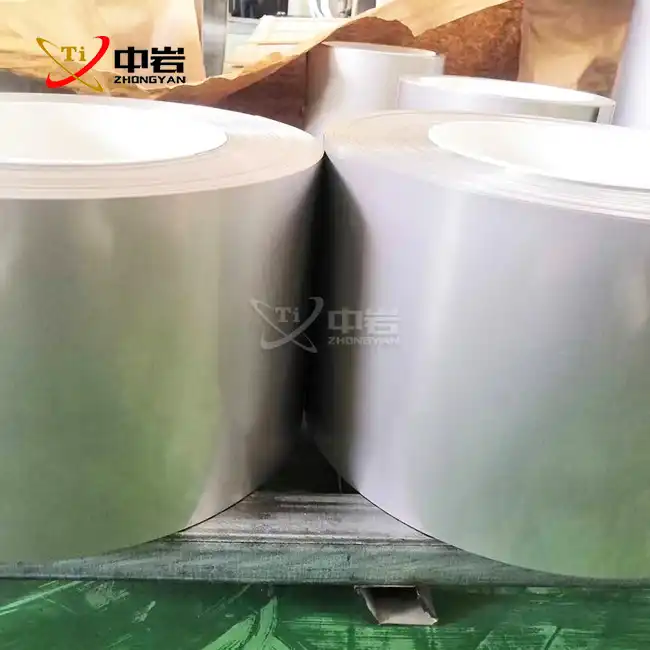
When you need the purest titanium foil that won't rust and is safe for living things, grade 1 titanium foil is the best choice. Titanium that is commercially pure is chemically stable, easy to shape, and light, which makes it very important in fields like electronics, airplanes, medicine, and chemical processing. It's strong for its weight, biocompatible for medical uses, and comes in different sizes (0.01mm to 0.5mm) to meet different building needs.
Understanding Grade 1 Titanium Foil: Properties and Applications
The best titanium you can buy in shops is grade 1 titanium metal. At least 99.5% of it is titanium, and there aren't many other elements in it. It is different from other metal foils on the market because it is so clean. It doesn't rust as easily and gets along better with live things.
Chemical Composition and Purity Standards
The chemicals that make up commercially pure titanium foil are very close to those in ASTM B265 standards. And this makes sure that the quality and performance are always the same. It doesn't rust even in small pieces because it has less than 0.18% air and less than 0.20% iron. However, it is very flexible. During the making process, intermediate parts need to be carefully watched over. The mechanical properties of the material and how easy it is to work with are both changed by this. This level of accuracy lets you make very thin foils that still have a good surface and structure.
Mechanical Properties and Performance Characteristics
This Grade 1 titanium foil is very thin, but it has great tensile properties. You can pull on it 240 MPa and stretch it 170 MPa. This means it can hold buildings up well and is still easy to shape for complicated manufacturing processes. The material is very flexible—it can stretch more than 24%—so it can be shaped in many different ways without coming apart. It is very helpful to have this trait because it makes the material more flexible when it needs to be deep drawn, stamped, or rolled.
Industrial Applications Across Multiple Sectors
In the aircraft business, this material is used to make heat shields, lightweight thermal protection systems, and parts that don't rust. Cutting weight has a direct effect on how fast you go and how much gas you use. This material is great for these tough jobs because it can handle changes in temperature and still keep its shape. Making medical devices that are biocompatible is important to those who make them because they use them to make sure that patients are safe and that the materials used are pure. It is the best for many medical uses because it doesn't have any dangerous chemicals in it and works well with tissues.
Comparing Grade 1 Titanium Foil with Other Foil Grades and Metals
Workers who buy titanium can make smart decisions based on the needs of the application if they know the order of the materials in the different types. Each grade has its own pros and cons that depend on how it will be used and where it is placed.
Grade Comparison Within the Titanium Family
The purest type of titanium, which is also the most valuable, is type 1 titanium foil. That makes it less likely to rust than Grades 2, 3, and 4. Grade 1 is still the best for important uses because it is the most acid-resistant and easy to shape.
From Grade 1 to Grade 4, the metal gets stronger, but less flexible and less resistant to rust. The lower strength of Grade 1 is actually a good thing when the material needs to be shaped a lot or is in an environment that is very corrosive, and long-term stable is more important than original strength numbers.
Performance Comparison with Alternative Materials
There are 4.5 g/cm³ of titanium Grade 1 foil in comparison to 8.0 g/cm³ of stainless steel foil. This means that titanium Grade 1 foil is 44% lighter than stainless steel foil while still being strong. This weight advantage means better speed and lower running costs in cars and planes. Even though aluminum foil is lighter than titanium Grade 1, it doesn't hold up as well against rust or changes in temperature. In chemical processes, aluminum would break down very quickly, but titanium foil will always have the same properties. In the long run, this saves money because it doesn't need to be fixed or changed as often. To be fair, titanium foil does cost more at first, but it usually ends up being cheaper in the long run because it lasts longer and works better in tough environments than other materials that need to be fixed or changed more often.
Core Advantages of Grade 1 Titanium Foil for Global B2B Clients
Titanium foil that you can buy in shops has a unique set of properties that make it very useful for fixing important issues in many fields. When hiring teams know about these benefits, they can pick the best supplies for the job, which will save time and money in the long run.
Exceptional Corrosion Resistance Performance
It is very hard for Grade 1 titanium foil to rust because it makes a stable, self-healing oxide layer when it comes in touch with air. This safe layer stays in place even though it is near strong chemicals like chlorine gas, nitric acid, and seawater. In the business world, tests have shown that titanium foil stays strong in places where other metals that don't rust break down in months. In chemical plants and at sea, this performance edge means that equipment will last longer and cost less to keep.
Superior Strength-to-Weight Ratio Benefits
They can come up with new ideas that wouldn't have been possible with regular materials because titanium foil is very strong for its weight. Engineers can make parts lighter without changing or hurting how well the system works. This helps the product work better and use less power. In aerospace, this drop in weight immediately means less fuel use and more space for cargo. Implants and tools that are lighter are better for manufacturers of medical equipment because they make patients less stressed while still meeting standards for strength and longevity.
Biocompatibility and Medical Grade Compliance
Grade 1 titanium foil is the best choice for medical uses, where the material needs to be carefully kept away from human skin because it is completely safe. Neutrality means that the substance doesn't hurt living things and stays stable in the body for a long time. As long as medical device makers follow the ASTM F67 standards for surgical implants, their products will always be of good quality and work properly. Following the law takes away the stress of worrying about how to get things approved, and it speeds up the process of making new goods.
Customization Capabilities and Flexibility
With the tools we have now, we can exactly control the width between 0.01mm and 0.5mm, which lets us make the best product for every use. It's possible to make a lot of things with lengths of up to 1000 mm because the qualities of the material stay the same all over the surface. Services that cut and pack materials to order make sure that they are ready to be used right away in the production process. This part of the service cuts down on what the store needs and stops the waste that comes from getting too much.
Procurement Insights: How to Source and Select Grade 1 Titanium Foil?
To buy good titanium foil, you need to know what the seller can do, what licenses they need, and how the market works, as this affects supply and price. Buying in a strategic way can have a big impact on both the quality of the results and the total cost of the purchase.
Supplier Evaluation Criteria and Certifications
Suppliers you can trust must show that they follow quality standards around the world, such as ISO9001:2015, ASTM B265, and AMS. There are strict rules about how things are made and how they should behave, and these certificates make sure that they always meet those rules. You should look at the production tools, quality control systems, and expert help resources when you review a manufacturing capability. Companies that offer advanced CNC machining and exact cutting can make their goods more valuable by combining their manufacturing solutions.
Strategic Procurement Approaches
When you buy in bulk, you can save a lot of money and be sure you always have the things you need for your project. To get the best overall procurement costs, procurement teams need to see how much it costs to keep items in stock, how many items they need to buy, and how much space they have. Services that offer custom sizes and accurate cutting get rid of materials that aren't needed and reduce the need for extra work. When you offer services that add value, you can usually charge more because they make better use of products and lower the cost of work.
Market Dynamics and Pricing Considerations
The cost of the raw materials is the main thing that changes the price of titanium foil. What changes the market is how much titanium sponge is available and how much people want it. When you know about these market trends, you can choose the best times to buy big things and sign long-term contracts. The end price depends a lot on how hard it is to process and how high the quality standards are. Prices go up for things with stricter specs and more specialized surface processes. Procurement teams should be clear about specs so that people don't waste money on things that aren't needed and so that the goods work well for what they're supposed to do.
Practical Guidance: How to Handle and Work with Grade 1 Titanium Foil?
Titanium foil needs to be treated and worked with in a certain way during the production process so that it keeps its strength and performance. By following the right steps, you can make sure that the materials are used well and that the quality of the end product stays the same.
Cutting and Fabrication Techniques
For precise cutting, you need tools that are made just for titanium so that the edge stays sharp and doesn't get dirty. Laser cutting is the best way to make clean cuts with few hot spots. Precision shears are a cheaper way to cut forms that aren't too complicated. To keep things clean, you should only use certain cutting tools, wipe down the work area, and stay away from metals that could galvanic rust. You can protect the titanium foil's ability to avoid rust by following these steps. This makes it useful for important tasks.
Storage and Environmental Controls
If you want to store things correctly, you need to keep them somewhere dry and away from things that could damage the surface. Protective packing keeps things clean and stops damage to metal from happening while they are being moved and handled. When you store something at a certain temperature, the temperature changes that cause thin foil materials to expand and shrink stop happening. When environmental conditions stay the same, things keep their stable sizes and qualities over long periods of time.
Quality Control and Inspection Protocols
To make sure that standards are met, materials should be checked often to see how thick they are, how good their surface is, and how accurate their measures are. Testing methods that don't damage the material keep its structure while showing its chemical and mechanical properties. To meet the needs of important uses that need to be able to track things, paperwork systems need to keep records, material licenses, and inspection results. In a lot of different types of companies, this knowledge helps with legal compliance and quality control programs.
Conclusion
Grade 1 titanium foil is the most efficient because it is very pure, doesn't rust, and can be used with living things. It has a high strength-to-weight ratio, can be cut to any size, and has been shown to meet international standards. This makes it the best choice for tough aircraft, medical, chemical processing, and electronics uses. A smart way to buy things that focuses on source certifications, quality control skills, and value-added services makes sure that materials work well together, lowers costs, and boosts performance over time.
FAQ
What distinguishes Grade 1 from Grade 2 titanium foil in terms of performance?
Grade 1 titanium foil is purer than Grade 2 titanium foil (at least 99.5% titanium content). This makes it harder to rust and easier to shape. Grade 2 is a bit stronger than Grade 1, but Grade 1 is better for uses that need to be more resistant to chemicals and are safe for living things. This is why it's the best material for medical gadgets and tools used to work with chemicals.
How does thickness customization affect the properties of titanium foil?
Going from 0.01mm to 0.5mm in width doesn't change the material's features, but it does change how it handles and what it can be used for. As you shape the metal, smaller sizes give you more freedom, while larger parts give the structure more support. The biocompatibility and rust protection of Grade 1 titanium are the same across all thickness ranges.
What are the key considerations for long-term storage of titanium foil?
Keep titanium foil in a clean, dry place and in a safe package so that it doesn't get dirty or broken by mechanical forces. In order to avoid heat stress and galvanic rusting, it is best to keep ferrous items away from the metal. Since materials don't change over time when they are kept properly, they are always ready to be used in making things.
Which industries benefit most from ASTM B265 compliance?
To make sure quality and follow the rules, companies that make aerospace products, medical devices, chemicals, and electronics must tightly follow ASTM B265 standards. This approval makes sure that the material's qualities don't change, that they can be watched, and that they always work. This is important for uses that are very important and where a failure of the material could have bad results.
How do OEM cutting and packaging services add value to procurement processes?
You don't have to waste as much material when you use a custom cutting service. They also make sure that the measurements are correct so that they can be used right away in production. The right kind of wrapping keeps things safe while they're being shipped and kept, and it also makes them easy to work with during production. Usually, the lower costs of labor and better use of products make up for the higher prices of these services.
Partner with Zhongyan for Premium Grade 1 Titanium Foil Solutions
Zhongyan is a well-known company that makes grade 1 titanium foil, so you can count on their quality and reliability. Because we are in China's Titanium Valley, we can give cheap materials that meet ASTM B265 standards. There are different thickness options available as part of our high-tech production services. We also offer exact OEM cutting and full quality assurance programs that meet the strict needs of aerospace, medical, and chemical processing uses. Because we are ISO9001:2015 certified and have worked with titanium goods for many years, we can promise you steady quality and on-time delivery for your important projects. You can email our team at sales@titaniumstudy.com to talk about your specific needs and find out how our premium grade 1 titanium foil for sale can help you make your manufacturing processes better and get better long-term results.
References
1. Boyer, R. R. "An Overview on the Use of Titanium in the Aerospace Industry." Materials Science and Engineering: A, 213(1-2), 103-114.
2. Froes, F. H. "Titanium: Physical Metallurgy, Processing, and Applications." ASM International, Materials Park, OH.
3. Brunette, D. M., Tengvall, P., Textor, M., & Thomsen, P. "Titanium in Medicine: Material Science, Surface Science, Engineering, Biological Responses and Medical Applications." Springer-Verlag Berlin Heidelberg.
4. Donachie, M. J. "Titanium: A Technical Guide, 2nd Edition." ASM International, Materials Park, OH.
5. Peters, M., Kumpfert, J., Ward, C. H., & Leyens, C. "Titanium Alloys for Aerospace Applications." Advanced Engineering Materials, 5(6), 419-427.
6. ASTM International. "Standard Specification for Titanium and Titanium Alloy Strip, Sheet, and Plate." ASTM B265-20, West Conshohocken, PA.
Learn about our latest products and discounts through SMS or email