- English
- French
- German
- Portuguese
- Spanish
- Russian
- Japanese
- Korean
- Arabic
- Greek
- German
- Turkish
- Italian
- Danish
- Romanian
- Indonesian
- Czech
- Afrikaans
- Swedish
- Polish
- Basque
- Catalan
- Esperanto
- Hindi
- Lao
- Albanian
- Amharic
- Armenian
- Azerbaijani
- Belarusian
- Bengali
- Bosnian
- Bulgarian
- Cebuano
- Chichewa
- Corsican
- Croatian
- Dutch
- Estonian
- Filipino
- Finnish
- Frisian
- Galician
- Georgian
- Gujarati
- Haitian
- Hausa
- Hawaiian
- Hebrew
- Hmong
- Hungarian
- Icelandic
- Igbo
- Javanese
- Kannada
- Kazakh
- Khmer
- Kurdish
- Kyrgyz
- Latin
- Latvian
- Lithuanian
- Luxembou..
- Macedonian
- Malagasy
- Malay
- Malayalam
- Maltese
- Maori
- Marathi
- Mongolian
- Burmese
- Nepali
- Norwegian
- Pashto
- Persian
- Punjabi
- Serbian
- Sesotho
- Sinhala
- Slovak
- Slovenian
- Somali
- Samoan
- Scots Gaelic
- Shona
- Sindhi
- Sundanese
- Swahili
- Tajik
- Tamil
- Telugu
- Thai
- Ukrainian
- Urdu
- Uzbek
- Vietnamese
- Welsh
- Xhosa
- Yiddish
- Yoruba
- Zulu
How Strong Is Titanium Metal Wire for Industrial Use?
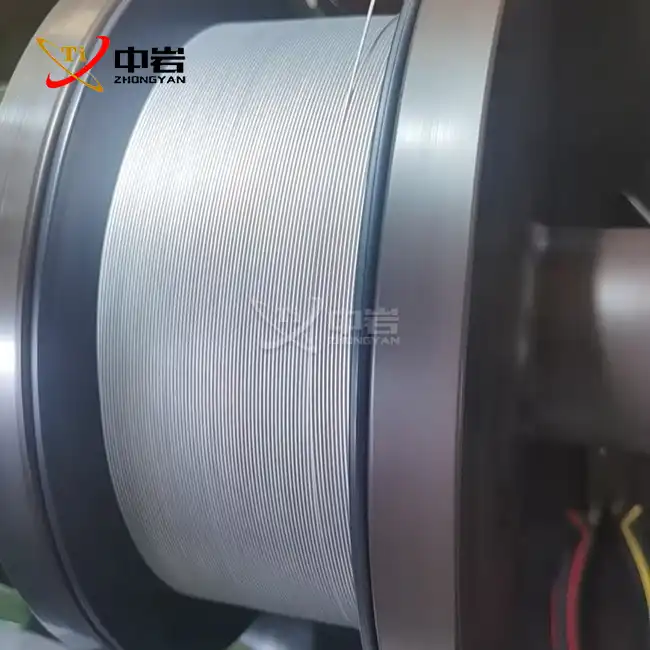
Titanium metal wire used in industry has a very high tensile strength that can range from 345 MPa to 895 MPa, based on the grade and alloy mix. Commercially pure Grade 2 titanium wire has a tensile strength of at least 345 MPa and is very resistant to rust. Grade 5 mixed wire can reach up to 895 MPa. Titanium metal wire for industrial applications is very strong for its weight, and they are also very resistant to chemicals and biocompatible. Because of these qualities, they are the best choice for aerospace fasteners, medical implants, chemical processing equipment, and high-performance manufacturing tasks that need to be reliable in harsh conditions.
Understanding Titanium Metal Wire Properties and Composition
The mechanical properties of titanium wire stem from its unique crystal structure and alloy makeup. Titanium forms a solid oxide layer (TiO2) on its own, which makes it very resistant to corrosion in harsh conditions.
Chemical Composition and Grade Classifications
Commercially pure titanium types (1-4) have very few alloying elements. The level of strength is determined by the amount of oxygen present. The most common commercial grade of titanium is grade 2, which has the best mix of strength, ductility, and resistance to corrosion. The chemical makeup is made up of:
- Titanium: at least 99.2%
- Oxygen: no more than 0.25%
- Iron: no more than 0.30%
- Carbon: no more than 0.10%
- Nitrogen: no more than 0.03%
- Hydrogen: no more than 0.015%
Some alloy types, like Ti-6Al-4V (Grade 5), have aluminum and vanadium added to them to make them much stronger. This alpha-beta metal has tensile strengths higher than 895 MPa and is very resistant to wear.
Mechanical Properties and Performance Characteristics
Titanium wire used in industry has amazing engineering qualities that are better than those of many other metals. Most of the time, the yield strength is between 275 MPa for Grade 2 alloys and 828 MPa for Grade 5 metals. These qualities don't change much at different temperatures. For example, titanium stays structurally sound at temperatures up to 400°C. Titanium's value of elasticity (110 GPa) is about half that of steel. This gives it great springback properties that are important for uses that need elastic bending. This property makes titanium metal wire for industrial applications particularly valuable in the production of springs and the design of flexible components. Another important benefit is that titanium wire has higher endurance limits than stainless steel options when it comes to fatigue resistance. According to research, titanium parts can go through millions of stress cycles without breaking. This makes them perfect for uses that need to handle dynamic loads.
Comparing Titanium Wire Strength to Other Industrial Metals
The strength comparison between titanium and other industrial metals reveals significant advantages in some situations. Knowing about these differences helps people who work in buying choose materials in a smart way.
Titanium vs. Stainless Steel Performance
The tensile strength of stainless steel 316L is between 485 and 620 MPa, and its density is 8 g/cm³. It is often used in industrial settings. However, Grade 2 titanium has the same level of corrosion protection and a compressive strength of 345 MPa while having a density of only 4.51 g/cm³. This means that the structure has a higher strength-to-weight ratio, which lowers the loads on it and makes the system work better. A study of corrosion protection shows that titanium is better in chloride environments. Stainless steel can split and crack when it comes into contact with seawater, but titanium doesn't break down at all when chloride is present. Because of this benefit, protective coverings are not needed, and upkeep needs are greatly reduced.
Heat Resistance and Thermal Properties
Titanium wire keeps its mechanical qualities at high temperatures, where aluminum and other common metals break down. Its freezing point of 1668°C gives it a lot of safety in high-temperature situations. Titanium's low thermal conductivity (6.7 W/m·K) makes it perfect for thermal barriers and stops heat from moving through sensitive equipment. Even though aluminum wire is light, it loses its strength quickly above 200°C and can't handle the rust that happens in tough industrial settings. Nickel-based metals work well at high temperatures, but they are much more expensive and have much higher densities. For many uses, titanium is the best balance.
Industrial Applications and Advantages of Titanium Metal Wire
Opportunities are created across a variety of industry areas by the special properties of titanium metal wire for industrial use. Applications in the real world show how flexible the material is and how well it works in tough conditions.
Aerospace and Defense Applications
Titanium wire is used by aerospace companies to make important fasteners, safety lines, and structural parts. Reducing weight has a direct effect on fuel economy and payload capacity. Due to its ability to stay strong at high altitudes and prevent corrosion from the air, the wire is essential for use in airplanes. Specifications from Boeing and Airbus often call for landing gear springs, control wire assemblies, and engine mount parts to be made of titanium. Titanium wire's resistance to fatigue means that it will work reliably throughout an airplane's service life. This lowers the cost of upkeep and raises the safety gaps. Defence uses include missile tracking systems, submarine parts, and protection for military vehicles, all of which need to be resistant to rust and work with electromagnetic fields. Titanium doesn't conduct electricity, so it doesn't mess up critical electrical systems.
Medical Device Manufacturing
Biocompatible titanium wire is used to make orthodontic devices, medical tools, and devices that are implanted in the body. The material is safe for patients and lasts a long time because it is non-toxic and doesn't absorb body fluids. It has been shown that cardiovascular stents made from titanium wire work better than those made from stainless steel. Long-term biocompatibility is better, and inflammatory reactions are lowered in clinical tests. Because titanium is radiolucent, it doesn't get in the way of images during medical treatments. Bone fixation wires, spine plates, and joint replacement parts are all used in orthopedics. The value of flexibility is very close to that of bone tissue. This means that there aren't as many stress shielding effects, which can cause bone to break down around implants.
Chemical Processing and Industrial Equipment
Companies that process chemicals use titanium metal wire for industrial equipment that is used in corrosive conditions. It is used in places where regular materials break down quickly, like in heat exchanger parts, filter elements, and process pipes. Titanium is resistant to chlorine and sodium hydroxide, which is good for chlor-alkali plants. Equipment manufactured with titanium wire components lasts more than 20 years without needing to be replaced, while systems made of stainless steel need to be replaced every 3 to 5 years. Desalination plants all over the world use titanium parts in their systems that handle seawater. The material is resistant to biofouling and pitting rust, so it can be used continuously without losing its effectiveness.
Procuring Industrial-Grade Titanium Metal Wire — What You Need to Know
To buy titanium wire successfully, you need to know the approval requirements, quality standards, and seller capabilities. Specifications and sources that are done correctly ensure that materials work well and follow the rules.
Certification and Quality Standards
Titanium wire used in industry has to meet strict standards, such as ASTM B863 for general uses and AWS A5.16 for welding supplies. The limits for chemical composition, mechanical qualities, and dimensional tolerances are set out in these specs so that the product always works the same way. ISO 9001:2015 certification makes sure that sellers keep up quality control systems that can make sure goods are always the same. For aerospace uses, you need extra AS9100 approval that shows you meet the quality standards for aerospace. Each package needs to have a mill test certificate (MTC) that shows the results of the chemical analysis, mechanical testing, and measurement checks. Important applications might need testing by a third party to make sure they meet the standards of the design.
Sizing Options and Customization Capabilities
Standard titanium wire comes in widths of 0.5mm to 3.0mm, but you can get it in any size you need for your purpose. Ø0.8mm ×500m coils are a popular type of industrial packaging that makes it easy to handle and keep track of goods. Bright annealed, pickled, and polished are some surface finishes. When it comes to making, bright annealed wire is the most flexible, and a pickled surface gets rid of rust scale for welding. For precise tasks, tolerance requirements usually allow for ±0.01mm circle accuracy. Standard configurations have coil weights running from 10 to 15 kg per spool, but custom packaging choices can be made to fit specific production needs. For specific uses that need few joints, larger coils or straight lengths are available.
Supply Chain Considerations and Lead Times
Titanium metal wire for industrial applications typically requires 4 to 8 weeks' lead time for normal grades. Custom alloys, on the other hand, need longer delivery times. Keeping smart amounts of inventory helps keep production going even when there are problems in the supply chain. Minimum order amounts depend on the diameter and grade, but for common setups, they usually start at 100 kg. Buying in bulk saves money and makes sure that the features of materials in different production lots are the same. Global shipping makes it possible to send goods all over the world, and the right packing protects the goods while they're in transit. Material certificates, shipping manifests, and customs statements for foreign exports are all types of paperwork that are needed.
Making the Right Choice: Titanium Wire in Your Industrial Supply Chain
To choose the right titanium wire types, you have to balance performance needs with cost concerns and the supplier's skills. Making strategic decisions improves both short-term results and long-term value.
Grade Selection Criteria
In most industrial settings, grade 2 titanium works very well for most tasks because it is very resistant to rust and easy to shape. Applications that need more strength should look at Grade 5 metal, even though it costs more. This is because it has better mechanical features. The right score is chosen based on an estimate of environmental exposure. For chloride protection, marine settings need at least Grade 2, and high-temperature uses may need Grade 5 for strength retention. Chemical compatibility testing makes sure that a material can be used in a certain way. A cost-benefit study should look at the total costs over the whole lifecycle, such as the price of the materials, the time they take to process, the upkeep they need, and how often they need to be replaced. Titanium wire is more expensive, but it lasts longer and needs less upkeep, so it's usually worth it.
Long-term Value and Performance Benefits
Titanium metal wire for industrial applications delivers an exceptional return on investment through reduced maintenance requirements and extended service intervals. The material's corrosion immunity eliminates the need for protective coatings and reduces inspection frequency. The benefits of reducing weight build-up throughout the design of the system allow for smaller support structures and fewer base needs. In aerospace uses, fuel is saved over the life of an aircraft, and in car applications, vehicles run better and use less fuel. Some benefits of environmental sustainability are being able to recycle and use fewer resources over the course of a product's lifetime. Titanium's longevity means that it doesn't need to be replaced as often, which saves material and reduces waste.
Conclusion
Titanium metal wire for industrial applications represents a smart material choice for tough places where strength, resistance to rust, and dependability are very important. Titanium wire is better than other materials in aircraft, medicine, and chemical processes because it has tensile strengths between 345 MPa and 895 MPa and a higher strength-to-weight ratio. The material's unique mix of biocompatibility, resistance to corrosion, and wear resistance promises long-term worth, even though it costs more at first. For implementation to go smoothly, the right grade must be chosen, approved providers must be used, and all application standards must be fully understood.
FAQ
What tensile strength can I expect from industrial titanium wire?
Industrial titanium wire tensile strength varies by grade. Grade 5 metal can reach up to 895 MPa, while commercially pure Grade 2 can reach up to 345 MPa. These numbers show the weakest strengths that are promised. In practice, strengths are often higher than these numbers.
How does titanium wire compare to stainless steel in corrosive environments?
Titanium wire is more resistant to rust than stainless steel, especially in places where chlorine is present. While stainless steel can split and crack when it comes into contact with seawater, titanium doesn't break down at all when chloride is present, even without protective layers.
What diameter options are available for custom applications?
Standard titanium metal wire for industrial applications typically has a width of between 0.5 mm and 3.0 mm, but special sizes are also available. Ø0.8mm ×500m coils that weigh 10–15 kg per spool are a common design and work well with automatic feeding systems.
Can titanium wire withstand high-temperature applications?
Titanium wire keeps its mechanical qualities at temperatures up to 400°C, and Grade 5 metal performs better at high temperatures. The material can be used in difficult thermal cycle applications because it doesn't expand or contract much when heated or cooled and doesn't oxidize easily.
What certifications should I require from titanium wire suppliers?
Asbestos must meet ASTM B863 standards for general industry uses and AWS A5.16 standards for welding supplies. Suppliers should keep their ISO 9001:2015 certification up to date. For aircraft uses, they need to add AS9100 certification and full mill test certificates.
Partner with Zhongyan for Premium Titanium Metal Wire Solutions
You can trust Zhongyan as your titanium metal wire for industrial provider. They make great goods by mixing advanced manufacturing with strict quality control. The Ø0.8mm ×500m CP Grade 2 titanium wire we sell meets ASTM B863 standards and has a tensile strength of at least 345 MPa, making it great for use in chemical processing, aircraft, and medicine. We are in China's Titanium Valley, which gives us access to cheaper materials and the most up-to-date CNC machining technology. This lets us offer custom sizes from 0.5mm to 3mm with full tracking. Get in touch with our technical team at sales@titaniumstudy.com to talk about your unique needs and see why global makers trust us.
References
1. American Society for Testing and Materials. "Standard Specification for Titanium Wire and Rod." ASTM B863-20, West Conshohocken, PA, 2020.
2. Boyer, Rodney R. "An Overview on the Use of Titanium in the Aerospace Industry." Materials Science and Engineering: A, vol. 213, no. 1-2, pp. 103-114, 1996.
3. Lutjering, Gerd, and James C. Williams. "Titanium: Engineering Materials and Processes." 2nd Edition, Springer-Verlag, Berlin, 2007.
4. Donachie, Matthew J. "Titanium: A Technical Guide." 2nd Edition, ASM International, Materials Park, OH, 2000.
5. International Organization for Standardization. "Titanium and Titanium Alloys - Chemical Composition and Form of Products." ISO 5832-2:2018, Geneva, Switzerland, 2018.
6. Peters, Manfred, et al. "Structure and Properties of Titanium and Titanium Alloys." Titanium and Titanium Alloys: Fundamentals and Applications, Wiley-VCH, Weinheim, 2003.
Learn about our latest products and discounts through SMS or email