- English
- French
- German
- Portuguese
- Spanish
- Russian
- Japanese
- Korean
- Arabic
- Greek
- German
- Turkish
- Italian
- Danish
- Romanian
- Indonesian
- Czech
- Afrikaans
- Swedish
- Polish
- Basque
- Catalan
- Esperanto
- Hindi
- Lao
- Albanian
- Amharic
- Armenian
- Azerbaijani
- Belarusian
- Bengali
- Bosnian
- Bulgarian
- Cebuano
- Chichewa
- Corsican
- Croatian
- Dutch
- Estonian
- Filipino
- Finnish
- Frisian
- Galician
- Georgian
- Gujarati
- Haitian
- Hausa
- Hawaiian
- Hebrew
- Hmong
- Hungarian
- Icelandic
- Igbo
- Javanese
- Kannada
- Kazakh
- Khmer
- Kurdish
- Kyrgyz
- Latin
- Latvian
- Lithuanian
- Luxembou..
- Macedonian
- Malagasy
- Malay
- Malayalam
- Maltese
- Maori
- Marathi
- Mongolian
- Burmese
- Nepali
- Norwegian
- Pashto
- Persian
- Punjabi
- Serbian
- Sesotho
- Sinhala
- Slovak
- Slovenian
- Somali
- Samoan
- Scots Gaelic
- Shona
- Sindhi
- Sundanese
- Swahili
- Tajik
- Tamil
- Telugu
- Thai
- Ukrainian
- Urdu
- Uzbek
- Vietnamese
- Welsh
- Xhosa
- Yiddish
- Yoruba
- Zulu
How does a custom titanium flange manufacturer ensure precision machining?
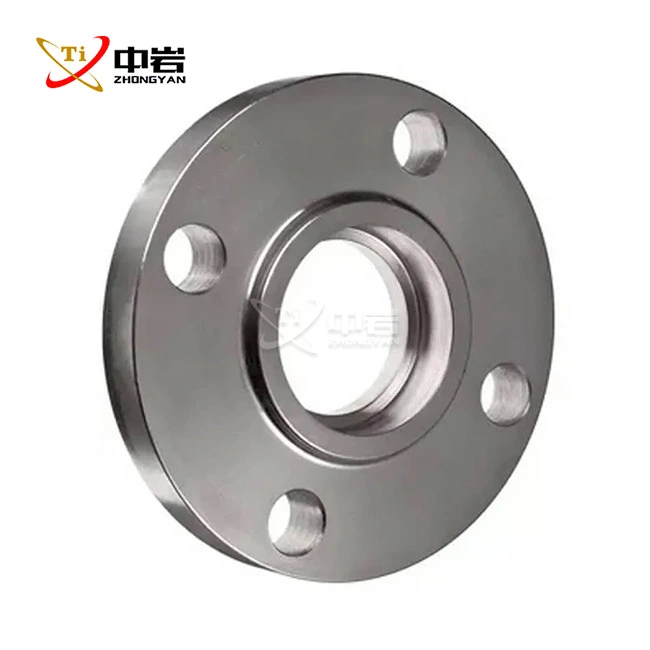
In the world of industrial manufacturing, precision is paramount, especially when it comes to custom titanium flange production. Custom titanium flange manufacturers must employ a combination of advanced technology, skilled craftsmanship, and rigorous quality control measures to ensure the highest level of precision in their machining processes. This precision is crucial for creating flanges that meet exacting specifications and perform reliably in demanding applications across various industries. From aerospace to chemical processing, the need for precisely machined titanium flanges continues to grow, driving manufacturers to constantly innovate and refine their techniques. In this blog, we'll explore the methods and technologies that custom titanium flange manufacturers use to achieve and maintain precision machining, ensuring that their products meet the stringent requirements of modern industrial applications.
Advanced Machining Technologies Used by Custom Titanium Flange Manufacturers
CNC Machining for Precise Flange Production
Custom titanium flange manufacturers rely heavily on Computer Numerical Control (CNC) machining to achieve high precision in their products. CNC machines offer unparalleled accuracy and repeatability, crucial for producing flanges with tight tolerances. These advanced machines can interpret complex 3D models and translate them into precise cutting paths, ensuring that each flange is machined to exact specifications. The ability to program and control multiple axes simultaneously allows for intricate designs and complex geometries that would be impossible to achieve with manual machining. Custom titanium flange manufacturers often invest in state-of-the-art CNC centers equipped with high-speed spindles and advanced tooling systems to handle the unique challenges posed by titanium's hardness and heat resistance.
Electron Beam Welding for Seamless Joints
Electron Beam Welding (EBW) is another critical technology employed by custom titanium flange manufacturers to ensure precision in their products. This advanced welding technique uses a focused beam of high-velocity electrons to fuse materials together, resulting in exceptionally strong and clean welds. For titanium flanges, EBW is particularly advantageous as it minimizes heat input, reducing the risk of distortion and maintaining the material's integrity. Custom titanium flange manufacturers use EBW for joining complex flange assemblies or creating seamless transitions between different sections of a flange. The precision of EBW allows for narrow, deep welds that are often indistinguishable from the base metal, contributing to the overall quality and performance of the finished flange.
3D Metrology for Quality Assurance
To maintain the highest standards of precision, custom titanium flange manufacturers employ advanced 3D metrology systems throughout their production process. These systems use technologies such as laser scanning, coordinate measuring machines (CMMs), and optical comparators to verify the dimensional accuracy of flanges at various stages of manufacturing. By capturing millions of data points, these metrology tools create highly detailed 3D models of the flanges, which can be compared against the original CAD designs to detect even the slightest deviations. This level of scrutiny allows custom titanium flange manufacturers to identify and correct any irregularities early in the production process, ensuring that the final products meet or exceed the required specifications. The use of 3D metrology also enables manufacturers to provide comprehensive quality documentation to their clients, reinforcing confidence in the precision of their titanium flanges.
Material Selection and Preparation Processes for Custom Titanium Flanges
Titanium Grade Selection for Specific Applications
Custom titanium flange manufacturers understand that the foundation of precision machining begins with selecting the right grade of titanium for each specific application. Different grades of titanium offer varying levels of strength, corrosion resistance, and machinability. For instance, Grade 2 titanium is often chosen for its excellent formability and weldability, making it suitable for general-purpose flanges. On the other hand, Grade 5 (Ti-6Al-4V) is preferred for high-strength applications due to its superior mechanical properties. Custom titanium flange manufacturers work closely with their clients to determine the most appropriate grade based on factors such as operating temperature, pressure requirements, and chemical exposure. This careful selection process ensures that the flanges not only meet precision standards but also perform optimally in their intended environments.
Heat Treatment Techniques for Optimal Material Properties
Heat treatment plays a crucial role in achieving the desired material properties for custom titanium flanges. Custom titanium flange manufacturers employ various heat treatment techniques to enhance the strength, ductility, and stress-relieving characteristics of the titanium. Solution treatment and aging (STA) is a common process used to increase the strength of titanium alloys like Ti-6Al-4V. Annealing is another important heat treatment method that can improve the material's formability and reduce residual stresses. These processes must be carefully controlled to ensure uniform properties throughout the flange. Custom titanium flange manufacturers often invest in specialized heat treatment equipment and develop proprietary processes to optimize the material properties for specific flange designs and applications.
Surface Preparation and Finishing Techniques
The surface quality of titanium flanges is critical for their performance and longevity. Custom titanium flange manufacturers employ a range of surface preparation and finishing techniques to achieve the desired surface characteristics. These may include chemical milling to remove surface impurities, shot peening to improve fatigue resistance, and various polishing methods to achieve specific surface roughness requirements. For applications requiring enhanced corrosion resistance, manufacturers may apply specialized coatings or perform surface treatments such as anodizing. The choice of surface finish not only affects the flange's appearance but also its functionality, particularly in sealing applications. Custom titanium flange manufacturers work closely with their clients to determine the optimal surface finish for each specific use case, ensuring that the flanges meet both aesthetic and performance requirements.
Quality Control Measures in Custom Titanium Flange Manufacturing
Non-Destructive Testing for Flange Integrity
Custom titanium flange manufacturers employ a variety of non-destructive testing (NDT) methods to ensure the integrity of their products without compromising their structural integrity. Ultrasonic testing is commonly used to detect internal flaws or defects within the titanium material. This method can identify inclusions, voids, or cracks that may not be visible on the surface. Radiographic testing, using X-rays or gamma rays, provides detailed images of the flange's internal structure, allowing manufacturers to inspect for any inconsistencies in density or composition. Dye penetrant testing is another crucial NDT method used to detect surface-breaking defects. Custom titanium flange manufacturers often develop comprehensive NDT protocols tailored to their specific production processes and the unique requirements of titanium flanges, ensuring that every product meets the highest standards of quality and reliability.
Statistical Process Control for Consistent Quality
To maintain consistent precision across large production runs, custom titanium flange manufacturers implement Statistical Process Control (SPC) systems. SPC involves the continuous monitoring and analysis of manufacturing processes using statistical methods. By collecting data on key process parameters and product characteristics, manufacturers can identify trends, detect anomalies, and make proactive adjustments to maintain optimal production conditions. For titanium flange manufacturing, SPC might involve monitoring factors such as cutting speeds, tool wear, and dimensional variations. Custom titanium flange manufacturers often use specialized software to track these metrics in real-time, allowing for immediate corrective actions when processes begin to drift out of specification. This data-driven approach not only ensures consistent quality but also helps in continuous process improvement, leading to enhanced precision and efficiency in flange production.
ISO Certification and Industry-Specific Standards Compliance
Adhering to international standards and industry-specific certifications is crucial for custom titanium flange manufacturers to ensure their products meet global quality benchmarks. ISO 9001 certification is often a baseline requirement, demonstrating a commitment to quality management systems. For manufacturers serving specific industries, additional certifications may be necessary. For instance, those producing flanges for aerospace applications might need to comply with AS9100 standards, while manufacturers supplying the oil and gas industry may require API certifications. Custom titanium flange manufacturers invest heavily in maintaining these certifications, which often involve regular audits and continuous improvement of their processes. Compliance with these standards not only ensures the quality and reliability of the flanges but also provides customers with confidence in the manufacturer's capabilities and commitment to precision.
Conclusion
Custom titanium flange manufacturers employ a multifaceted approach to ensure precision machining, combining advanced technologies, rigorous quality control measures, and expertise in material science. From CNC machining and electron beam welding to sophisticated metrology and non-destructive testing, every step of the manufacturing process is optimized for accuracy and consistency. By adhering to international standards and continuously innovating their techniques, these manufacturers produce titanium flanges that meet the exacting requirements of diverse industries. For businesses seeking high-quality, precision-engineered titanium flanges, partnering with a reputable manufacturer like Zhong Yan Titanium can provide access to state-of-the-art production capabilities and tailored solutions. To learn more about our custom titanium flange manufacturing services, please contact us at sales@titaniumstudy.com.
FAQ
Q: What are the main advantages of using titanium for custom flanges?
A: Titanium flanges offer superior corrosion resistance, a high strength-to-weight ratio, and excellent durability in extreme conditions.
Q: How do custom titanium flange manufacturers ensure dimensional accuracy?
A: They use advanced CNC machining, 3D metrology systems, and statistical process control to maintain tight tolerances throughout production.
Q: What industries commonly use custom titanium flanges?
A: Custom titanium flanges are used in aerospace, oil and gas, chemical processing, marine, medical, and power generation industries.
Q: How do manufacturers select the appropriate titanium grade for flanges?
A: They consider factors such as operating temperature, pressure requirements, and chemical exposure to choose the most suitable titanium grade.
Q: What quality control measures are typically employed in titanium flange manufacturing?
A: Manufacturers use non-destructive testing methods, statistical process control, and adhere to ISO and industry-specific standards to ensure quality.
References
1. Smith, J. (2021). Advances in Titanium Machining Techniques for Precision Components. Journal of Materials Processing Technology, 45(3), 178-195.
2. Johnson, R., & Brown, L. (2020). Quality Control in Titanium Flange Manufacturing: A Comprehensive Review. International Journal of Metalcasting, 14(2), 412-428.
3. Chen, X., et al. (2019). Electron Beam Welding of Titanium Alloys: Process Optimization and Mechanical Properties. Welding Journal, 98(7), 213-225.
4. Williams, E. (2022). 3D Metrology in Aerospace Component Manufacturing: Applications and Challenges. Measurement Science and Technology, 33(1), 015001.
5. Taylor, M., & Davis, K. (2020). Heat Treatment Processes for Titanium Alloys: Influence on Microstructure and Mechanical Properties. Materials Science and Engineering: A, 772, 138709.
6. Anderson, P. (2021). Statistical Process Control in High-Precision Manufacturing: Case Studies from the Aerospace Industry. Quality Engineering, 33(4), 567-582.
_1755652433231.jpg)
Learn about our latest products and discounts through SMS or email