- English
- French
- German
- Portuguese
- Spanish
- Russian
- Japanese
- Korean
- Arabic
- Greek
- German
- Turkish
- Italian
- Danish
- Romanian
- Indonesian
- Czech
- Afrikaans
- Swedish
- Polish
- Basque
- Catalan
- Esperanto
- Hindi
- Lao
- Albanian
- Amharic
- Armenian
- Azerbaijani
- Belarusian
- Bengali
- Bosnian
- Bulgarian
- Cebuano
- Chichewa
- Corsican
- Croatian
- Dutch
- Estonian
- Filipino
- Finnish
- Frisian
- Galician
- Georgian
- Gujarati
- Haitian
- Hausa
- Hawaiian
- Hebrew
- Hmong
- Hungarian
- Icelandic
- Igbo
- Javanese
- Kannada
- Kazakh
- Khmer
- Kurdish
- Kyrgyz
- Latin
- Latvian
- Lithuanian
- Luxembou..
- Macedonian
- Malagasy
- Malay
- Malayalam
- Maltese
- Maori
- Marathi
- Mongolian
- Burmese
- Nepali
- Norwegian
- Pashto
- Persian
- Punjabi
- Serbian
- Sesotho
- Sinhala
- Slovak
- Slovenian
- Somali
- Samoan
- Scots Gaelic
- Shona
- Sindhi
- Sundanese
- Swahili
- Tajik
- Tamil
- Telugu
- Thai
- Ukrainian
- Urdu
- Uzbek
- Vietnamese
- Welsh
- Xhosa
- Yiddish
- Yoruba
- Zulu
How Do Surface Finishes Affect GR2 Titanium Hex Bar Performance?
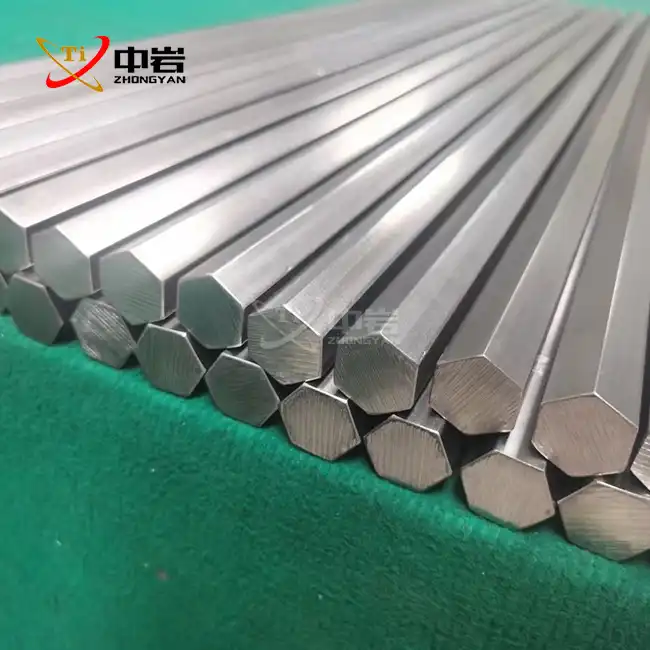
Surface finishes have a big effect on how well thegr2 titanium hex bar works by changing how resistant they are to rust, how long they last, how easy they are to machine, and how stable their dimensions are. A polished surface reduces the number of places where microcracks can start, which extends the service life in cyclic-load aerospace applications. In the making of medical implants, bright anodized finishes improve chemical inertness. When purchasing ASTM B348-compliant titanium hex bar stock, procurement managers need to know about finish specifications such as mill-finish roughness (Ra 3.2 μm) and precision-ground tolerances (h9). These specifications have a direct effect on the reliability of parts, the cost of tools, and compliance with ISO 5832-2 standards in tough industrial settings.
Understanding Surface Finishes on GR2 Titanium Hex Bars
The surface finish of a metal part is its topography and the state of its metalworking on the top layer, which is measured in micrometers of average roughness (Ra). This seemingly small feature controls important performance outcomes in metal production, especially for commercially pure titanium alloys used in biocompatible or corrosive settings.
Defining Surface Finish in Industrial Context
The finish on a gr2 titanium hex bar includes both geometric roughness (measured by peaks and valleys) and surface integrity (measured by residual stress, oxide layer thickness, and microstructural changes). A mill-finished hex bar usually has Ra values between 1.6 and 3.2 μm and has cutting lines that can be seen. It can be used for most industrial fittings. In contrast, a precision-ground finish achieves Ra ≤0.4 μm and dimensional tolerance reaching h9 grade, which is necessary for hydraulic valve stems and closing surfaces where stopping leaks is a must.
Common Surface Finish Classifications
Engineers can define the right techniques when they know the taxonomy of finishes. There are three main types: as-rolled or mill finish, where bars still have forge scale and oxide layers from hot working; machined finishes, which are made by turning or grinding and provide controlled roughness for assembly clearances; and polished finishes, which range from 240-grit satin to mirror-bright electropolish and get rid of surface irregularities that bacteria can live on in pharmaceutical equipment.
Interaction with GR2 Titanium Properties
Commercially pure Grade 2 titanium has many benefits, including a tensile strength of over 345 MPa, high resistance to pitting caused by chloride, and a passive oxide film that fixes itself in oxidizing conditions. Finishing the surface either makes these qualities stronger or weaker. When you compare electropolished parts to rough mill finishes with deep tool marks, the rough mill finish forms stress concentrators that lower fatigue strength by 15 to 20 percent. Chemical pickling in hydrofluoric-nitric acid baths gets rid of dirty top layers while keeping the material's 4.43 g/cm³ density and 114 GPa stiffness, which are important for aircraft frames that need to be light.
Common Surface Finishing Methods for GR2 Titanium Hex Bars
To choose the right finishing method, you have to weigh the needs for surface quality against the costs of production. There are three main methods that factories use, and each one meets a different practical need in B2B supply lines.
Mechanical Finishing Techniques
To get the desired roughness and consistency in dimensions, mechanical methods remove material physically. Using aluminum oxide or silicon carbide wheels to grind gives hex bar sides a uniform Ra 0.8 μm finish, which is perfect for meeting h9 tolerance requirements on 10mm diameter bars that will be used in precision instrument systems. Centerless grinding works really well for making a lot of blank parts for medical devices, and it can keep the diameter the same over 1000mm of length.
As you move from 120-grit roughing passes to 600-grit finishing passes, the abrasive materials used in polishing get thinner. The automatic polishing cells at our facility get surfaces that are very smooth and have Ra values below 0.2 μm. These surfaces meet strict standards for sputtering target substrates because the quality of the thin film deposition depends on how regular the surface is. When metal is cold-drawn instead of hot-rolled, the dimensions are naturally closer together. This means that less material needs to be wasted and less cutting is needed.
Chemical and Electrochemical Methods
Chemical finishing changes the makeup of the surface without taking away a lot of material. Pickling at 50°C in liquids containing 10-15% HF and 30-40% HNO₃ gets rid of heat tint and iron contamination from cutting, leaving a clean layer of titanium oxide. This treatment is necessary before welding or when sending hex bar stock to chemical processing plants that work with reducing acids, where surface contamination could cause rust to start in one area.
Through electrolytic oxidation, anodizing makes controlled oxide layers. Type II anodizing makes films that are 5–25 microns thick and make the material more resistant to wear without changing its HRC 36 hardness. Anodized finishes are used by medical device makers on tooth implant abutments that are machined from hex bar stock because they are biocompatible and provide color-coding for surgical tool identification. Electropolishing, which is basically reverse plating, breaks down surface peaks more efficiently, leaving behind very smooth finishes (Ra <0.1 μm) that keep particles from sticking to semiconductor production tools.
Advanced Surface Treatment Technologies
New coating technologies fill in the gaps in performance in harsh working circumstances. Physical vapor deposition (PVD) adds layers of titanium nitride or chromium nitride to polished gr2 titanium hex bar surfaces. This makes the surface harder (HRC 70+) for wear-critical uses like aircraft actuator shafts that work with rough hydraulic fluids. Using fiber lasers for laser surface melting changes the composition of the top 50–100 micron layer, making the grains smaller and getting rid of casting flaws without changing the main mechanical properties.
Using nitric acid solutions for passivation processes makes the naturally occurring TiO₂ film better at protecting against chloride attack in marine fastener uses. These advanced processes are industrial skills that R&D teams are increasingly asking for as they work on the next generation of equipment for offshore wind farms and desalination plants, where the costs of materials failing quickly rise.
How Surface Finish Influences Key Performance Factors of GR2 Titanium Hex Bar
The link between surface state and component performance can be measured by looking at specific working situations that happen in different industries.
Corrosion Resistance Enhancement
There are two ways that smoother surfaces show significantly better corrosion protection. When the surface is less rough, there are fewer cracks where chloride ions can gather. This keeps the passive film from breaking down in one place. The corrosion rate of electropolished Gr2 titanium hex bar bolts in seawater is less than 0.001 mm/year, while the rate of corrosion for as-machined versions with Ra 1.6 μm finishes is 0.015 mm/year.
For valve stems and pump shafts, chemical processing plants that work with wet chlorine gas use pickling and passivated Gr2 titanium hex bar stock. The chemically cleaned surface keeps its protective oxide structure even when exposed to 90°C chlorine-filled brine. This means that equipment doesn't need to be serviced every 18 months, but more than 5 years. Purchasing managers in pulp and bleaching plants say that lifetime costs are 60% lower when they select properly finished titanium parts instead of replacing them so often with stainless steel ones.
Fatigue Life and Mechanical Strength
The finish on the surface has a big effect on how well it resists wear in cyclic-load situations. Microscopic surface flaws act as stress risers, speeding up the start of cracks during tensile-compressive cycles. According to aerospace testing standards, hex bar fasteners with polished shanks (Ra ≤0.4 μm) have a 10⁷ cycle fatigue life at 60% ultimate tensile strength, while mill-finished versions fail after 4×10⁶ cycles with the same load.
When landing gear parts are made from annealed Gr2 titanium hex bar stock with a bright finish, they have 25–30% higher wear strength than parts with rough-turned surfaces. Precision grinding gets rid of micro-notches, which stop cracks from starting at service pressures below the material's 850 MPa yield strength. As part of our quality control process, we check the finished surfaces for magnetic particles to make sure that no grinding burns or decarburization damage the cold-drawn microstructure before sending it to aircraft OEM customers.
Machinability and Tooling Considerations
The state of the surface has a big impact on the cost of later machining. When compared to hot-rolled stock with scale inclusions, starting with a cold-drawn hex bar with uniform Ra 1.2 μm finishes cuts carbide insert wear by 40% during CNC turning operations. The consistent surface hardness (HRC 36 ±2) lets machine shops find the best cutting settings without having to change tools often. This lowers the cost of making each part for large production runs of medical screws.
Controlled surface finish standards help thread-rolling processes used to make fasteners. When compared to harder starting material, hex bar stock with Ra 0.8 μm ground surfaces makes threads with a better surface finish and better measurement accuracy. When cold forming, there is less friction, which means that die wear rates are lower. This makes production more efficient for automakers who fit the gr2 titanium hex bar into lightweight engine mounting bolts. Consistent dimensions ensure that the right amount of force is maintained across assembly lines.
Temperature Stability Across Operating Ranges
Surfaces that are properly finished stay the same size over the -40°C to +425°C temperature range that is common for Grade 2 titanium uses. The rate of oxidation at high temperatures is controlled by the thickness of the oxide layer. Anodized hex bars have oxidation rates 70% lower than bare metal when exposed continuously to 350°C in aircraft auxiliary power unit housings. The controlled oxide structure stops oxygen from diffusing into the base. This keeps the material's 114 GPa tensile and elastic qualities even when it is heated and cooled many times.
Titanium's resistance to weakening is used in cryogenic uses in LNG transfer systems, where polished hex bar stock keeps its impact toughness below -160°C. The smooth surface keeps ice from forming and sticking to valve stems that work in liquid natural gas settings, so they can be reliably opened and closed without getting stuck. When building offshore facilities, procurement engineers choose electropolished Gr2 titanium hex bar parts for these important safety systems. The quality of the surface has a direct effect on how reliably they work over 20-year service lives.
Choosing the Right Surface Finish: Factors for B2B Procurement Decisions
When you do strategic buying, you have to find a balance between technical requirements and economic facts while keeping the supply chain in mind. Decision models should include more than just unit price as an evaluation criterion.
Aligning Finish Selection with Application Requirements
For aerospace fastener uses, Ra ≤0.8 μm polished finishes are needed to stop fatigue cracks from starting in high-cycle settings. This is why they cost 15-20% more than mill-finished options. Medical implant parts need electropolished surfaces that meet FDA biocompatibility standards. Spending money on surface treatment prevents expensive regulatory compliance failures from happening. Pickled finishes at Ra 1.6 μm are often used on industrial chemical equipment because they are 30% cheaper than polished standards and still provide enough corrosion protection.
Our expert team helps procurement managers figure out the minimum acceptable surface standards by doing failure mode analysis. Over-specifying the finish quality drives up costs for no reason, while under-specifying it increases the chance of early component failure and guarantee claims. A methodical approach that looks at load conditions, environmental exposure, and legal requirements makes sure that the best standard is found that matches cost with performance.
Cost-Performance Optimization Strategies
Lifecycle costing shows that even though they cost more to buy, expensive surface finishes often give a better return on investment. When you add up the costs of installation work, downtime, and removal, a $45 electropolished Gr2 titanium hex bar bolt that lasts eight years in marine service is better than three $20 mill-finished replacements that break every 30 months. Instead of just looking at the prices of buy orders, procurement analytics should figure out the total cost of ownership over the design life of the equipment.
Buying in bulk has a big effect on the costs of surface finish. Our plant has different prices for cold-drawn hex bar stock with polished finishes. For sales over 500 kg, the price per kilogram goes down by 18%. Long-term supply deals let us make the best use of our production schedules. We pass on these savings to our customers by offering lower prices on certain surface processes while still meeting ISO 9001:2015 quality standards.
Supplier Qualification and Quality Verification
Checking a supplier's surface finish skills stops expensive quality problems before they happen. Material test certificates (MTCs) should be required for all purchases, and acceptance standards should be written into the purchase orders. These MTCs should show readings of the finish using profilometry. Our facility keeps surface roughness testers that are calibrated and traceable to NIST standards. These testers give certified Ra readings on certificates of conformance that are sent with every hex bar shipping.
Supply chain risk is lower when audit programs check suppliers' finishing tools and process controls. Automated grinding cells that can be monitored while they work make sure that Ra values are the same across production lots. On the other hand, Ra values vary more when polishing is done by hand. Asking for process capability studies (Cpk values) for important surface specs helps procurement teams find qualified Gr2 titanium hex bar providers who can meet the quality system requirements of aerospace AS9100 or medical ISO 13485.
Case Studies and Industry Examples Demonstrating Surface Finish Impact
Real-life examples show how choosing the right surface finish strategically can help solve problems that are unique to a certain business, leading to measured performance gains that meet specification requirements.
Aerospace Component Longevity
A big airplane maker switched from cadmium-plated steel hex bolts to polished Gr2 titanium hex bar screws in the landing gear systems. This cut the weight by 45% and got rid of the environmental problems caused by the toxic plating. After 15 years of coastal service, the bright-finished titanium parts (Ra 0.3 μm) showed no rust. In contrast, the old steel gear had to be replaced every three years because of hydrogen embrittlement and stress corrosion cracking.
Fatigue testing validated the design change, with polished titanium hex screws that could withstand more than 5 million flying cycles without starting to crack. The aircraft OEM's engineering study showed that the quality of the surface finish was responsible for 40% of the improvement in fatigue life. The other 60% was due to the natural features of titanium. This case shows how procurement requirements that focus on surface finish, not just base material grade, can lower costs over the lifecycle of safety-critical uses.
Medical Device Sterilization Durability
A company that makes orthopedic implants switched from machined to electropolished Gr2 titanium hex bar stock for surgery tool handles that needed to be sterilized in an autoclave over and over again. The very smooth surface finish (Ra 0.08 μm) got rid of cracks where bacteria could hide and stopped corrosion from occurring after more than 3,000 steam cleaning rounds over the life of the instrument.
According to clinical comments, the bright surface finish made it easier to check visually for cleanliness, which supported hospital infection control procedures. The electropolished parts kept their sizes stable within ±0.02mm over a 5-year service time. This was different from earlier machined-finish instruments, which had surface pitting and dimensional shift that made surgery less accurate. The cost of buying electropolished stock went up by 22%, but fewer warranty claims and a better image in the market made the standard change worth it.
Chemical Processing Equipment Reliability
In wet chlorine service, a chlor-alkali plant switched out 316L stainless steel valve stems for pickling and passivated Gr2 titanium hex bar parts. The chemically treated surface was not affected by the harsh chlorine climate that had been causing valve failures every three months with stainless steel. After the material and finish change, there were 95% fewer unexpected shutdowns, which were recorded in maintenance logs.
A study of operating costs showed that the titanium parts, even though they cost four times as much as the other materials, gave an eight-to-one return on investment by preventing production losses during emergency fixes. The pickling process formed an inactive oxide layer that self-healed small surface damage from particle erosion. This layer kept its corrosion protection for the 7 years of service before it needed to be replaced. This business case shows how the choice of surface finish has a direct effect on the reliability and profitability of a plant, which are measures that procurement teams keep track of.
Conclusion
The choice of surface finish is an important technical decision that affects how well gr2 titanium hex bar parts work, how much they cost over their lifetime, and how well they meet regulatory requirements in aircraft, medical, and industrial settings. Instead of just going with the cheapest option, procurement managers should look at finish specs using a full framework that includes corrosion resistance requirements, overload loading conditions, and industry-specific quality standards. Industrial case studies show that the best surface treatments, like polishing, electropolishing, or chemical passivation, make parts last longer and make systems more reliable, which makes the standard expenses worth it. By forming strategic partnerships with qualified gr2 titanium hex bar suppliers that offer certified finishing services, documented process controls, and technical support services, procurement organizations can balance performance needs with budget constraints and make sure that ASTM B348 and ISO standards for mission-critical applications are met.
FAQ
How does surface finish enhance corrosion resistance?
Smoother finishes get rid of cracks where toxic substances tend to gather, which keeps the protective oxide layer on titanium intact. In chloride settings, electropolished surfaces show erosion rates that are 10 to 15 times lower than rough-machined surfaces.
Can surface treatments improve machinability?
When compared to as-rolled material with scale inclusions, cold-drawn gr2 titanium hex bar stock with uniform Ra 1.2 μm finishes cuts cutting tool wear by 40%. This lowers the cost of making each part in high-volume production.
What finish options suit bulk procurement?
Different uses call for surfaces with a mill finish, a pickled finish, a ground finish, or a polished finish. If you buy more than 500 kg, you can get better prices on certain processes while still meeting the requirements of ASTM B348 and the H9 grade.
Partner with Zhongyan for Precision-Finished GR2 Titanium Hex Bar
Zhongyan is an expert at making precise gr2 titanium hex bar stock with surface finishes that are specific to uses in aircraft, medicine, and chemical processing. We can make ASTM B348-compliant hex bars through cold-drawn production. These bars have controlled Ra values, h9 dimensional tolerances, and approved mechanical qualities like tensile strength of ≥900 MPa and hardness HRC 36. We use cutting-edge CNC grinding, electropolishing, and chemical passivation tools to meet ISO 9001:2015 quality standards and offer low prices for large orders. Our factory is in Baoji, which is known as China's titanium production hub. Get in touch with our engineering team at sales@titaniumstudy.com to talk about your needs and get expert advice on choosing the best surface finish from a reliable Gr2 titanium hex bar provider that is dedicated to providing you with high-quality materials that improve the performance of your product.
References
1. Boyer, R., Welsch, G., & Collings, E.W. (1994). Materials Properties Handbook: Titanium Alloys. ASM International, Materials Park, Ohio.
2. Donachie, M.J. (2000). Titanium: A Technical Guide, Second Edition. ASM International, Materials Park, Ohio.
3. ASTM International. (2021). ASTM B348-21: Standard Specification for Titanium and Titanium Alloy Bars and Billets. West Conshohocken, Pennsylvania.
4. Lutjering, G., & Williams, J.C. (2007). Titanium, Second Edition. Springer-Verlag, Berlin Heidelberg.
5. Schutz, R.W., & Thomas, D.E. (1987). Corrosion of Titanium and Titanium Alloys. Metals Handbook, Volume 13: Corrosion, ASM International, 669-706.
6. International Organization for Standardization. (2016). ISO 5832-2: Implants for Surgery—Metallic Materials—Part 2: Unalloyed Titanium. Geneva, Switzerland.
Learn about our latest products and discounts through SMS or email