- English
- French
- German
- Portuguese
- Spanish
- Russian
- Japanese
- Korean
- Arabic
- Greek
- German
- Turkish
- Italian
- Danish
- Romanian
- Indonesian
- Czech
- Afrikaans
- Swedish
- Polish
- Basque
- Catalan
- Esperanto
- Hindi
- Lao
- Albanian
- Amharic
- Armenian
- Azerbaijani
- Belarusian
- Bengali
- Bosnian
- Bulgarian
- Cebuano
- Chichewa
- Corsican
- Croatian
- Dutch
- Estonian
- Filipino
- Finnish
- Frisian
- Galician
- Georgian
- Gujarati
- Haitian
- Hausa
- Hawaiian
- Hebrew
- Hmong
- Hungarian
- Icelandic
- Igbo
- Javanese
- Kannada
- Kazakh
- Khmer
- Kurdish
- Kyrgyz
- Latin
- Latvian
- Lithuanian
- Luxembou..
- Macedonian
- Malagasy
- Malay
- Malayalam
- Maltese
- Maori
- Marathi
- Mongolian
- Burmese
- Nepali
- Norwegian
- Pashto
- Persian
- Punjabi
- Serbian
- Sesotho
- Sinhala
- Slovak
- Slovenian
- Somali
- Samoan
- Scots Gaelic
- Shona
- Sindhi
- Sundanese
- Swahili
- Tajik
- Tamil
- Telugu
- Thai
- Ukrainian
- Urdu
- Uzbek
- Vietnamese
- Welsh
- Xhosa
- Yiddish
- Yoruba
- Zulu
How Do GR5 Titanium Bars Compare to Grade 2 Titanium?
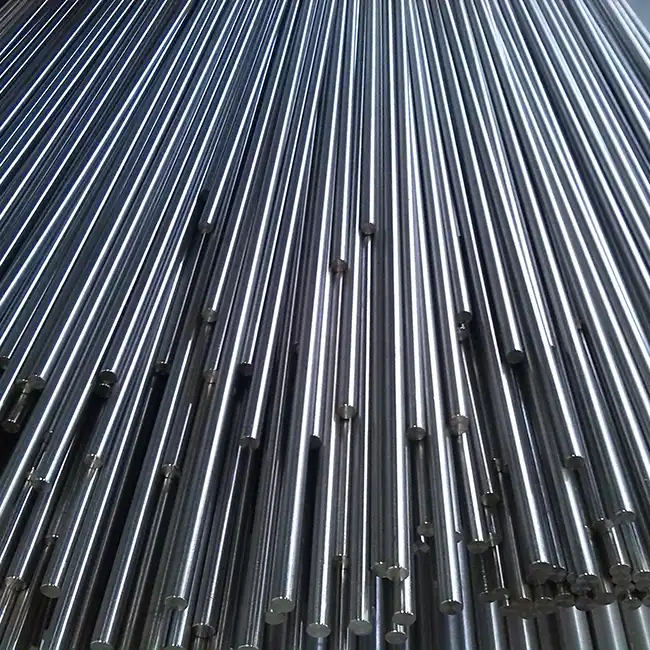
The main difference between GR5 titanium bars and Grade 2 titanium is how well they work mechanically and what kinds of jobs they can be used for. The tensile strength of GR5 titanium bars, which are also called Ti-6Al-4V alloy, is almost three times that of Grade 2 bars. They usually have more than 900 MPa of strength, while Grade 2 bars have 345 MPa. With 6% aluminum and 4% vanadium, this combination turns economically pure titanium into a high-performance material that is best for use in load-bearing structures. Grade 2 titanium is commercially pure and contains 99.2% titanium. It is very good at resisting corrosion and being easy to shape, but it is not strong enough for challenging aircraft or high-stress industrial parts. When procurement managers choose between these grades, they have to think about what the parts will be used for. For example, GR5 titanium bars are good for high-strength, fatigue-critical parts, while Grade 2 bars are better for chemical processing and marine settings where corrosion protection is more important than strength.
Understanding GR5 and Grade 2 Titanium Bars
To choose the right material, you must first understand the main differences between these two types of titanium. GR5 and Grade 2 are two different types of titanium, each designed to solve a different set of problems in industry. The difference between these materials has a direct effect on how quickly and cheaply they can be made, how long their parts last, and how much the whole project costs in the aircraft, medical, and industrial gear sectors.
Chemical Composition and Alloying Elements
GR5 titanium bars are an alpha-beta alloy, which means they have aluminum (5.5–6.75%) and vanadium (3.5–4.5%) as their main alloying elements. These additions completely change the molecular structure of the material, which lets heat treatment work in ways that make it much stronger. The aluminum presence makes it more resistant to rust and lowers its density. The vanadium stabilizes the beta phase, which makes it tougher. At Zhongyan, we strictly control the intermediate elements during the manufacturing process. The amount of oxygen stays below 0.20%, the amount of iron stays below 0.40%, and the amount of hydrogen stays below 0.015%. This makes sure that the mechanical properties are the same from one production batch to the next. Grade 2 titanium, on the other hand, is commercially pure and has very little alloying content. It is made up of 99.2% titanium and a small amount of oxygen (0.25% at most), which gives it some extra power without making it less flexible. This level of purity makes it very hard for rust to happen in harsh chemical settings, such as those with oxidizing acids and chloride solutions. Because Grade 2 doesn't have any alloying elements, it is cheaper and easier to make using standard metalworking methods.
Mechanical Properties and Performance Characteristics
There is a big difference in how well these grades work mechanically. Our Baoji plant makes GR5 titanium bars that have a modulus of elasticity of about 114 GPa and a tensile strength of over 900 MPa. They also have a yield strength of over 850 MPa. Because of these qualities, parts can handle heavy cyclic loads and operate at temperatures up to 400°C. The material's elongation of 10% and hardness grade of HRC 36 show that it is strong enough for accurate CNC machining while also being easy to work with. The tensile strength of Grade 2 titanium is about 345 MPa, and the yield strength is about 275 MPa. Better flexibility, with elongation values usually reaching 20%, makes up for the lower strength ceiling. Because of this, Grade 2 is perfect for uses that need complicated shaping, deep drawing, or welding without heat treatment. The lower hardness of the material (about HRB 80) means that tools don't wear out as quickly when it's being machined, which lowers the cost of production for large batches.
Heat Treatment Response and Microstructure
One important difference that affects buying choices is the ability to heat-treat materials. Solution treatment and aging processes have a predictable effect on GR5 titanium bars, which lets makers change the mechanical qualities to fit different uses. When metal is annealed, it is easiest to work with, but when it is solution-treated and aged (STA), it can gain 20 to 25 percent in tensile strength. Our cold-drawn GR5 products come with polished ends and h9 tolerances, so they are ready for precise cutting right away. This saves you money because you don't have to do any extra processing steps. Because it has a single-phase alpha structure, heat treatment can't make Grade 2 titanium stronger. Stress reduction annealing is still the main thermal method used to make things flexible again after they have been cold worked. Because of this limitation, Grade 2 parts can't be made stronger after they've been made, so choosing the right materials at the start is very important for meeting design requirements. When selecting this grade, procurement teams must correctly guess the service loads during the specification process.
Performance Comparison: GR5 Titanium Bars vs Grade 2 Titanium Bars
Analyses of behavior in great detail show how each object works in the real world. Knowing these differences helps engineering teams avoid expensive material failures and build parts that will last and work well.
Strength and Fatigue Resistance
In situations where there is cyclic stress and fatigue-critical work, GR5 titanium bars are the most common choice. The material has a high-cycle fatigue strength of about 500 MPa at 10^7 cycles, which makes it essential for parts of rotating aircraft equipment, medical tools that move back and forth, and industrial machinery that vibrates. Ultrasonic testing is done on our production runs to find any internal flaws that could lead to stress cracks. This makes sure that the parts meet the standards set by ASTM B348 and ISO 5832-2.
Corrosion Resistance Across Environments
In oxidizing settings and high-temperature working conditions, where Grade 2 would rust more quickly, GR5 titanium bars keep their excellent corrosion protection. In hot chloride solutions, the alloying elements create stable oxide layers that can stand up to erosion-corrosion and stress corrosion cracking. GR5 is often used in chemical labs that work above 80°C, downhole oil and gas equipment, and aircraft hydraulic systems because it is strong and doesn't rust. Our manufacturing keeps surface finishes with Ra values below 0.8µm, which gets rid of places where crevice rust can start and weaken the component.
Machinability and Processing Considerations
Because titanium doesn't conduct heat well and reacts chemically with cutting tools, it needs to be machined by someone with special skills. GR5 titanium bars are moderately hard to machine because they need carbide tools, controlled cutting speeds (15–25 m/min for turning), and coolant that is applied all the time. Because the material tends to work harden, you need to use sharp tools and steady feed rates. Our polished cold-drawn bars cut down on machining tolerances, which lowers production costs and wait times for special parts.
International Standards and Quality Certifications
Adhering to well-known standards gives buying teams a quality guarantee that can be checked. Zhongyan makes GR5 titanium bars that meet the standards set by ASTM B348, AMS 4928, and ISO 5832-3. Each output lot comes with mill test certificates that list the chemical makeup, mechanical properties, and heat treatment settings for each ingot number. Our ISO 9001:2015 certification shows that we handle quality in a planned way throughout all of our production processes.
Practical Applications and Use Cases for GR5 vs Grade 2 Titanium Bars
Real-life examples of how materials are used show how their qualities can be used to make things better in a wide range of businesses. These case studies help people who work in buying choose the right titanium grade for their operations and their budgets.
Aerospace and Defense Applications
GR5 titanium bars are the best material for parts of airplane structures, landing gear systems, and jet engines. Due to its high strength-to-weight ratio—it has the same strength as steel at 55% of the weight—over half of all GR5 produced goes to the aircraft industry. Our Dia. 10mm GR5 bars that are 1000mm long and have been heated are used to make precision-machined fasteners, hydraulic actuator parts, and flight control links. With a density of 4.43 g/cm³, the material saves a lot of weight, which directly improves fuel economy and payload capability.
Medical and Dental Industry Applications
Both types of titanium are used a lot in medical equipment, but they are used for very different things. Load-bearing orthopedic implants, such as hip stems, knee replacements, and spine fusion devices, are mostly made of GR5 titanium bars. The modulus of elasticity of the material (114 GPa) is very close to the modulus of elasticity of human cortical bone (10–30 GPa). This means that there are fewer stress buffering effects that cause bone to break down around implants. Our polished surface finish meets biological cleaning standards, which lowers the risk of contamination during surgical insertion.
Industrial Machinery and Chemical Processing
Industrial uses take advantage of the unique benefits of each type. GR5 titanium bars are used in high-performance pump shafts, valve stems, and compressor parts that work in high-pressure, corrosive conditions. Ti-6Al-4V is used in the oil and gas industry for downhole drilling tools, wellhead parts, and underwater production systems where hydrogen sulfide, seawater rust, and mechanical stress all come together. Our goods meet the AMS standards that big energy sector OEMs and builders need.
Cost-Benefit Analysis for Material Selection
Material prices are only one part of figuring out the total cost of ownership. Due to the addition of alloys and the need for more complicated processes, GR5 titanium bars usually cost 20–30% more than Grade 2 bars. But because it's stronger, designers can make parts with smaller cross-sections and lighter overall, which could help cover the cost of raw materials by making systems work better and saving fuel in transportation.
Procurement Considerations for GR5 and Grade 2 Titanium Bars
In addition to basic material requirements, strategic buying requires paying attention to what the seller can do, how they handle quality, and how reliable the supply chain is. Professionals in procurement have to look at a lot of different factors to make sure that the right materials are delivered on time and meet quality and output goals.
Supplier Evaluation and Certification Requirements
Checking manufacturing certifications and quality control systems is the first step in choosing reliable titanium providers. Zhongyan Titanium has ISO 9001:2015 approval, which shows that they have organized process controls in place for all of their production activities. Our factory in Baoji is close to China's main titanium-producing area, which gives us access to high-quality sponge titanium and advanced metalworking knowledge. Supplier checks should look at records of how the testing equipment was calibrated, how the operators were trained, and how the ingots can be tracked.
Customization Capabilities and Technical Support
For modern titanium uses, versatility goes beyond normal catalog sizes. Our production skills include diameters from 6mm to 300mm and custom lengths up to 6000mm, so we can make parts with a wide range of patterns without wasting material on oversized stock. The cold-drawn method gives h9 diameter specs straight from production, so there is no need for expensive and time-consuming centerless grinding. You can get surfaces that are as-forged black scale or finished bright surfaces with Ra values below 0.8µm that can be used for straight cutting or coating.
Quality Control and Inspection Protocols
Full quality control starts with checking the raw materials that come in and ends with inspecting the finished product. Optical emission spectroscopy is used in our lab to do chemical research and make sure that the makeup meets ASTM standards. As part of mechanical testing, samples from each output heat are used to do tension tests, hardness tests, and impact tests. Ultrasonic testing finds internal breaks, like inclusions or pores, that could weaken the stability of a component.
Pricing Structures and Market Trends
Titanium prices depend on how much the raw materials cost, how much energy they use, and how hard they are to work with. Because of the need for alloying and heat treatment, GR5 titanium bars usually cost 15–25% more than Grade 2 bars. Market prices fluctuate on the market depending on how much is available, how much demand there is in the aircraft industry, and how busy the world's factories are. Long-term supply deals that promise a certain amount of goods help keep prices stable for customers whose needs are reliable.
Making the Right Choice: GR5 or Grade 2 Titanium Bars?
Selecting the optimal titanium grade requires systematic evaluation of technical requirements, economic factors, and regulatory constraints. Decision frameworks help procurement teams navigate complex trade-offs and document selection rationale for internal stakeholders and external auditors.
Performance Requirements Analysis
Before choosing a material, it's important to set the lowest levels of strength, resistance to corrosion, wear life, and working temperature that are suitable. GR5 titanium bars are usually needed to keep things from breaking too soon in situations where there are steady loads above 400 MPa or cycle stresses above 300 MPa. GR5 is also better than widely pure grades at resisting creep and rust, so it is better for use in high-temperature applications above 300°C.
Cost Optimization Strategies
Cost of materials, time spent on cutting, yield losses, and lifetime costs are all part of total cost modeling. Even though GR5 titanium bars use more raw materials, their higher hardness lets parts be made smaller, which uses less material overall. Grade 2 may be better for complex shapes because it is easier to machine and has less tool wear, which makes up for the fact that it can't be improved through heat treatment.
Regulatory and Compliance Factors
Industries like nuclear power, medical products, and aircraft have strict rules about the materials they use that require full paperwork and traceability. For use in aircraft, GR5 titanium bars must meet the requirements of AMS 4928 and come with test papers that prove their properties and make-up. Medical implant materials need to be compliant with ISO 5832-3 and have extra biocompatibility testing data to back up regulatory applications.
Decision Matrix for Material Selection
An organized comparison approach makes it clear which option is best for each situation. Even though they cost more, GR5 titanium bars are the best choice when maximum strength and wear resistance are very important. GR5 benefits make the higher price worth it in situations like aerospace structural parts, high-performance race gear, and medical implants that carry weight.
Conclusion
To tell the difference between GR5 titanium bars and Grade 2 titanium, you need to look closely at their material qualities, where they will be used, and how much they cost. The Ti-6Al-4V alloy that makes up GR5 has a tensile strength of over 900 MPa and great fatigue resistance, which is why it is used in so many high-stress industry machines and structural parts for spacecraft. The fairly pure makeup of Grade 2 titanium makes it very resistant to corrosion and easy to shape, making it perfect for use in chemical processing equipment and on the water. Buyers should think about how strong something needs to be, along with how likely it is to rust, how hard it is to machine, and how much it will cost over its whole life. At Zhongyan, we can make both types and provide full certifications, custom measurements, and expert support to help you make an informed material choice. By understanding these differences, engineering teams can choose titanium types that make parts work better while still being cost-effective in tough industrial settings.
FAQ
Can GR5 titanium bars be welded like Grade 2 titanium?
GR5 titanium bars can be bonded, but the process needs to be carefully protected with inert gases like argon or helium to keep oxygen from getting in and weakening the bars. A lot of people use friction stir welding, electron beam welding, and TIG welding. To keep the mechanical qualities, both the weld pool and the cooling zones must stay covered. Because it is weaker and has a single-phase structure, Grade 2 titanium welds more easily. This means that less heat is needed and there is less chance of warping.
How does heat treatment affect GR5 titanium bars versus Grade 2?
Solution treatment and age processes on GR5 titanium bars raise their tensile strength by about 20 to 25 percent, but they also make them less flexible. Our annealed condition products are the easiest to work with, and our STA condition products are best for situations where strength is needed. Because it is made of the alpha-phase, Grade 2 titanium can't be improved by heat treatment. The only thermal method that can recover ductility after cold working is stress reduction annealing.
What kinds of certificates should buying teams ask for when they buy titanium bars?
People who are in charge of buying things should ask for EN 10204 3.1 Mill Test Certificates that show the chemical makeup, mechanical qualities, and heat treatment conditions that can be linked to specific heat numbers. Both types must meet ASTM B348 standards. For aircraft GR5 uses, materials must also be certified by AMS 4928, and for medical-grade materials, they must be certified by ISO 5832-3. When we make something, we give you all the paperwork you need to support your quality processes and regulatory reports.
Source Premium GR5 Titanium Bars from Zhongyan
Zhongyan Titanium is a reliable source for GR5 titanium bars, offering approved materials that are perfect for the toughest military, medical, and industrial uses. Our factory is in Baoji, which is known as the titanium manufacturing hub of China. It uses cutting-edge production technology and strict quality control systems that are approved to ISO 9001:2015 standards. We make Ti-6Al-4V bars with polished surfaces, h9 tolerances, and full ASTM B348 and ISO 5832-2 compliance paperwork. The bars can have widths from 6mm to 300mm and unique lengths up to 6000mm.
Our engineering team can help you choose the right materials, make the best cuts, and make sure the heat treatment instructions are exactly right for your part. Whether you need a few prototypes or a lot of them, our manufacturing is flexible enough to meet your needs. We offer low prices and reliable foreign shipping for both OEM and ODM solutions. Get in touch with our purchasing experts at sales@titaniumstudy.com to talk about your needs for GR5 titanium bars and get detailed quotes that include full technical specs and certification paperwork to help your quality control processes.
References
1. Lutjering, G., & Williams, J.C. (2007). Titanium (2nd Edition). Springer-Verlag Berlin Heidelberg.
2. Donachie, M.J. (2000). Titanium: A Technical Guide (2nd Edition). ASM International.
3. ASTM International. (2021). ASTM B348-21: Standard Specification for Titanium and Titanium Alloy Bars and Billets. West Conshohocken, PA.
4. Boyer, R., Welsch, G., & Collings, E.W. (1994). Materials Properties Handbook: Titanium Alloys. ASM International.
5. Peters, M., Kumpfert, J., Ward, C.H., & Leyens, C. (2003). Titanium Alloys for Aerospace Applications. Advanced Engineering Materials, 5(6), 419-427.
6. Rack, H.J., & Qazi, J.I. (2006). Titanium alloys for biomedical applications. Materials Science and Engineering: C, 26(8), 1269-1277.
(1)_1755588522797.jpg)
Learn about our latest products and discounts through SMS or email