- English
- French
- German
- Portuguese
- Spanish
- Russian
- Japanese
- Korean
- Arabic
- Greek
- German
- Turkish
- Italian
- Danish
- Romanian
- Indonesian
- Czech
- Afrikaans
- Swedish
- Polish
- Basque
- Catalan
- Esperanto
- Hindi
- Lao
- Albanian
- Amharic
- Armenian
- Azerbaijani
- Belarusian
- Bengali
- Bosnian
- Bulgarian
- Cebuano
- Chichewa
- Corsican
- Croatian
- Dutch
- Estonian
- Filipino
- Finnish
- Frisian
- Galician
- Georgian
- Gujarati
- Haitian
- Hausa
- Hawaiian
- Hebrew
- Hmong
- Hungarian
- Icelandic
- Igbo
- Javanese
- Kannada
- Kazakh
- Khmer
- Kurdish
- Kyrgyz
- Latin
- Latvian
- Lithuanian
- Luxembou..
- Macedonian
- Malagasy
- Malay
- Malayalam
- Maltese
- Maori
- Marathi
- Mongolian
- Burmese
- Nepali
- Norwegian
- Pashto
- Persian
- Punjabi
- Serbian
- Sesotho
- Sinhala
- Slovak
- Slovenian
- Somali
- Samoan
- Scots Gaelic
- Shona
- Sindhi
- Sundanese
- Swahili
- Tajik
- Tamil
- Telugu
- Thai
- Ukrainian
- Urdu
- Uzbek
- Vietnamese
- Welsh
- Xhosa
- Yiddish
- Yoruba
- Zulu
How Are Custom Hex Titanium Bolts Manufactured Precisely?
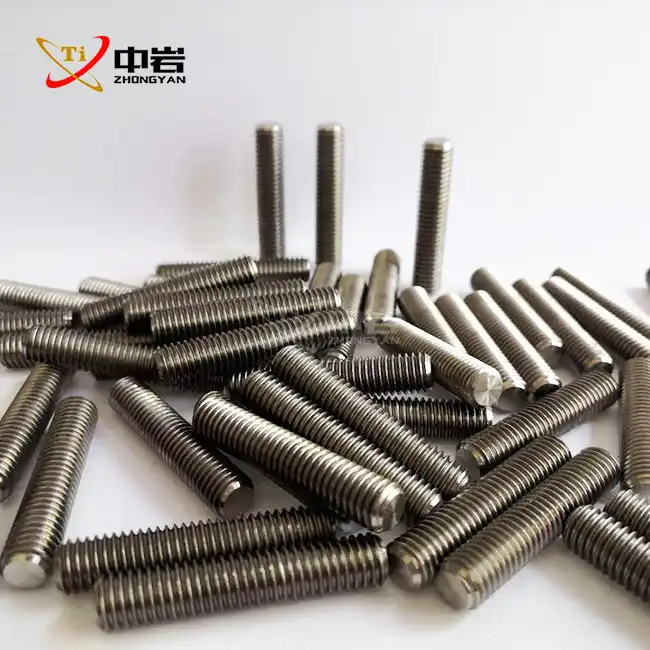
From the very beginning to the very end, making a Custom Hex Titanium Bolt requires careful planning. First, aerospace-grade titanium alloys are chosen. Grade 5 (Ti-6Al-4V) is often used because it has better tensile strength and resistance to rust. The hexagonal head and threads are made with precise CNC cutting, and the material is stabilized by controlled heat treatment. Passivation and anodizing are surface processes that make things last longer. Each bolt is carefully measured and checked against ASTM and AMS standards to make sure it meets the high standards needed in industries like aircraft, medicine, and high-performance, where failure is not an option.
Understanding the Properties and Dimensions of Custom Hex Titanium Bolts
When engineers choose titanium screws for important systems, they do so after careful thought and research into the properties of the metal. Custom Hex Titanium Bolt solutions have a unique set of qualities that steel and aluminum can't offer at the same time. Due to its low density (about 4.43 g/cm³), the material is 45% lighter than steel alternatives. This can directly lead to better fuel efficiency in airplanes or better handling in race cars. Even though Grade 5 titanium is very light, it has a tensile strength between 860 and 1100 MPa, which is about the same as many strengthened steels.
Titanium stands out in tough settings because it doesn't rust. A titanium dioxide (TiO2) passive layer forms on its own, protecting stainless steel from seawater, chlorides, and reactive acids that would quickly break it down. Custom Hex Titanium Bolt components taken out of naval tools after ten years of use showed no pitting or structural degradation, which shows that this natural defense system works.
Standard Specifications vs. Custom Requirements
Titanium nuts that are used in industry usually follow ISO, DIN, or ANSI size rules. Custom apps, on the other hand, often need changes that can't be made in regular catalogs. A common request for customization could be for a non-standard grip length to fit a custom assembly thickness or for changed thread sizes (UNC, UNF, or Metric versions) to work with threaded inserts that are already in place.
Choosing the right thread type affects how the load is distributed and how well it stops vibrations. When you press rolled threads instead of cutting them, the grain flow stays the same and the wear resistance goes up by about 30% compared to cut threads. In situations with dynamic loading, like suspension parts or engine bearings, where cyclic stress accumulation can start cracks spreading, this difference is very important.
Material Grade Selection and Performance Trade-offs
Grade 2 commercially pure titanium has the best rust resistance and biocompatibility. This makes it perfect for use in medical devices and chemical processing equipment where the climate is very harsh but the mechanical loads are low. It has a tensile strength of about 340 MPa, which is good enough for many uses but not for solid aircraft parts.
Most high-performance uses are for Grade 5 titanium metal (Ti-6Al-4V). Adding 6% aluminum and 4% vanadium makes the steel much stronger while keeping its great resistance to rust. This metal stays structurally sound at temperatures up to 400°C, which is very important for installs in the engine bay. The hardness grade of 33–37 HRC makes it resistant to wear in situations where the part needs to be installed and removed many times.
Verification and Authentication Standards
Professionals in procurement have good reasons to be worried about the reliability of materials. We use a number of different levels of checking during production. Spectroscopic analysis is done on each batch of raw titanium to make sure that the metal makeup meets the requirements of ASTM B348. Every package comes with a mill test report (MTR), which lets you track back to the original titanium ingot.
Coordinate measuring tools (CMMs) that can measure to the level of microns are used for dimensional compliance checking. Thread testers make sure that the pitch diameter, major diameter, and thread angle all meet the requirements for tolerance class 6g or smaller. Measurements of surface roughness make sure that the quality of the finish matches the engineering plans. This is especially important for uses that need specific friction coefficients or closing surface properties.
Step-by-Step Precision Manufacturing Process of Custom Hex Titanium Bolts
From raw titanium bar stock to a finished precision Custom Hex Titanium Bolt, the production process is carefully planned out. Each step affects the end result, and procurement managers can tell the difference in quality between sellers when they understand this process.
Raw Material Selection and Preparation
Our factory starts making things in Baoji, which is known as China's Titanium Valley, and is where we keep direct ties with titanium smelters. Because we are in a better location, we can get Grade 5 titanium rods that meet military standards at prices that are competitive and guarantee the stability of the supply chain. The raw material comes with a certified chemical composition study that shows the amount of aluminum is between 5.5 and 6.75% and the amount of vanadium is between 3.5 and 4.5%. These are the exact ranges needed for consistent mechanical qualities.
CNC Precision Machining Operations
Titanium is hard to machine because it doesn't conduct heat well and reacts chemically with cutting tools. The material doesn't get rid of heat well, which leads to temperature spikes at the tool-chip contact that speed up tool wear. To fix this, we use special CNC code that lowers the cutting speed, speeds up the feed rate, and delivers coolant in a flood that keeps chip removal steady.
Heat Treatment and Stress Relieving
Most of the time, Grade 5 titanium is used after being solution-treated and aged. However, special Custom Hex Titanium Bolt requirements often need more stress release cycles. When you machine something, you leave behind forces that can make the dimensions less stable or lower the wear performance. Depending on the performance needs, we use vacuum heat treatment at temperatures that are carefully controlled between 480°C and 650°C.
Surface Finishing and Protective Treatments
During fitting, the surface state has a big effect on both how resistant it is to corrosion and how slippery it is. Standard "as-machined" finishes show the natural layer of titanium oxide, and the surface is rough, measuring between 1.6 and 3.2 Ra. This finish is good for many uses, but it can be made better with extra processes.
Quality Assurance and Standards Compliance
According to ISO 9001:2015 quality control systems, each batch of output goes through a thorough inspection process. For dimensional checking, both human and automatic measuring tools are used. With precise go/no-go scales and optical comparators that check thread angle, pitch, and profile shape, thread parameters are checked.
Comparing Manufacturing Methods: Traditional vs Advanced Techniques
In the last twenty years, the titanium bolt business has changed a lot. Knowing the differences between standard and modern manufacturing methods helps procurement teams figure out what suppliers can do and make smart decisions about where to get things like the Custom Hex Titanium Bolt.
Limitations of Conventional Production Methods
Traditional ways of making titanium bolts rely on a lot of handwork and general-purpose machines. Each cutting process would be set up by a different operator, who would use mechanical dial signs and micrometer measures to check the quality. This method worked fine for industrial fasteners with a big tolerance, but it was hard to get the accuracy needed for medical and aircraft uses.
Conventional grinding of titanium caused tools to wear out too quickly because the cutting conditions were not ideal. Machinists often went slowly because they didn't have access to computer-controlled feed rates and advanced toolpath planning. This made cycle times much longer. Since this made production costs go up, titanium bolts were too expensive for many uses where their qualities would be useful.
Advantages of Modern CNC and Automated Solutions
Multi-axis CNC machining machines with built-in tool life management systems are used at our plant. When tools wear down, these machines automatically make up for it, so the dimensions stay accurate throughout production runs. Automated object loading systems cut down on time spent not cutting and allow manufacturing to happen while the lights are off, which greatly increases the rate at which equipment is utilized.
We can quickly and easily make unique Custom Hex Titanium Bolt solutions from 3D models given by customers thanks to advanced CAD/CAM integration. Simulation software checks toolpaths before cutting metal. This gets rid of the need to try things out and see what works, which wastes time and material in traditional setups. This feature comes in handy when making small amounts of one-of-a-kind configurations, which is usually needed for custom apps.
Efficiency Gains Through Process Optimization
A recent job for an aerospace client shows how these economic benefits can be used in real life. For the job, Grade 5 Custom Hex Titanium Bolt products with a thread length that wasn't normal and a head shape that wasn't like any other were needed. Using standard methods, making a prototype would have taken about 4 to 6 weeks, which would have included several setup rounds and quality checks that were done by hand.
Our integrated CNC method cut this time down to 10 days, from acceptance of the plan to review of the first piece. Automated thread rolling equipment made 500 pieces, and there were no rejects for size issues. On the first production run, every bolt met the tight tolerance requirements. The company saved a lot of money because they didn't have to do as much work twice, and the project went faster, which let their assembly go ahead as planned.
Balancing Precision Requirements and Production Economics
When making a purchase choice, the total cost of ownership must be weighed against the technical needs. Ultra-tight specs make production much harder and cost a lot more. We work closely with the engineering teams of our customers to figure out which measurements really need to be controlled with great accuracy and which ones can handle standard business tolerances without affecting the function of the assembly.
When it comes to thread size, it's normal for clearer specifications to save money. A loose fit (class 1A/1B) makes assembly easy and has wide tolerance bands. Precision fits (class 3A/3B), on the other hand, promise very little space but cost a lot to grind the threads. Standard rolling methods make it easy to make threads of the middle class 2A/2B that work perfectly in many situations. Customers can get the efficiency they need without having to pay extra for accuracy that they don't need.
Practical Applications & Industry-Specific Requirements for Custom Hex Titanium Bolts
When regular materials don't work well enough in tough situations, titanium screws are used instead. When procurement professionals understand these use cases, they can find situations where a Custom Hex Titanium Bolt specification offers real value, even though the material costs more at first.
Aerospace and Aviation Critical Fastening
Custom Hex Titanium Bolt components may be used in the most difficult situations when they are used in aircraft structural systems. Attachments to fuselage panels have to be able to handle alternate stress patterns caused by changing pressures thousands of times over the course of an airplane's life. Grade 5 titanium has a very high durability limit (about 500 MPa), which stops cracks from starting that would cause catastrophic failure.
Medical Device and Surgical Instrument Assembly
Because of biocompatibility rules in medical uses, most industrial materials can't be used. Titanium's track record in making implantable devices easily stretches to making surgical instruments and putting together medical tools. Custom Hex Titanium Bolt solutions hold moving joints in place in robotic surgery systems. They provide a reliable way to attach parts that are sterilized over and over again at 134°C.
High-Performance Automotive and Racing Applications
Getting rid of extra weight in the unsprung suspension parts directly helps how the car handles and how it rides. We make custom hex titanium bolts for race teams that want to get every speed edge they can. Titanium's strength-to-weight ratio makes it a good choice for fixing bolts for brake calipers, wheel hub fasteners, and suspension link gear.
Installation and Maintenance Best Practices
Custom Hex Titanium Bolt products work best and last longest when they are installed correctly. Because the material tends to gall—that is, cold welding between threads under high friction—special care must be taken. Applying molybdenum disulfide anti-seize compound to threads before fitting is suggested. This lowers friction coefficients and makes sure that torque-tension relationships are reliable.
Sustainability and Lifecycle Considerations
Titanium is very durable, so parts made of it last a lot longer than parts made of other materials that need to be replaced every so often. The material can be recycled over and over again, which supports the ideas of the circular economy. Titanium that is used in manufacturing is recycled and turned into new alloys without losing any of its properties. This is different from many industrial plastics that lose their properties when they are recycled.
How to Source Reliable Custom Hex Titanium Bolts: Procurement Best Practices
Comparing unit prices is only one part of a successful buying process for a Custom Hex Titanium Bolt. If you look at a supplier's skills, make sure the quality is consistent, and manage the customization process well, you can tell if the relationship is good for the long run or if it causes production delays and quality problems.
Evaluating Manufacturer Credentials and Capabilities
Quality certificates are the basis for judging a seller. ISO 9001:2015 certification shows that quality management systems are well-established, but it doesn't ensure knowledge in titanium by itself. If your product needs that level of quality control, you should check to see if any possible suppliers have aerospace-specific certifications like AS9100.
Cost Analysis and Value Engineering
Custom Hex Titanium Bolt prices depend on the cost of the raw materials, how hard they are to machine, and how much customization is needed. Grade 5 titanium bar stock is much more expensive than steel, but looking only at the cost of the material doesn't take into account the whole value factor. Less weight means more payload, longer service life means no replacement costs, and rust resistance means the system doesn't fail. All of these things add economic value that goes beyond the difference in the initial purchase price.
Managing Custom Orders and Technical Specifications
Misunderstandings that cost a lot of money can be avoided by being clear during the design step of a Custom Hex Titanium Bolt. We need 3D CAD models or full dimensional drawings from the user that show the thread specs, head style, finish requirements, and material grade. Specifications that aren't clear cause prototype changes, which slow down projects and cost more.
After-Sales Support and Long-Term Partnership
Technical help goes beyond just fulfilling orders. Our engineering team helps with fitting problems, questions about torque specifications, and suggestions for making designs better. This helpful method helps customers get the most out of the Custom Hex Titanium Bolt products they buy.
Conclusion
To accurately make a Custom Hex Titanium Bolt, you need to know a lot about material science, advanced machining, and quality assurance. The process turns aerospace-grade titanium metals into screws with great strength-to-weight ratios, resistance to corrosion, and dependability in the toughest situations. Every step of the manufacturing process, from choosing the raw materials to CNC precise machining, heat treatment, and strict checking routines, has an effect on how well the finished product works. When procurement workers understand these steps, they can better evaluate suppliers, choose the right customization choices, and make sourcing decisions that balance technical needs with total cost of ownership. Precision-made titanium hex bolts have value that goes far beyond the cost of the materials they are made of. They can be used to support flight systems, medical devices, or high-performance industrial equipment.
FAQ
Why is Grade 5 titanium better for making unique hex nuts than Grade 2?
The tensile strength of Grade 5 titanium alloy (Ti-6Al-4V) is 1100 MPa, which is much higher than Grade 2's 340 MPa. This makes it necessary for structural uses in the aircraft and high-performance car industries. Grade 2 is better at resisting rust and being biocompatible, but it's not strong enough for heavily loaded systems.
How do rolled threads work better than cut threads to make bolts work better?
When compared to cut threads, rolled threads have about 30% more wear resistance because they keep the grain flow going and work-harden the surface. When you roll something, you compress it instead of removing it. This gets rid of the stress places where wear cracks usually start in machined threads.
When titanium bolts are taken apart, can they be used again?
Titanium nuts can usually be installed more than once as long as they are properly torqued and covered with anti-seize compounds. A thread check should be done to make sure that there are no galling or deformations from the last use. Critical flight uses often need fasteners that can only be used once, no matter what state they are in.
What are the torque requirements for titanium hex bolts?
Values for torque rely on the thread's size, grade, and how well it is oiled. Titanium has a lower elastic stiffness than steel, so it needs less torque—usually 60 to 70% of the torque needed for steel fasteners. Based on the needs of the product, we give specific torque suggestions with every custom order.
Partner with Zhongyan for Your Custom Hex Titanium Bolt Requirements
For your precise Custom Hex Titanium Bolt needs, Zhongyan is ready to help. They can make them using approved titanium parts and unique CNC machining. Our factory in Baoji, China's Titanium Valley, has cutting-edge multi-axis CNC machines and full quality systems that meet ISO 9001:2015 standards. We offer Custom Hex Titanium Bolt options from prototypes to large-scale production, and at every stage of the manufacturing process, we make sure to follow ASTM, AMS, and ISO standards.
Whether you need aerospace-grade Grade 5 titanium hex bolts with specific head shapes or biocompatible screws for medical systems, our engineering team can help you with the details and make sure your projects are made perfectly. As a Custom Hex Titanium Bolt maker with a lot of experience, we can fully support your special needs through OEM and ODM. Email our team at sales@titaniumstudy.com to talk about your unique needs and find out how our knowledge of titanium can help your product work better.
References
1. Boyer, R., Welsch, G., and Collings, E.W. (1994). "Materials Properties Handbook: Titanium Alloys," ASM International, Materials Park, Ohio.
2. Donachie, Matthew J. (2000). "Titanium: A Technical Guide, 2nd Edition," ASM International, Materials Park, Ohio.
3. Lutjering, Gerd and Williams, James C. (2007). "Engineering Materials and Processes: Titanium," Springer-Verlag, Berlin Heidelberg.
4. Veiga, C., Davim, J.P., and Loureiro, A.J.R. (2012). "Properties and Applications of Titanium Alloys: A Brief Review," Reviews on Advanced Materials Science, Volume 32, pp. 133-148.
5. Ezugwu, E.O. and Wang, Z.M. (1997). "Titanium Alloys and Their Machinability: A Review," Journal of Materials Processing Technology, Volume 68, Issue 3, pp. 262-274.
6. American Society for Testing and Materials (2021). "ASTM B348: Standard Specification for Titanium and Titanium Alloy Bars and Billets," ASTM International, West Conshohocken, Pennsylvania.
(1)_1755587759206.jpg)
Learn about our latest products and discounts through SMS or email