- English
- French
- German
- Portuguese
- Spanish
- Russian
- Japanese
- Korean
- Arabic
- Greek
- German
- Turkish
- Italian
- Danish
- Romanian
- Indonesian
- Czech
- Afrikaans
- Swedish
- Polish
- Basque
- Catalan
- Esperanto
- Hindi
- Lao
- Albanian
- Amharic
- Armenian
- Azerbaijani
- Belarusian
- Bengali
- Bosnian
- Bulgarian
- Cebuano
- Chichewa
- Corsican
- Croatian
- Dutch
- Estonian
- Filipino
- Finnish
- Frisian
- Galician
- Georgian
- Gujarati
- Haitian
- Hausa
- Hawaiian
- Hebrew
- Hmong
- Hungarian
- Icelandic
- Igbo
- Javanese
- Kannada
- Kazakh
- Khmer
- Kurdish
- Kyrgyz
- Latin
- Latvian
- Lithuanian
- Luxembou..
- Macedonian
- Malagasy
- Malay
- Malayalam
- Maltese
- Maori
- Marathi
- Mongolian
- Burmese
- Nepali
- Norwegian
- Pashto
- Persian
- Punjabi
- Serbian
- Sesotho
- Sinhala
- Slovak
- Slovenian
- Somali
- Samoan
- Scots Gaelic
- Shona
- Sindhi
- Sundanese
- Swahili
- Tajik
- Tamil
- Telugu
- Thai
- Ukrainian
- Urdu
- Uzbek
- Vietnamese
- Welsh
- Xhosa
- Yiddish
- Yoruba
- Zulu
Grade 4 titanium foil vs other grades: strength, weldability & cost
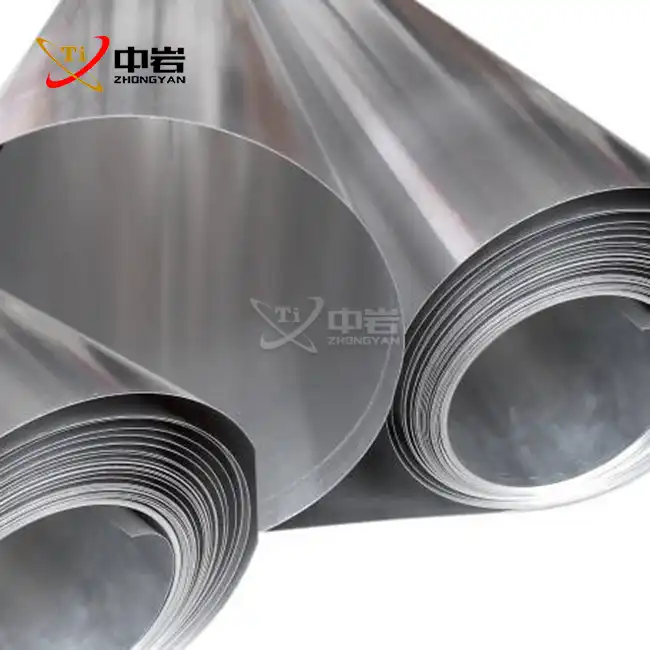
Comparing different types of titanium foil, Grade 4 titanium foil stands out as the best option for tough industrial uses that need high strength, good weldability, and low cost. Lower grades lose some of their mechanical qualities, but Grade 4 has a tensile strength of over 550 MPa while still being very resistant to rust and easy to shape. Its balanced makeup makes it stronger than Grade 2 alloys and cheaper than expensive Grade 5 alloys. This makes it the best choice for industries like aerospace, medicine, and chemical processing that need stable, high-performance materials.
Understanding Grade 4 Titanium Foil and Its Key Properties
The widely pure titanium family has four different types. Grade 4 titanium foil is the hardest, with great mechanical qualities thanks to its carefully controlled chemical makeup. This material meets ASTM B265 standards and has small amounts of oxygen in it that make it stronger while keeping the great rust protection that pure titanium has. The limited amount of oxygen raises the tensile strength to at least 550 MPa, which is much higher than what smaller types can do.
Superior Mechanical Performance
Because it is stronger, Grade 4 titanium is different from other widely pure types because of its mechanical features. With a stretch value of at least 15% and a yield strength of more than 485 MPa, this material has the structural stability needed for tough jobs. The maximum hardness rating of 280 HV makes Grade 4 titanium very durable against wear while still being flexible enough for complicated shaping tasks. These mechanical properties make it especially useful in situations where weight reduction must not compromise structural performance. The mass of the material, which is 4.51 g/cm³, makes it much lighter than standard steel options while still making it stronger. In aircraft uses, where every gram of weight loss means better fuel economy and speed, this combo works especially well.
Customization and Processing Capabilities
According to modern production needs, materials need to be able to handle different thickness standards and special cutting needs. The thickness of grade 4 titanium foil can be anywhere from 0.025 mm to 1.0 mm, so it can be perfectly matched to specific needs in a wide range of situations. This material is very easy to shape and keeps its shape while it is being processed. Its smooth surface finish, which is achieved through advanced production processes, means that it doesn't need any extra surface treatments in many situations. This feature cuts down on handling time and costs while keeping quality high across all production runs. Custom cutting and packing services make it possible for producers to get materials that are ready to be used right away in their production processes. This improves the efficiency of the supply chain.
Comparative Analysis: Grade 4 Titanium Foil vs Other Titanium Grades
Understanding the performance differences between titanium grades enables informed material selection based on specific application requirements. Grade 4 titanium foil occupies a unique position within the titanium family, offering enhanced strength compared to lower grades while maintaining cost advantages over premium alloy variants.
Grade 4 vs Grade 2 Titanium Comparison
When you compare Grade 4 and Grade 2 titanium, you can see that they work very differently, which affects your choice of material. Grade 2 titanium is very resistant to rust, but it is not as strong mechanically. Its tensile values are usually between 345 and 483 MPa. This difference in strength is very important in situations where more weight needs to be carried or where structural integrity needs to be improved. Grade 4 titanium's higher strength allows for thinner material specifications while still performing the same, which saves weight and money on materials. The higher strength also means better resistance to wear, which means the part will last longer in applications that use repeated loads. These benefits make Grade 4 titanium the best choice for uses where mechanical performance is more important than cost. On the other hand, Grade 2 titanium is still better in some situations because it is easier to shape and has lower hardness values. Because Grade 2 is easier to work with, it may be useful in situations where a lot of shaping or great flexibility is needed. The difference in price between these grades often affects the choice that is made in price-sensitive situations where Grade 4's higher strength is not needed.
Grade 4 vs Grade 5 Performance Analysis
Most of the time, grade 5 titanium (Ti-6Al-4V) is used because it is the strongest titanium metal because it has aluminum and vanadium added to it. Grade 5 titanium is better for mechanical performance than Grade 4 titanium because its tensile strength is higher than 895 MPa. But better performance comes at a higher cost in terms of materials and processing. For example, welding Grade 5 titanium is more complicated than welding Grade 4, because Grade 5 titanium is made of a different metal. In some situations, Grade 5 is easier to weld, but the need for special welding methods and heat treatment makes the process more expensive and difficult. The commercially pure makeup of Grade 4 titanium makes soldering easier because there is less chance of contamination and no need for heat treatment. Grade 4 titanium is often chosen over Grade 5 titanium when the high strength of Grade 5 is not needed. The difference in the cost of the materials can be big, especially when a lot of them are needed. In most settings, Grade 4's great corrosion protection is the same as Grade 5's, so there is no need for the higher metal price in uses where rust is important.
Weldability Characteristics Across Grades
Welding efficiency is an important thing to think about when choosing a material, especially for tasks that need to be fabricated or put together. Grade 4 titanium is very easy to weld because it is commercially pure and doesn't contain any alloying elements that can make the process more difficult. Different types of welding, like TIG, MIG, and electron beam welding, work well with the material. Because Grade 4 titanium contains oxygen, it's important to keep the welding environment under control to avoid contamination and keep the integrity of the joint. Using the right shielding gas and taking steps to keep the area clean will lead to high-quality weld parts that have the same mechanical qualities as the base material. Because Grade 4 titanium alloys are easy to weld, they can be used in industrial settings that don't have special heat treatment equipment. Unlike Grade 5 titanium alloys, Grade 4 doesn't need to be heat-treated after welding in most cases, which saves time and money. The lack of aluminum and vanadium also makes the metal less sensitive to pollution during welding, which makes welding processes more forgiving. With these qualities, Grade 4 is especially good for jobs that need a lot of welding or for production settings that don't have a lot of specialized welding tools.
How to Choose the Best Titanium Foil Grade for Your Application
Selecting the appropriate titanium foil grade requires careful evaluation of application-specific requirements, including mechanical performance, environmental conditions, and economic considerations. The decision process involves analyzing strength requirements against weldability needs while consideringthe total cost of ownership throughout the component lifecycle.
Strength Requirements Assessment
Choosing the right titanium grade is based on how strong it needs to be mechanically. The better mechanical qualities of Grade 4 titanium are usually useful for tasks that need tensile forces over 400 MPa. The material's yield strength of 485 MPa gives it enough safety margins for structural uses while keeping its lightweight properties that are important for aerospace and automotive uses. Critical load-bearing parts need to be carefully stress-analyzed to make sure they have enough strength margins throughout their operational lifecycle. Because grade 4 titanium is so resistant to wear, it is especially useful in situations where the load changes over time. The higher strength lets designers make better designs by using thinner materials while still meeting the standards for structural integrity. Grade 4's mix of strength and rust protection is useful in industries like chemical processing and naval uses. Because the material can keep its mechanical qualities even in harsh settings, it doesn't need to be coated to protect it or replaced often. This longevity means lower upkeep costs and better working dependability over longer service times.
Weldability and Fabrication Considerations
The type of fabrication needed has a big impact on the choice of grade 4 titanium foil, especially when a lot of welding or shaping is needed. Because Grade 4 titanium is so easy to weld, production processes can be done quickly and easily without the need for special tools or complicated steps. Standard welding methods can be used on this material, which means less training and equipment costs. Grade 4 is good for complex systems that need multiple weld joints because it is forgiving when it comes to welding and less sensitive to changes in heat input. The economically pure makeup keeps the quality of the joints uniform across production runs and reduces the chance of weld contamination. These features are especially helpful in high-volume manufacturing settings where consistent welding affects both the quality of the product and the efficiency of production. Grade 4's balanced mechanical properties also help with shaping, giving it the strength needed for structural integrity while still allowing for the flexibility needed for complex shapes. The work-hardening properties of the material allow for controlled stiffening through making processes, which could mean that no further heat treatment is needed. This feature speeds up output while lowering the cost of making things.
Economic Analysis and Cost Optimization
To get the best cost savings, you need to look at both the prices of materials and the total cost of ownership over the span of a component. Most of the time, Grade 4 titanium costs more than Grade 2 titanium, but it's cheaper than Grade 5 metals. Although the materials are more expensive, they are often worth it because they allow for higher strengths, that mean thinner layers are needed. Buying in bulk from well-known sources can save you a lot of money, especially for high-volume uses. Total buying costs are affected by minimum order amounts and tailoring services. Choosing the right provider is therefore essential for reducing costs. Long-term supply deals with qualified providers often offer stable prices and assured access for important uses. Things that affect processing costs are the difficulty of the welding, the need for shaping, and the need for finishing the surface. When compared to more complicated metal grades, Grade 4 is easier to work with and costs less to make. Because the material has a great surface finish, extra finishing processes are often not needed. This lowers the total cost of production while still meeting quality standards.
Procurement Guide: Finding Reliable Grade 4 Titanium Foil Suppliers
Supplier selection represents a critical decision impacting material quality, delivery reliability, and total procurement costs. Qualified suppliers must demonstrate compliance with international standards while providing the customization capabilities necessary for modern manufacturing requirements. The evaluation process requires assessment of technical capabilities, quality systems, and commercial terms.
Quality Certification and Standards Compliance
Verification of quality certifications makes sure that providers meet the strict needs of medical, industrial, and aircraft uses. ISO 9001:2015 certification sets the basic standards for a quality system, while certifications specific to an industry, like AS9100 for aircraft uses, show that the system has certain specialized abilities. Material standards, such as ASTM B265 compliance, make sure that the qualities of different lots of materials are the same. For important uses that need to be traceable, providers must have complete material tracking systems. Full records, like material test results, chemistry analyses, and checks of mechanical properties, make sure that the requirements of the application are met. Suppliers must show that they can provide batch-specific paperwork that meets quality standards all along the supply chain. Third-party quality checks and customer site reviews give buyers even more trust in suppliers' abilities. Established sellers usually have a lot of different certifications and are regularly checked for quality by big buyers. These confirmation steps give purchasing managers faith in the dependability and regularity of suppliers' quality.
Customization Capabilities and Service Portfolio
Today's industry needs providers who can offer personalized solutions, such as specific thickness ranges, custom cuts, and unique packing. Grade 4 titanium foil suppliers must show that they can meet width requirements ranging from 0.025mm to 1.0mm while keeping quality levels the same across the whole range. Custom wide options let you get the best results from your materials for certain uses. Value-added services like precise cutting, edge finishing, and safe packing lower the cost of production while keeping materials intact during transport and storage. When you work with suppliers that offer just-in-time shipping, you can keep your production plan reliable while also optimizing your supplies. These services are especially useful in high-volume production settings where the speed with which materials are moved affects overall productivity. Technical support services, like help with choosing materials, welding suggestions, and application engineering support, add to the value of these services beyond just supplying materials. Based on a lot of application knowledge, experienced providers can help you find ways to improve processes and make materials work better. This method of professional partnerships makes it possible to keep improving how materials are used and how costs are kept low.
Delivery Reliability and Logistics Management
Delivery performance has a direct effect on how well production schedules are kept and how well inventory is managed. Qualified providers must show that they can consistently deliver on time and be flexible enough to adapt to changes in the plan and urgent needs. Predictable lead times allow for accurate production planning and optimal inventory management. For international buying, global logistics skills are necessary, requiring sellers with established shipping networks and customs clearance knowledge. The right way to package and handle items ensures their purity during foreign shipping while lowering the risk of damage. Suppliers who have worked with foreign markets know what paperwork is needed and how to follow the rules. Part of managing the risks in the supply chain is figuring out how stable the supplier's finances are, what their capacity limits are, and what other options they have for getting supplies. Having a network of different suppliers gives you backup plans for important uses and keeps prices fair. Long-term supply deals with reliable providers keep prices stable and make sure that enough capacity is available to meet rising demand.
Our Expertise in Premium Grade 4 Titanium Foil Supply
As a leading manufacturer and seller of Grade 4 titanium foil, Baoji Zhongyan Titanium Industry Co., Ltd. takes advantage of its site in China's Titanium Valley to offer top-notch goods to customers around the world. Our full range of manufacturing services covers the whole production cycle, from handling raw materials to delivering finished goods. This makes sure that important industrial uses always get the quality they need.
Advanced Manufacturing Capabilities
Our modern production facilities use cutting-edge rolling and heating tools to make Grade 4 titanium foil that meets the strictest requirements. Precise thickness control systems are built into the production process to make sure that the normal range of thickness specifications from 0.025mm to 1.0mm is met. As part of quality control, the mechanical properties, chemical makeup, and surface finish characteristics are constantly checked. The production capacity allows for both standard products to be made and unique manufacturing solutions that are made to fit the needs of each application. Our scientific team works closely with customers to come up with the best material specs that meet both performance and cost needs. This way of working together makes sure that the properties of the material exactly match the needs of the application while keeping the manufacturing process as efficient as possible. Investing in high-tech testing equipment lets you fully characterize the material by doing things like tensile testing, corrosion evaluation, and microstructural analysis. These features help with both quality control in production and testing needs that are specific to each customer. Complete chemical analyses, mechanical property checks, and dimensional inspection reports are all part of material certification documents.
Comprehensive Product Portfolio
Our range of Grade 4 titanium foil products meets the needs of a wide range of industries by offering flexible specs and extra services that add value. Standard thickness ranges are good for most uses, and unique thickness options let you get the best results for certain needs. Different manufacturing processes can use widths ranging from 5mm to 1000mm. Custom cutting services get rid of waste and make sure materials come ready to use right away in production settings. Precision cutting includes straight cuts, unique forms, and edge finishing services that meet very tight standards for size. Specialized packing choices keep materials safe during transport and make handling easier at the customer site. OEM and ODM solutions meet the specific needs of each application through joint development programs. Our expert team works with clients to come up with unique material needs, handling methods, and quality standards that make things work better in certain situations. Most of the time, these relationships lead to better use of materials and lower overall costs of ownership.
Quality Assurance and International Compliance
Our Grade 4 titanium foil meets the strict requirements of aircraft, medical, and chemical processing uses because we strictly follow international quality standards. Our dedication to quality management is shown by our ISO 9001:2015 approval, and our ASTM B265 compliance makes sure that the features of our materials meet international standards. Our operations are held to the highest standards by regular quality checks and efforts to make things better all the time. Material tracking systems keep full records from receiving raw materials to delivering finished goods. This detailed tracking makes it possible to quickly answer customer questions and help with quality investigations when needed. Material test records, processing settings, and inspection results are all included in batch-specific paperwork. Expertise in international shipping makes it possible to reliably send to clients all over the world while keeping the purity of the materials throughout the logistics process. International deals go smoothly when the right paperwork and customs processing steps are taken. Our transportation network gives you a variety of delivery choices, such as faster shipping for urgent needs.
Conclusion
For tough industrial uses, Grade 4 titanium foil is the best combination of strength, weldability, and cost-effectiveness. This material is the best choice for the aircraft, medical, and chemical processing industries because it has great mechanical qualities, doesn't rust, and is easy to work with. The material's higher strength lets designers make better designs while still keeping the lightweight properties that are important in modern manufacturing. Knowing the differences in performance between titanium types helps you make smart purchasing choices that balance performance and cost, which leads to great project results in a wide range of industrial settings.
FAQ
What makes Grade 4 titanium foil superior to other commercially pure grades?
Grade 4 titanium foil offers the highest strength among commercially pure titanium grades, with tensile strength exceeding 550 MPa compared to Grade 2's maximum of 483 MPa. The controlled oxygen content enhances mechanical properties while maintaining excellent corrosion resistance and weldability characteristics essential for critical applications.
How does Grade 4 titanium foil compare to Grade 5 in terms of cost and performance?
Grade 4 titanium provides cost advantages over Grade 5 alloys while delivering adequate strength for most applications. While Grade 5 offers higher ultimate strength, Grade 4's commercially pure composition enables simpler welding procedures and eliminates heat treatment requirements, reducing total manufacturing costs for many applications.
What thickness ranges are available for custom Grade 4 titanium foil orders?
Standard thickness ranges extend from 0.025mm to 1.0mm, with custom thickness specifications available based on specific application requirements. Width specifications accommodate ranges from 5mm to 1000mm, enabling optimization for various manufacturing processes while minimizing material waste.
What are the typical lead times for Grade 4 titanium foil delivery?
Standard products typically ship within 2-3 weeks, while custom specifications may require 4-6 weeks, depending on complexity and order quantity. Expedited delivery options are available for critical requirements, with logistics coordination supporting global delivery requirements.
What quality certifications and standards does Grade 4 titanium foil meet?
Our Grade 4 titanium foil complies with ASTM B265 specifications and ISO 9001:2015 quality standards. Complete material certification includes chemical analysis, mechanical property verification, and dimensional inspection reports supporting traceability requirements for critical applications.
Partner with Zhongyan for Premium Grade 4 Titanium Foil Solutions
Zhongyan Titanium Industry combines decades of manufacturing expertise with advanced production capabilities to deliver superior Grade 4 titanium foil solutions tailored to your specific requirements. Our comprehensive product portfolio includes customizable thickness ranges, precision cutting services, and specialized packaging designed to optimize your manufacturing processes. Located in China's Titanium Valley, we leverage rich titanium resources and advanced processing capabilities to provide competitive pricing without compromising quality standards. Our technical team provides comprehensive application support, including material selection guidance, welding recommendations, and processing optimization to ensure successful project outcomes. As a trusted grade 4 titanium foil supplier, we maintain extensive inventory levels and flexible manufacturing capacity to accommodate both standard and rush orders. Contact our sales team at sales@titaniumstudy.com to discuss your specific requirements and receive detailed product specifications with competitive pricing tailored to your application needs.
References
1. Boyer, R., Welsch, G., & Collings, E.W. (2007). Materials Properties Handbook: Titanium Alloys. ASM International, Materials Park, OH.
2. Peters, M., Kumpfert, J., Ward, C.H., & Leyens, C. (2003). Titanium and Titanium Alloys: Fundamentals and Applications. Wiley-VCH, Weinheim, Germany.
3. Donachie, M.J. (2000). Titanium: A Technical Guide, Second Edition. ASM International, Materials Park, OH.
4. ASTM International (2019). ASTM B265-15 Standard Specification for Titanium and Titanium Alloy Strip, Sheet, and Plate. ASTM International, West Conshohocken, PA.
5. Lutjering, G. & Williams, J.C. (2007). Titanium: Engineering Materials and Processes, Second Edition. Springer-Verlag, Berlin, Germany.
6. Rack, H.J. & Qazi, J.I. (2006). Titanium alloys for biomedical applications. Materials Science and Engineering C, 26(8), 1269-1277.
(1)_1755588522797.jpg)
Learn about our latest products and discounts through SMS or email