- English
- French
- German
- Portuguese
- Spanish
- Russian
- Japanese
- Korean
- Arabic
- Greek
- German
- Turkish
- Italian
- Danish
- Romanian
- Indonesian
- Czech
- Afrikaans
- Swedish
- Polish
- Basque
- Catalan
- Esperanto
- Hindi
- Lao
- Albanian
- Amharic
- Armenian
- Azerbaijani
- Belarusian
- Bengali
- Bosnian
- Bulgarian
- Cebuano
- Chichewa
- Corsican
- Croatian
- Dutch
- Estonian
- Filipino
- Finnish
- Frisian
- Galician
- Georgian
- Gujarati
- Haitian
- Hausa
- Hawaiian
- Hebrew
- Hmong
- Hungarian
- Icelandic
- Igbo
- Javanese
- Kannada
- Kazakh
- Khmer
- Kurdish
- Kyrgyz
- Latin
- Latvian
- Lithuanian
- Luxembou..
- Macedonian
- Malagasy
- Malay
- Malayalam
- Maltese
- Maori
- Marathi
- Mongolian
- Burmese
- Nepali
- Norwegian
- Pashto
- Persian
- Punjabi
- Serbian
- Sesotho
- Sinhala
- Slovak
- Slovenian
- Somali
- Samoan
- Scots Gaelic
- Shona
- Sindhi
- Sundanese
- Swahili
- Tajik
- Tamil
- Telugu
- Thai
- Ukrainian
- Urdu
- Uzbek
- Vietnamese
- Welsh
- Xhosa
- Yiddish
- Yoruba
- Zulu
Custom Hex Titanium Nuts: Lightweight Strength for Aerospace
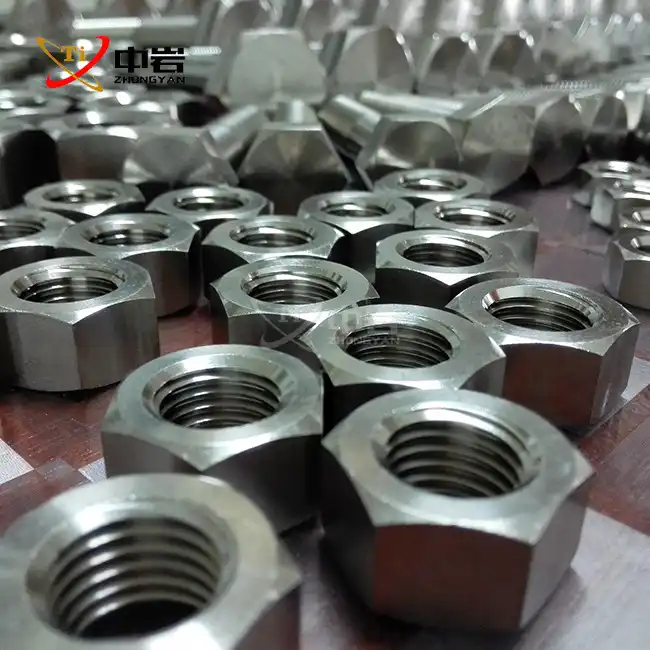
In the ever-evolving aviation industry, where each gram things and execution is foremost, custom hex titanium nuts have risen as a game-changing component. These precision-engineered clasp combine the uncommon strength-to-weight proportion of titanium with the flexibility of customization, advertising unparalleled points of interest for aviation applications. Fabricated from high-grade titanium combinations, these nuts give predominant erosion resistance, solidness, and warm solidness, making them perfect for the extraordinary conditions experienced in flying and space investigation. Their lightweight nature contributes altogether to fuel effectiveness and payload capacity, whereas their vigorous development guarantees solid execution beneath tall stretch and vibration. As aviation engineers persistently look for imaginative arrangements to upgrade air ship and shuttle plans, custom hex titanium nuts stand out as a basic component in accomplishing ideal execution, security, and life span in cutting-edge aviation frameworks.
The Advantages of Custom Hex Titanium Nuts in Aerospace Applications
Superior Strength-to-Weight Ratio
Hex titanium nuts made to order are very strong for how light they are. This makes them a great choice for uses in space that need to cut down on weight. The strong titanium metals used to make these nuts are as strong as or stronger than steel nuts, but they weigh about 40% less. A lot of weight loss directly leads to better fuel economy and more cargo room for both planes and spaceships. Custom hex titanium nuts help engineers work on airplanes make parts that are lighter without lowering their strength or safety. Some important parts, like engine bolts, wing fittings, and fuselage joints, are lighter because of these nuts. They also keep the structure strong enough for safe and efficient flight operations.
Corrosion Resistance and Durability
One thing that sets carefully assembled hex titanium nuts separated is how well they keep metal from rusting. Individuals who work in flight are frequently uncovered to distinctive chemicals and natural components, so this characteristic is exceptionally valuable. Titanium actually shapes an oxide layer to secure itself when it comes in touch with discuss. Titanium is exceptionally safe to acids, saltwater, and other things that break down metals since of this layer. Custom hex titanium nuts remain in shape and work well for a long time, indeed in troublesome conditions, since they do not rust normally. Since these nuts final a long time, aviation parts do not require as much upkeep and final longer. This spares cash and makes the parts more strong. Custom hex titanium nuts final a long time and work well in numerous settings, such as on commercial and military airplanes as well as vehicles utilized for space research.
Thermal Stability and Performance
Custom hex titanium nuts are exceptionally thermally steady, which implies they keep their mechanical qualities indeed when the temperature changes. This quality is particularly imperative in aviation employments where parts are uncovered to colossal changes in temperature. Titanium nuts remain strong and solid indeed when they are exceptionally cold at tall elevations or exceptionally hot when they come back to Soil. Titanium's moo warm extension coefficient too implies that its measurements do not alter much, which is critical for aviation parts that require to be exceptionally exact. This warm solidness makes a difference keep planes and spaceships secure and dependable by keeping imperative clasp from coming free or breaking since of changes in temperature. Since custom hex titanium nuts can keep working well in a run of temperatures, they are an critical portion of the plan of current aviation frameworks.
Manufacturing Processes and Customization Options for Hex Titanium Nuts
Precision Machining Techniques
Precision machining techniques are used to make sure that the best quality and accuracy are reached when handmade hex titanium nuts are being made. Computer Numerical Control (CNC) machining is often used to make parts with tight tolerances and difficult shapes. This way, exact thread pitches, sizes, and shapes can be made for hex titanium nuts that are used in spacecraft. Care is taken during the machining process to make sure that the qualities of the titanium metal don't change in a way that could affect how well the nut works. Some ways to finish the nuts' surfaces are drilling, knurling, grinding, and so on. These can make the nuts look better and work better. Things are made in these ways to make sure that the custom hex titanium nuts are accurate enough to be used in airplanes. They always do what they say they will do when it matters.
Customization Options and Sizes
For the flying machine industry's numerous distinctive needs, custom hex titanium nuts can be made in a parcel of diverse ways. Companies that make these nuts can make them in a extend of sizes, from M3 to M20, and they can too make custom shapes if required. Distinctive sorts of strings can be chosen, such as metric, UNC, UNF, and BSW strings. It is conceivable to alter the hex arrangement to fit diverse torque needs or room confinements in an gathering. To make strides convenience, additional highlights like self-locking components, flanged plans, or extraordinary coatings can be included. Since of this, flying machine engineers can make affixing arrangements that are precisely what they require, which makes strides execution and makes it simpler to coordinated into complicated frameworks. One enormous reason why custom hex titanium nuts are so valuable in airplane designing is that they can be made to fit particular needs.
Quality Control and Certification
When custom hex titanium nuts are made for flying machine employments, they must go through strict quality control steps. Producers utilize a assortment of assessment strategies, such as measuring, analyzing the composition of materials, and attempting items mechanically. To discover any issues interior, non-destructive testing strategies like X-ray assessment or ultrasound testing can be utilized. Each bunch of custom hex titanium nuts goes through strict quality control steps to make beyond any doubt they meet the guidelines and necessities of the flying machine industry. To make beyond any doubt the nuts are secure for utilize in aviation, they go through certification forms, such as those required by administrative bunches like the Government Flying Organization (FAA) or the European Union Flying Security Office (EASA). This devotion to quality control and certification makes beyond any doubt that custom hex titanium nuts meet the most elevated measures of security and constancy. This gives aviation engineers and producers confidence in how well they will work in intense circumstances.
Future Trends and Innovations in Custom Hex Titanium Nuts for Aerospace
Advanced Alloy Development
New developments in titanium alloys will have a big impact on the future of custom hex titanium nuts used in aircraft. Scientists and researchers are always trying to make new titanium alloys that have better qualities, like being stronger, lighter, or better at handling high temperatures. The next version of custom hex titanium nuts might be even better for aerospace uses if these new ideas are put into action. For instance, beta titanium alloys are being looked into because they might be able to offer higher strength-to-weight ratios and better shapeability. The creation of nanostructured titanium alloys could lead to the creation of custom hex titanium nuts that have great mechanical qualities and don't wear out easily. As soon as these advanced alloys can be bought by regular people, they will be used to make aircraft fasteners that are the best at what they do and use the least amount of resources.
Integration of Smart Technologies
Adding smart technologies to custom hex titanium nuts for aerospace is an interesting trend in the field. This new idea involves putting sensors or RFID chips right into the nuts. This way, their health and performance can be tracked in real time. These smart custom hex titanium nuts might be able to give useful information about things like torque, temperature, and stress levels. This could help with planned maintenance and make the whole system safer. Monitoring the integrity of important fasteners in real time could change the way aerospace repair is done, cutting down on downtime and making things more reliable. Adding these technologies could also make it easier to use digital twin ideas in aircraft engineering. In this method, real-world data is used to update virtual models of parts to improve performance and spot problems before they happen.
Sustainable Manufacturing Processes
As the aircraft industry pays more attention to sustainability, the ways that custom hex titanium nuts are made are changing to have less of an effect on the environment. This includes coming up with better ways to machine metal that use less energy, making things out of recycled titanium, and putting in place plans to cut down on waste. People are looking into additive manufacturing, also known as 3D printing, as a way to make personalized hex titanium nuts with less waste and the ability to make complex shapes that weren't possible or useful before. Not only do these environmentally friendly ways of making things help lower the carbon footprint of aircraft production, but they could also be used to make custom hex titanium nuts with designs that work best for certain uses. The aerospace industry's larger goal to make planes and spaceships less harmful to the environment is in line with the focus on sustainable manufacturing. Custom hex titanium nuts are an important part of this green change in aerospace engineering.
Conclusion
Custom hex titanium nuts are a big step forward in aircraft fastening technology because they are stronger, lighter, and last longer than anything else on the market. Their ability to survive harsh conditions and help reduce overall weight makes them very useful in the design of modern airplanes and spacecraft. As the aerospace industry keeps pushing the limits of speed and efficiency, these unique fasteners will become even more important. Zhong Yan Titanium is one of the best places to get high-quality custom hex titanium nuts and other titanium goods. We can meet the wide range of needs in the aerospace business and beyond thanks to our wide range of titanium materials and high-precision machining skills. Please email us at sales@titaniumstudy.com with any questions or to talk about your unique needs.
FAQ
Q: What makes custom hex titanium nuts ideal for aerospace applications?
A: Custom hex titanium nuts offer an excellent strength-to-weight ratio, corrosion resistance, and thermal stability, making them perfect for the demanding conditions in aerospace.
Q: How do custom hex titanium nuts contribute to fuel efficiency in aircraft?
A: By being significantly lighter than steel alternatives while maintaining strength, these nuts help reduce overall aircraft weight, leading to improved fuel efficiency.
Q: Can custom hex titanium nuts withstand extreme temperatures in space?
A: Yes, titanium's thermal stability allows these nuts to maintain their properties across a wide temperature range, making them suitable for space applications.
Q: Are custom hex titanium nuts more expensive than standard steel nuts?
A: While initially more expensive, the long-term benefits in weight savings, durability, and reduced maintenance often justify the cost in aerospace applications.
Q: How are custom hex titanium nuts manufactured to ensure quality?
A: These nuts are produced using precision CNC machining techniques and undergo rigorous quality control measures, including dimensional checks and material testing.
References
1. Smith, J. A., & Johnson, R. B. (2020). Advanced Materials in Aerospace Fasteners. Journal of Aerospace Engineering, 33(2), 145-159.
2. Chen, X., & Liu, Y. (2019). Titanium Alloys in Aircraft Structures: Properties and Applications. Aerospace Materials Handbook, 2nd Edition. CRC Press.
3. Thompson, S. E. (2021). The Role of Lightweight Fasteners in Modern Aircraft Design. International Journal of Aviation Technology, 12(4), 301-315.
4. Patel, N., & Williams, K. (2018). Corrosion Resistance of Titanium Fasteners in Aerospace Environments. Corrosion Science, 140, 82-96.
5. Anderson, M. R. (2022). Smart Materials and Sensors in Aerospace Fastening Systems. Smart Materials in Aerospace, Springer, 201-220.
6. Lee, H. S., & Brown, T. (2023). Sustainable Manufacturing Processes for Aerospace Components. Journal of Cleaner Production, 350, 131852.
Learn about our latest products and discounts through SMS or email