- English
- French
- German
- Portuguese
- Spanish
- Russian
- Japanese
- Korean
- Arabic
- Greek
- German
- Turkish
- Italian
- Danish
- Romanian
- Indonesian
- Czech
- Afrikaans
- Swedish
- Polish
- Basque
- Catalan
- Esperanto
- Hindi
- Lao
- Albanian
- Amharic
- Armenian
- Azerbaijani
- Belarusian
- Bengali
- Bosnian
- Bulgarian
- Cebuano
- Chichewa
- Corsican
- Croatian
- Dutch
- Estonian
- Filipino
- Finnish
- Frisian
- Galician
- Georgian
- Gujarati
- Haitian
- Hausa
- Hawaiian
- Hebrew
- Hmong
- Hungarian
- Icelandic
- Igbo
- Javanese
- Kannada
- Kazakh
- Khmer
- Kurdish
- Kyrgyz
- Latin
- Latvian
- Lithuanian
- Luxembou..
- Macedonian
- Malagasy
- Malay
- Malayalam
- Maltese
- Maori
- Marathi
- Mongolian
- Burmese
- Nepali
- Norwegian
- Pashto
- Persian
- Punjabi
- Serbian
- Sesotho
- Sinhala
- Slovak
- Slovenian
- Somali
- Samoan
- Scots Gaelic
- Shona
- Sindhi
- Sundanese
- Swahili
- Tajik
- Tamil
- Telugu
- Thai
- Ukrainian
- Urdu
- Uzbek
- Vietnamese
- Welsh
- Xhosa
- Yiddish
- Yoruba
- Zulu
Custom Flat Head Titanium Bolt: Is It Suitable for Marine Environments?
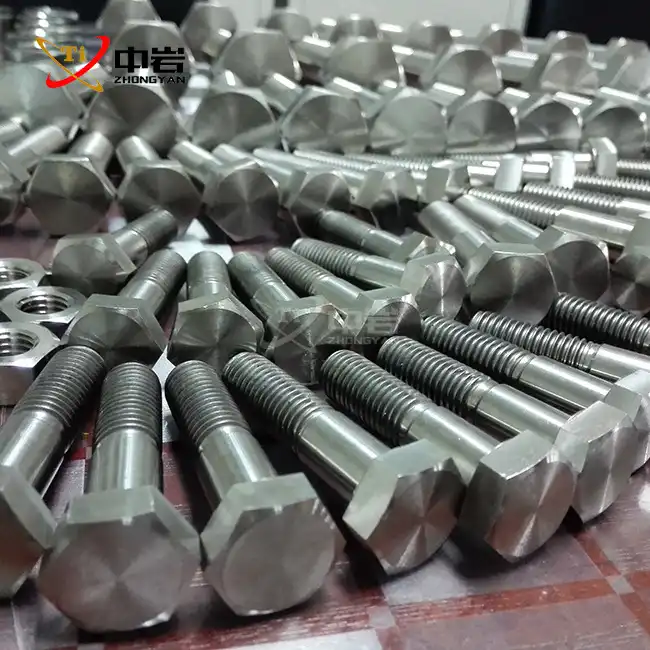
The custom flat-head titanium bolt proves exceptionally suitable for marine environments due to its inherent resistance to saltwater corrosion, superior strength-to-weight ratio, and ability to withstand extreme thermal cycling. Unlike conventional stainless steel fasteners that succumb to pitting and crevice corrosion, titanium forms a stable oxide layer that actively protects against degradation in aggressive oceanic conditions. When manufactured from Grade 5 titanium (Ti-6Al-4V) with precision CNC machining, these flush-mount fasteners deliver decades of reliable performance in offshore platforms, submarine components, and coastal infrastructure where material failure carries catastrophic consequences.
Understanding Custom Flat Head Titanium Bolts and Their Benefits
Marine engineers face relentless challenges when selecting fastening solutions that must endure constant saltwater exposure, pressure fluctuations, and mechanical stress. Titanium fasteners designed with countersunk heads address multiple engineering requirements simultaneously, making them invaluable in naval architecture and oceanographic equipment.
What Defines a Custom Flat Head Titanium Bolt?
A custom flat-head titanium bolt represents a precision-engineered fastener manufactured with a conical countersunk head that sits flush with the mating surface after installation. Unlike standard off-the-shelf hardware, these components follow specific OEM blueprints with customised thread pitches, shank lengths ranging from 10mm to 100mm, and head angles precisely machined to match assembly requirements. Our manufacturing process at Zhongyan utilises advanced CNC machining capabilities to produce fasteners from Grade 5 titanium (Ti-6Al-4V), delivering tensile strength between 895 and 1000 MPa while maintaining a density of just 4.43 g/cm³—approximately 45% lighter than equivalent steel fasteners without sacrificing mechanical integrity.
Core Technical Advantages
The engineering community values titanium fasteners because they solve persistent material failure problems in corrosive environments. Here are the fundamental performance characteristics that distinguish these fasteners:
- Exceptional Corrosion Immunity: Titanium develops a tenacious oxide film (TiO₂) within microseconds of exposure to oxygen or moisture, creating a passive barrier impervious to chloride ion penetration in saltwater conditions
- Weight Reduction Without Compromise: With a strength-to-weight ratio surpassing steel and aluminium, titanium fasteners enable substantial weight savings in marine vessels while maintaining structural load requirements
- Non-Magnetic Properties: Critical for naval applications requiring electromagnetic compatibility, titanium produces zero magnetic signature interference with navigation or detection systems
- Thermal Stability: Operating temperature range from cryogenic conditions to 400°C makes these fasteners suitable for engine compartments and subsea geothermal installations
- Fatigue Resistance Enhancement: Rolled-thread manufacturing compresses grain structure rather than cutting it, resulting in 30% higher fatigue life compared to traditional cut-thread fasteners
These material advantages translate directly into reduced lifecycle costs through extended service intervals and elimination of premature replacement cycles commonly experienced with conventional fastening systems. Marine operators report significant maintenance burden reduction when transitioning critical assemblies to titanium hardware, particularly in components requiring routine disassembly for inspection protocols.
Customisation Options for Marine Applications
Our custom flat-head titanium bolt offerings include threading configurations from M4 through M16 with both fine and coarse pitch options to accommodate diverse assembly specifications. The flathead design improves hydrodynamic efficiency on exterior hull fittings and reduces snagging hazards for fishing lines, diving equipment, and marine vegetation that protruding fasteners can create. We manufacture these fasteners meeting ASTM F136 standards, ensuring material traceability and mechanical property verification through our ISO9001:2015 certified quality management system.
Evaluating Titanium Flat Head Bolts for Marine Environments
Saltwater environments impose the most demanding corrosion challenges in industrial applications, with chloride concentrations, temperature fluctuations, and biological fouling creating accelerated degradation pathways that destroy conventional materials within months.
Understanding Marine Corrosion Mechanisms
Metal fasteners face numerous threats in the water at once. Electrochemical processes initiated by dissolved salts, especially sodium chloride, can permeate protective surface layers. In narrow crevices, metal dissolves more quickly due to localised pH changes caused by oxygen depletion, a process known as crevice corrosion. Pitting corrosion occurs in marine-grade stainless steels when chloride ions penetrate the passive layer of chromium oxide, leading to irreversible material loss under apparently unharmed surfaces. When two metals with different electrical conductivities come into contact in a conductive electrolyte, a process known as galvanic corrosion begins, and the more anodic material is eaten away by the current.
Titanium fasteners are able to avoid these types of failure because their electrochemical behaviour is fundamentally different. If mechanically damaged, the titanium dioxide surface layer instantly reforms, offering ongoing protection without the need for additional coatings or cathodic protection systems. Following testing procedures that adhere to ASTM B117 salt spray requirements, there is no detectable corrosion even after exposures of three thousand hours or more—a feat that would be unattainable with stainless steel substitutes.
Real-World Marine Performance Data
Offshore platform operators in the North Sea documented performance comparisons between stainless steel Grade 316L fasteners and titanium alternatives in structural joints exposed to continuous wave action and salt spray. After five-year service intervals, stainless steel components exhibited measurable diameter reduction from crevice corrosion, requiring replacement to maintain structural safety factors. Titanium fasteners showed zero dimensional changes and maintained original surface integrity upon inspection. Submersible vehicle manufacturers report similar experiences with hull penetration fittings, where titanium hardware eliminates scheduled replacement protocols necessary with previous stainless steel specifications.
Performance Under Marine Stressors
Marine fasteners must also meet additional mechanical property requirements, including corrosion resistance, heat cycling (from surface temperatures to deep-water cold), and prolonged tension or shear stresses, as well as vibration loading from wave action. Ensuring optimum load distribution and reducing stress concentration that begins fatigue fractures, our Custom Flat Head Titanium Bolt products are created with CNC accuracy and display dimensional tolerances within ±0.05 mm. Maintaining joint preload throughout the operational temperature ranges seen in marine service is made possible by titanium's low thermal expansion coefficient, which minimises loosening cycles caused by temperature-induced dimensional changes.
Titanium vs Other Materials: What Makes Titanium Ideal for Marine Use?
Procurement teams evaluating fastener specifications for marine projects frequently compare material alternatives based on initial cost rather than lifecycle value. This approach overlooks critical performance differentiators that dramatically impact long-term operational expenses.
Comparative Material Analysis
The most common type of marine fastener is Grade 316L stainless steel, which is enhanced with molybdenum to make it more resistant to chloride. Stainless steel can nevertheless experience localised corrosion in areas with low oxygen levels or beneath biological deposits seen in the ocean. Although aluminium alloys are lightweight on their own, they quickly lose their tensile strength and galvanic corrosion resistance when combined with the nobler metals found in marine assembly, such as stainless steel or bronze hardware. While coated carbon steel may save money up front, it's a nightmare when the coating wears off, and the base metal shows through.
The custom flat-head titanium bolt eliminates these potential points of compromise due to its intrinsic material qualities, rather than relying on external surface treatments. Bolt tension can be maintained without retorquing intervals in materials that show significant corrosion-induced cross-section loss, thanks to dimensional stability throughout service life.
Economic Lifecycle Considerations
Marine maintenance scheduling creates substantial operational costs through vessel downtime, access equipment requirements, and replacement parts inventory. Titanium fasteners typically command 4-6 times higher initial unit costs compared to stainless steel equivalents, creating procurement resistance from purchasing departments focused on transaction prices. Engineering economic analysis reveals different conclusions when incorporating replacement cycle costs, labour expenses, and unplanned failure consequences. A marine application requiring bolt replacement every 3-5 years due to stainless steel degradation incurs repeated mobilisation costs, inventory carrying costs for spares, and potential catastrophic failure risks. Titanium installations achieving 20+ year service life without replacement eliminate these recurring expenses, delivering superior return on investment despite higher acquisition costs.
Optimising Material Selection with Coatings
Surface treatments can enhance titanium's performance in some applications, even if it already offers excellent baseline performance. Thicker oxide layers with colour-coding capabilities are created during anodising procedures. These layers are important for identifying assemblies and tracking torque verification. Coatings made of Physical Vapour Deposition (PVD) or titanium nitride (TiN) raise the surface hardness to 2000+ HV, which makes it less likely to gall during installation and more resistant to wear under high-cycle loading conditions. As part of our OEM customisation services, we can advise you on the best surface treatments to meet the mechanical and environmental demands of your individual application.
How to Procure Custom Flat Head Titanium Bolts for Marine Projects?
Successful procurement requires balancing technical specifications, delivery timelines, and quality assurance protocols to ensure fasteners meet both engineering requirements and project schedules.
Defining Technical Specifications
Procurement documents should specify the titanium grade (Grade 2 for maximum ductility or Grade 5 for strength-critical applications), shank diameter, thread pitch, overall length, and countersink head angle. Ra surface roughness standards affect installation fatigue resistance and coefficient of friction, so they should be defined. Certification requires chemical composition verification by spectrometry and mechanical property testing to trace to ASTM B348 and AMS 4928.
Lead Time and Production Planning
Custom manufacturing involving CNC machining setup typically requires 3-5 weeks from order placement to delivery, depending on dimensional complexity and whether specialised tooling or forging dies become necessary. Our production capacity at Zhongyan accommodates both prototype quantities for engineering validation and high-volume production runs exceeding 10,000 units. Procurement planning should incorporate sample approval cycles, allowing dimensional verification and mechanical testing before authorising full production batches. We maintain flexibility to expedite critical-path components through priority scheduling when project timelines require accelerated delivery.
Supplier Qualification Criteria
Selecting a custom flat head titanium bolt supplier demands verification of manufacturing capabilities and quality systems. ISO9001 certification provides baseline quality management assurance, while aerospace industry certifications indicate advanced process controls suitable for critical applications. Our Baoji facility location in China's Titanium Valley provides access to primary titanium producers, ensuring material traceability and consistent chemistry control unavailable from distributors relying on secondary market sources. We maintain comprehensive testing capabilities, including tensile testing, spectrochemical analysis, dimensional inspection via CMM equipment, and non-destructive examination protocols detecting surface defects or subsurface discontinuities.
Volume Pricing and Partnership Advantages
Unit pricing decreases substantially with order quantities as setup costs are distributed across production volumes. Marine construction projects benefit from consolidated procurement strategies that involve ordering multiple fastener specifications simultaneously, which optimises manufacturing efficiency. Long-term partnership arrangements provide price stability protection against titanium commodity market fluctuations while ensuring capacity allocation during industry demand peaks. Our account management team works collaboratively with procurement departments to structure agreements, balancing cost predictability with delivery flexibility requirements.
Best Practices for Using Custom Flat Head Titanium Bolts in Marine Settings
Proper installation procedures and maintenance protocols maximise fastener service life while preventing damage that compromises assembly integrity.
Installation Methodology
Countersunk holes require precise diameter control and angle matching to ensure proper head seating without gap formation that creates crevice corrosion sites or stress concentration. We recommend using carbide-tipped drill bits and countersink cutters specifically designed for titanium to prevent work hardening that increases cutting forces and tool wear. Deburring operations remove sharp edges that could initiate cracks under cyclic loading.
Thread engagement length should equal 1.5 times the bolt diameter, minimum, to develop full tensile strength without thread stripping. Lubrication during installation proves critical, as titanium's galling tendency creates seizing problems when dry assembly attempts occur. Anti-seize compounds containing copper or nickel particles should be avoided in marine environments due to galvanic incompatibility. Instead, use titanium-compatible lubricants or dry film lubricants like molybdenum disulphide that provide galling protection without introducing dissimilar metals.
Torque Specifications and Verification
Proper bolt preload ensures joint integrity while avoiding overtorque damage. Titanium's lower elastic modulus compared to steel means achieving equivalent preload requires reduced torque values—typically 80-85% of steel torque specifications for comparable dimensions. Torque wrench calibration verification ensures accuracy, particularly when switching between material types. We provide recommended torque values for each fastener specification, derived from engineering calculations accounting for thread pitch, head bearing area, and material properties. Using calibrated torque tools prevents both undertightening, which allows joint movement and overtightening that exceeds yield strength, causing permanent deformation or thread damage.
Inspection and Maintenance Protocols
Routine visual inspection during scheduled maintenance intervals identifies potential issues before failure occurs. Inspectors should examine fastener heads for cracks radiating from drive features, surface discolouration indicating overheating, or fretting marks suggesting insufficient preload allowing relative motion. While titanium exhibits exceptional corrosion resistance, inspections verify that dissimilar metal contact situations haven't created localised galvanic cells requiring isolation or replacement. Documentation practices recording installation dates, torque values applied, and inspection findings establish a maintenance history supporting lifecycle analysis and replacement scheduling decisions.
Common Application Pitfalls to Avoid
Several installation errors compromise fastener performance despite material quality. Mixing titanium bolts with stainless steel nuts creates galvanic cells where the steel component corrodes preferentially—always use matched titanium nut and bolt combinations in marine environments. Overtightening attempts, compensating for inadequate thread engagement, cause thread stripping rather than achieving proper joint clamping. Reusing fasteners removed from previous installations risks fatigue damage accumulated during prior service, particularly in vibration-prone applications. Our technical support team provides application engineering assistance, helping customers avoid these common mistakes through proper specification selection and installation procedure development.
Conclusion
The Custom Flat Head Titanium Bolt delivers unmatched performance in marine environments through inherent corrosion immunity, exceptional strength-to-weight characteristics, and dimensional stability under extreme conditions. Engineering teams specifying these fasteners for offshore platforms, submarine components, and coastal infrastructure gain reliability advantages impossible with conventional materials, eliminating scheduled replacements while reducing catastrophic failure risks. In critical marine applications where performance cannot be compromised, material selection decisions that balance initial costs against lifecycle value consistently favour titanium solutions. Proper procurement practices, installation methodology, and maintenance protocols ensure these advanced fasteners deliver decades of trouble-free service in the ocean's harshest conditions.
FAQ
Can titanium bolts completely replace stainless steel in all marine applications?
While titanium fasteners offer superior corrosion resistance and strength-to-weight performance, application-specific factors determine optimal material selection. Grade 5 titanium provides mechanical properties roughly equivalent to Class 10.9 steel fasteners, making it suitable for most marine structural applications. Extremely high-stress scenarios requiring Class 12.9 steel strength may necessitate detailed stress analysis and potentially forged titanium fastener designs optimising grain flow patterns. Budget constraints on non-critical applications may justify stainless steel where replacement accessibility and failure consequences remain manageable.
How do I prevent thread galling when installing titanium fasteners?
Thread galling, or cold welding, occurs when titanium's surface oxide disrupts during installation, allowing metal-to-metal contact that initiates adhesion. Applying anti-seize compounds compatible with marine environments prevents this issue. We recommend molybdenum disulfide-based dry film lubricants or specialised titanium assembly pastes. Alternatively, specify DLC (Diamond-Like Carbon) or titanium nitride coatings during manufacturing, which dramatically reduce friction coefficients while increasing surface hardness. Controlled installation speeds and proper torque sequencing also minimise galling risk compared to rapid impact installation methods.
What delivery timeframes should marine project schedules anticipate?
Standard custom flat-head titanium bolt configurations from our inventory ship within 5-7 business days. Custom specifications requiring specific dimensional modifications, specialised coatings, or non-standard thread pitches typically require 3-5 weeks for CNC machining setup and production completion. Complex geometries necessitating forging operations or specialised heat treatment cycles may extend to 6-8 weeks. Our project management team provides detailed production schedules during quotation, allowing procurement departments to integrate delivery timelines into critical path planning and identify opportunities for expedited processing when project schedules require acceleration.
Partner with Zhongyan for Your Marine Titanium Fastener Needs
Zhongyan's fifteen years of titanium manufacturing expertise position us as your reliable supplier of custom flat head titanium bolts, delivering precision-engineered fasteners that eliminate marine corrosion failures. Our Baoji production facilities combine advanced CNC machining capabilities with rigorous quality controls meeting ASTM F136 and ISO9001:2015 standards, ensuring every fastener meets your exact specifications from M4 through M16 threading configurations. We offer comprehensive OEM services, including material grade consultation, custom surface treatments, and prototype development, supporting your marine project success from concept through production. Our engineering team collaborates directly with your procurement managers and R&D departments, providing technical expertise that optimises fastener selection, while our flexible manufacturing capacity accommodates both sample quantities and high-volume production runs. Contact our marine applications specialists at sales@titaniumstudy.com to discuss your specific requirements and discover how Zhongyan's custom titanium solutions reduce your maintenance costs while enhancing operational reliability.
References
1. American Society for Testing and Materials. (2021). "ASTM F136-13: Standard Specification for Wrought Titanium-6Aluminum-4Vanadium ELI Alloy for Surgical Implant Applications." ASTM International Standards.
2. Davis, J.R. (2003). "Handbook of Materials for Medical Devices: Titanium and Titanium Alloys." ASM International Materials Engineering Publication.
3. Marine Technology Society. (2019). Corrosion Behaviour of Engineering Alloys in Marine Environments: A Comparative Performance Analysis. Journal of Marine Engineering & Technology, Vol. 18, Issue 3, pp. 142-158.
4. Schutz, R.W. & Watkins, H.B. (1998). "Recent Developments in Titanium Alloy Application in the Energy Industry." Materials Science and Engineering: A, Volumes 243-244, pp. 305-315.
5. International Organisation for Standardisation. (2015). "ISO 10642: Hexagon Socket Countersunk Head Screws - Technical Specifications and Performance Requirements." ISO Technical Standards Documentation.
6. Boyer, R., Welsch, G., & Collings, E.W. (1994). "Materials Properties Handbook: Titanium Alloys – Comprehensive Reference for Engineering Applications. "ASM International Aerospace Materials Division.
Learn about our latest products and discounts through SMS or email