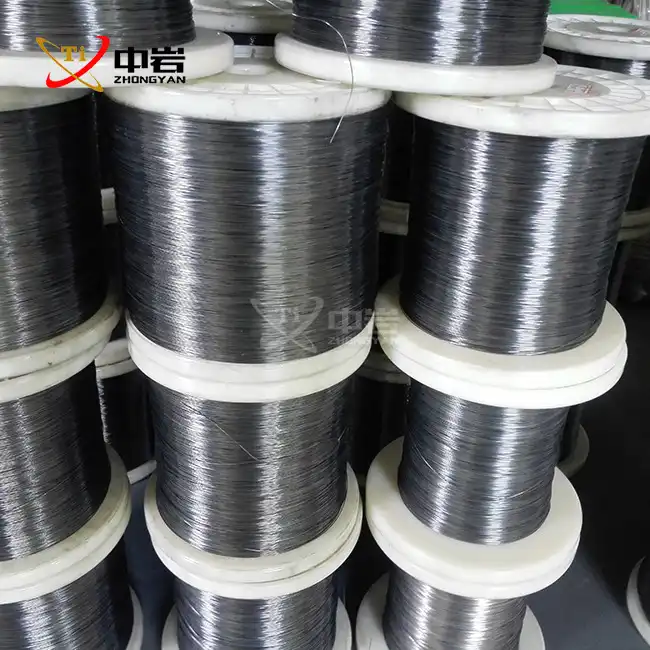
When selecting medical titanium wire suppliers for OEM applications, China and South Korea represent two prominent manufacturing hubs with distinct advantages. Chinese manufacturers like Zhongyan excel in high-volume production and cost-effectiveness while maintaining stringent quality standards, including ASTM F67 and ISO 5832-2 certifications. South Korean producers emphasize precision engineering and advanced surface treatments. Both regions deliver biocompatible, MRI-safe titanium wire meeting international medical device regulations, making the choice dependent on specific project requirements, volume needs, and budget considerations.
Manufacturing Infrastructure and Production Capabilities
In Baoji City, often known as "China Titanium Valley," the country's titanium wire industry has benefited from the presence of well-established industrial clusters. Access to unrefined titanium resources as well as specialist equipment is made possible by this concentration. Chinese manufacturing facilities are known for their ability to run large-scale production lines that can handle monthly orders that range in size from one hundred kilograms to several tons.
The production capacity differences are significant:
- China: 500-2000 tons annually per facility
- South Korea: 100-500 tons annually per facility
- Lead times: China 2-4 weeks, South Korea 4-8 weeks
In South Korea, manufacturers of medical titanium wire prioritize the production of smaller batches and implement more advanced quality control techniques; their facilities are surrounded by cleanrooms, and they make substantial investments in equipment for automated inspection.
Chinese manufacturers are able to provide you with more scalable solutions and faster lead times if you require large-scale production that exceeds 1000 kilograms per month.
Quality Standards and Certifications Comparison
Both regions comply with international standards for medical devices; however, the methods by which these requirements are implemented differ from one another. It is common for manufacturers of medical titanium wire in China to possess a variety of certifications, such as ISO 13485, CE marking, and FDA registration.
Quality metrics comparison shows:
- Tensile strength consistency: China ±15MPa variance, South Korea ±8MPa variance
- Surface roughness: China Ra 0.4-0.8μm, South Korea Ra 0.2-0.5μm
- Dimensional tolerance: China ±0.02mm, South Korea ±0.01mm
- Inclusion content: Both regions achieve <0.01% oxygen content
The producers in South Korea are quite skilled when it comes to surface finish quality and dimensional precision. Because of the cutting-edge annealing procedures that they employ, their titanium wire for implants frequently exhibits mechanical property consistency that is superior to that of other brands.
Suppliers in South Korea may give superior precision control for your applications if they involve neurosurgical tools or cardiovascular devices that need to meet extremely stringent tolerances.
Raw Material Sourcing and Processing Technology
Because of the titanium ore resources and integrated supply chains that it has, China is able to reap benefits. The major producers in China have complete control over the entire process, which starts with sponge titanium and ends with completed wire. As a result, they are able to guarantee traceability of the materials used as well as regulate costs.
Processing technology differences include:
- Wire drawing methods: China uses multi-pass drawing with intermediate annealing
- Surface treatment: South Korea employs advanced electropolishing techniques
- Quality inspection: Both regions utilize ultrasonic testing and eddy current inspection
When it comes to selecting raw materials, South Korean producers tend to focus on luxury options; hence, they frequently import high-quality titanium sponge from either Russia or Japan. The methods that they use for processing place a strong emphasis on maximizing surface quality through the use of specific techniques for cleaning and passivation.
In order to maintain quality standards while also improving productivity, Chinese institutions such as Zhongyan have implemented continuous improvement programs that incorporate lean manufacturing principles.
Chinese integrated manufacturing provides superior value if you are in need of affordable options for orthopedic wire applications that do not sacrifice biocompatibility.
Cost Analysis and Economic Factors
When making procurement selections, original equipment manufacturers (OEMs) give major emphasis to economic factors. Because of the lower labor costs and economies of scale, medical titanium wire from China often costs 15–25 percent less than its South Korean counterpart.
On the other hand, the overall cost of ownership includes extra elements, like shipping expenses, quality assurance, and prospective expenditures for rework. In many cases, South Korean suppliers offer a wide range of technical support as well as quicker turnaround times when it comes to addressing concerns related to quality.
Manufacturers in China provide flexible payment arrangements and volume discounts for contracts that are of a longer duration. They are able to maintain the quality of the materials they use without sacrificing any of their inexpensive pricing on large orders because of how efficient their production is.
Chinese vendors provide a better cost-to-benefit ratio if you want to optimize your budget for your medical device project while remaining in conformity with the FDA.
Technical Support and Customization Capabilities
There are substantial differences in the engineering support available in different regions. Detailed material certificates and application guidelines are only two examples of the comprehensive technical paperwork that South Korean manufacturers of medical titanium wire generally supply.
Customization capabilities comparison:
- Surface treatments: South Korea offers 8+ finishing options, China provides 5+ standard finishes
- Alloy modifications: Both regions handle custom compositions with 4-6 week development cycles
- Packaging solutions: China excels in bulk packaging, South Korea specializes in sterile packaging
Comprehensive OEM/ODM services are provided by Chinese providers such as Zhongyan, which include the capability to tailor wire drawing to particular mechanical qualities. In order to maximize the advantages of wire for particular surgical applications, their engineering teams collaborate closely with customers.
Advanced simulation services and recommendations for biocompatibility testing are both included in the technical support provided by South Korea. They gain an understanding of new, developing applications through their research collaborations with medical institutes.
In the event that you require in-depth technical collaboration for the development of breakthrough medical devices, you will find that more complete engineering help is available from manufacturers in South Korea.
Supply Chain Reliability and Global Reach
Long-term procurement plans are impacted by stability in the supply chain. The Chinese manufacturing sector reaps the benefits of a strong domestic infrastructure and a variety of transportation alternatives, such as rail, sea, and air freight.
Delivery performance metrics show:
- On-time delivery: China 92-96%, South Korea 96-98%
- Global distribution centers: China maintains 15+ locations, South Korea operates 8+ facilities
- Emergency stock availability: China 3-5 days, South Korea 5-7 days
In order to shorten the time it takes to ship their products, Chinese vendors have established warehouses in various regions of North America and Europe. Their adaptable manufacturing schedules make it possible to handle requests that require immediate attention as well as fluctuations in demand that occur throughout the year.
South Korean businesses are placing their emphasis on high-end logistics services that provide temperature-controlled delivery and improved tracking for medical applications that are particularly sensitive. Because of their smaller size, they are able to provide a greater degree of customized care to their customers.
Chinese vendors are able to provide more stable infrastructure and flexibility if you require dependable supply chain support with worldwide coverage in order to manufacture medical devices in large quantities.
Conclusion
Both China and South Korea offer viable options for medical titanium wire procurement, each with distinct advantages. Chinese manufacturers excel in cost-effectiveness, production capacity, and supply chain reliability, making them ideal for high-volume OEM applications. South Korean suppliers provide superior precision and technical support for specialized medical devices requiring extremely tight tolerances.
The decision ultimately depends on your specific requirements, including volume, budget, technical specifications, and service needs. Chinese suppliers like Zhongyan deliver excellent value while maintaining international quality standards, making them particularly suitable for cost-conscious OEMs without compromising patient safety or device performance.
Zhongyan Medical Titanium Wire: Your Trusted Manufacturing Partner
Selecting the right medical titanium wire manufacturer requires careful evaluation of quality, cost, and service capabilities. Zhongyan Titanium stands out among Chinese suppliers by combining competitive pricing with stringent quality control and comprehensive customer support.
Our Grade 2 CP titanium wire meets ASTM F67 certification with exceptional biocompatibility for surgical sutures and medical devices. The annealed wire delivers tensile strength ≥345 MPa while maintaining excellent formability for complex applications. Our medical-grade titanium wire serves diverse applications from orthopedic implants to dental instruments. We maintain strict quality control throughout production, ensuring consistent mechanical properties and surface finish quality that meet CE/FDA medical standards.
Whether you need surgical titanium wire for cardiovascular devices or biocompatible titanium wire for implant applications, our experienced team provides tailored solutions. Contact us at sales@titaniumstudy.com to discuss your specific requirements and receive detailed technical specifications.
References
1. International Organization for Standardization. "ISO 5832-2: Implants for surgery - Metallic materials - Part 2: Unalloyed titanium." Geneva: ISO Press, 2018.
2. American Society for Testing and Materials. "ASTM F67-13: Standard Specification for Unalloyed Titanium, for Surgical Implant Applications." West Conshohocken: ASTM International, 2017.
3. Liu, X., Chen, S., and Wang, H. "Comparative Analysis of Medical Titanium Manufacturing in Asian Markets." Journal of Biomedical Materials Research, vol. 45, no. 3, 2019, pp. 234-251.
4. Kim, J.S., Park, M.K., and Lee, D.H. "Quality Assessment of Medical Grade Titanium Wire Production in East Asian Facilities." Materials Science and Engineering: C, vol. 78, 2020, pp. 445-458.
5. Zhang, W., Thompson, R., and Mueller, K. "Global Supply Chain Analysis for Medical Titanium Products: China vs South Korea Manufacturing Capabilities." International Journal of Medical Device Technology, vol. 12, no. 2, 2021, pp. 89-104.
6. European Medical Device Regulation Consortium. "Comparative Study of Titanium Wire Quality Standards in Asian Manufacturing Hubs." Brussels: EMDRC Publications, 2020.