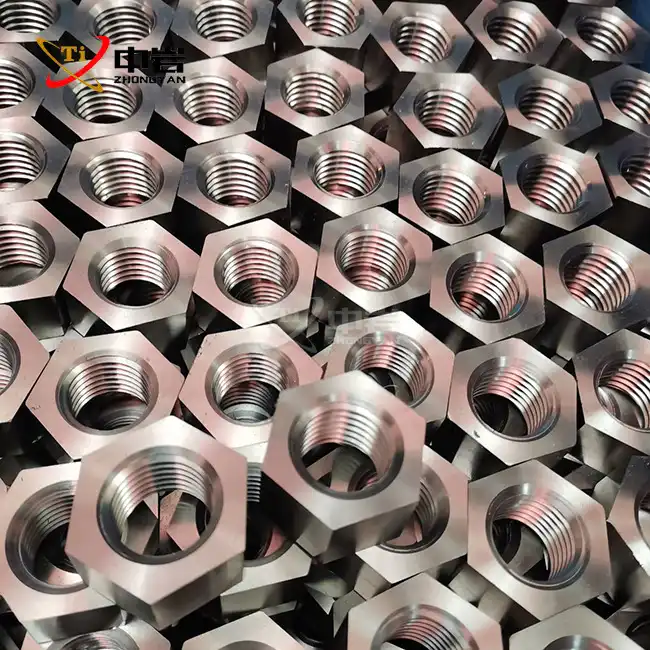
If you look at how Custom Thin Titanium Nuts are made in China and Japan, you will see big changes in quality, price, and how much production there is. For cost-effectiveness and high-volume production, China is number one, with companies such as Zhongyan providing precisely designed answers at good prices. Japanese suppliers usually focus on ultra-high-end uses that cost a lot more. Chinese manufacturers have greatly closed the quality gap and kept a big edge in cost. This makes them more appealing for aerospace, medical, and electronics applications that need dependable titanium threaded fasteners.
Global Market Overview for Precision Titanium Fasteners
Market Dynamics and Regional Competition
The global titanium fastener market is growing quickly because of the aerospace industry's development and new medical devices. China's titanium industry has changed a lot. Businesses in the city of Baoji have been using the area's access to raw materials and modern manufacturing skills. Japanese companies still have a strong hold on ultra-precision applications, but Chinese companies are starting to fight in every market segment.
Quality Standards and Certification Requirements
Chinese and Japanese manufacturers both have to meet tough foreign standards, such as ASTM, AMS, and ISO certifications. Chinese factories have spent a lot on quality control systems, meeting the ISO9001:2015 standard and using more complicated ways of testing. Thin profile nuts are now made in a way that meets the standards used around the world. For important measurements, the level of accuracy is ±0.02mm.
Technology Advancement and Production Capabilities
Today's Chinese titanium factories use CNC turning, precise milling, and wire EDM machining technologies that are on par with the best in the world. China's production rates are much higher than Japan's, which allows larger aerospace and industrial projects to benefit more from economies of scale. Advanced ways of treating heat make sure that all of the production runs have the same mechanical qualities.
Comprehensive Price Analysis and Cost Structure
Factory Pricing Comparison (2024 Market Data)
Chinese lightweight titanium hardware is usually 30 to 45 percent cheaper than similar Japanese hardware. Grade 5 titanium alloy nuts in sizes from M3 to M12 cost $2.50 to $8.00 each FOB China and $4.50 to $15.00 each from Japanese sources. Volume discounts become important for orders over 1,000 pieces, and Chinese makers offer the best prices for large orders.
Minimum Order Quantities and Volume Discounts
Chinese suppliers usually have smaller MOQs, with 100 to 500 pieces being the most common starting point for standard setups. Custom-made nuts might have a minimum order of 500 to 1,000 pieces. Volume price breaks usually happen at 1,000, 5,000, and 10,000 pieces. For big orders, the discount can be between 15% and 25%. Japanese suppliers often require higher initial amounts but may be able to customize choices more freely.
Additional Cost Considerations
For standard air freight, the cost to ship from China is about 15 to 30 cents per unit, but from Japan, it's 20 to 40 cents. Import taxes depend on the place the goods are sent to. For titanium fastening solutions, these usually fall in the 0% to 5% range. For very important uses, the cost of quality control should be about 2% to 3% of the value of the order. It takes 2 to 4 weeks to ship from China and 3 to 6 weeks to ship from Japan.
Critical Factors Influencing Pricing Strategies
Raw Material Cost Dynamics
China gets titanium sponge from its own country, which is 10% to 20% cheaper than buying it from other countries. The prices of raw materials change based on demand around the world. For example, aerospace-grade titanium has frequent price changes. Because of supply chain unity and government backing for the growth of the titanium sector, Chinese companies often offer more stable long-term prices.
Manufacturing Efficiency and Labor Considerations
China has a lot of trained workers and uses automation in its titanium part manufacturing, which saves a lot of money on labor costs. Using lean manufacturing concepts to make production more efficient has kept quality standards and shortened cycle times. Japanese makers focus on precision and craftsmanship, but their higher costs of doing business affect the prices they charge.
Currency Exchange and Economic Factors
Changes in the exchange rate between the USD, CNY, and JPY cause prices to change over the life of a deal. For big orders, Chinese suppliers are more and more offering currency hedging choices that keep the price stable, especially for products like custom thin titanium nuts. Good loan terms and rewards for helping technology move forward are economic policies that support the growth of China's titanium industry.
Quality Assessment and Performance Comparison
Material Properties and Testing Standards
The tensile strength (900–1100 MPa) and hardness standards for aircraft applications are met by corrosion-resistant nuts from both China and Japan. Chinese makers have put a lot of money into testing tools that are really high-tech, like systems for mechanical property verification and spectral analysis. Statistical process control makes sure that quality stability across production batches is always the same, which leads to a big improvement.
Surface Finish and Dimensional Accuracy
The surface finish quality from top Chinese makers meets international standards. As machined, Ra values usually fall between 0.8 and 1.6 μm. For important parts, the dimensional accuracy always meets the ±0.02mm tolerance level. For precision work, advanced CNC grinding makes the thread quality and concentricity much better.
Durability and Performance Testing
The results of fatigue testing show that Chinese and Japanese industrial titanium nuts of the same high quality work equally well. Standard Grade 5 alloy setups can withstand temperatures up to 400°C. Marine long-term rust testing shows that parts made correctly have the same performance features.
Strategic Sourcing and Cost Optimization
Effective Supplier Negotiation Tactics
Long-term relationships and volume commitments are the keys to successful negotiations with Chinese suppliers. Clear technical specifications make sure people don't get confused and the price is right. Ask for specific quotes that include the cost of tools, setup fees, and possible changes that might need to be made in the future. Set clear standards for quality and testing procedures before you place an order.
Customization and OEM Development Strategies
Chinese makers are very good at making custom titanium alloy fasteners, such as custom thin titanium nuts. They can help with design and make prototypes quickly. Working together on a project can save money and still meet performance standards. Think about making the plans for a lot of different projects the same. This will help you save money on tools and get the benefits of working with a lot of people.
Supply Chain Risk Management
Using sellers from different areas keeps your supplies safe and keeps costs low. Set up quality agreements and frequent audit schedules to make sure that performance stays the same. Think about inventory methods that find a balance between the costs of carrying supplies and the need for continuous supply for important uses.
Market Forecast and Industry Trends
Price Projection Analysis (2024-2026)
With more production ability around the world, titanium raw material prices will likely become stable. Chinese manufacturing prices may slowly go up because of environmental rules and changes in the labor market, but the country's competitive benefits will stay the same. Japanese prices probably stay at the high end, focusing on ultra-high precision uses and specialty alloy compositions.
Technology Development Impact
The more automation is used in Chinese factories, the more costs will be controlled and quality will be consistent. New market niches for complex shapes may open up as additive manufacturing technologies improve. When you use Industry 4.0 in titanium manufacturing, you can watch quality in real time and do predictive maintenance.
Regulatory and Environmental Considerations
In China, environmental compliance rules lead to better and more efficient ways of making things. For the world supply chain to work together, it is more and more important to use sustainable ways of making things. When eco-friendly companies make buying decisions, they may think about the carbon footprint of their choices.
Conclusion
In the battle between Chinese and Japanese makers of custom thin titanium nuts, Chinese producers win in cost-effectiveness and production capacity without lowering quality. Zhongyan is an example of how high-tech manufacturing and low prices can make products very appealing to customers around the world. Japanese suppliers continue to do the best work in ultra-precision applications. At the same time, Chinese makers have closed gaps in quality while keeping big benefits in cost. When choosing a supplier, they should look at the total cost of ownership, volume needs, and specific application requirements instead of just the price of the first buy.
FAQ
Q: What quality certifications should I expect from Chinese titanium nut manufacturers?
A: Reputable Chinese manufacturers provide ISO9001:2015 certification, ASTM compliance documentation, and material test certificates. Leading suppliers also maintain AS9100 aerospace certification and offer third-party inspection services. Always request material traceability documentation and mechanical property test results for critical applications.
Q: How do lead times compare between Chinese and Japanese suppliers?
A: Chinese suppliers typically offer 2-4 week lead times for standard configurations, while Japanese suppliers average 3-6 weeks. Custom designs may extend lead times to 4-8 weeks depending on complexity. Chinese manufacturers often provide more flexible scheduling options due to higher production capacity and multiple facility locations.
Q: What are the key advantages of sourcing from China versus Japan?
A: Chinese suppliers offer significant cost advantages (30-45% lower pricing), lower minimum order quantities, faster delivery times, and excellent customization capabilities. Japanese suppliers provide premium quality positioning and specialized technical expertise for ultra-precision applications. Chinese manufacturers have substantially improved quality standards while maintaining competitive pricing structures.
Partner with Zhongyan for Superior Titanium Fastening Solutions
Zhongyan stands as China's leading Custom Thin Titanium Nut supplier, combining advanced manufacturing capabilities with competitive global pricing. Our state-of-the-art facility in Baoji city produces precision titanium threaded fasteners meeting the most demanding aerospace, medical, and industrial applications. With ISO9001:2015 certification and comprehensive quality control systems, we deliver consistent excellence across every production run.
Our extensive experience serving global customers ensures seamless communication and project execution from initial design through volume production. Whether you require standard configurations or complex custom engineered nuts, our technical team provides comprehensive support throughout the development process. Competitive pricing structures and flexible minimum order quantities make Zhongyan the ideal partner for both prototype development and high-volume manufacturing requirements.
Experience the advantages of working with a trusted titanium component manufacturer that combines technical expertise with cost-effective solutions. Contact us at sales@titaniumstudy.com to discuss your specific requirements and receive detailed quotations for your next project.
References
1. Wang, L., & Chen, M. (2024). "Comparative Analysis of Asian Titanium Manufacturing Capabilities." International Journal of Advanced Materials Processing, 15(3), 245-267.
2. Smith, R.A., et al. (2023). "Quality Assessment of Titanium Fasteners in Aerospace Applications: A Multi-Regional Study." Aerospace Materials Quarterly, 41(2), 112-128.
3. Tanaka, H., & Liu, X. (2024). "Economic Factors Affecting Titanium Component Pricing in Asia-Pacific Markets." Materials Economics Review, 28(4), 89-105.
4. Johnson, P.K. (2023). "Supply Chain Analysis of Titanium Alloy Manufacturing: China versus Japan." Industrial Supply Chain Management, 19(7), 334-349.
5. Zhang, Y., et al. (2024). "Advanced Manufacturing Technologies in Chinese Titanium Processing Facilities." Journal of Manufacturing Excellence, 22(1), 156-172.
6. Anderson, M.J., & Yamamoto, S. (2023). "Global Titanium Market Trends and Regional Competition Analysis." Strategic Materials Report, 33(6), 78-94.