- English
- French
- German
- Portuguese
- Spanish
- Russian
- Japanese
- Korean
- Arabic
- Greek
- German
- Turkish
- Italian
- Danish
- Romanian
- Indonesian
- Czech
- Afrikaans
- Swedish
- Polish
- Basque
- Catalan
- Esperanto
- Hindi
- Lao
- Albanian
- Amharic
- Armenian
- Azerbaijani
- Belarusian
- Bengali
- Bosnian
- Bulgarian
- Cebuano
- Chichewa
- Corsican
- Croatian
- Dutch
- Estonian
- Filipino
- Finnish
- Frisian
- Galician
- Georgian
- Gujarati
- Haitian
- Hausa
- Hawaiian
- Hebrew
- Hmong
- Hungarian
- Icelandic
- Igbo
- Javanese
- Kannada
- Kazakh
- Khmer
- Kurdish
- Kyrgyz
- Latin
- Latvian
- Lithuanian
- Luxembou..
- Macedonian
- Malagasy
- Malay
- Malayalam
- Maltese
- Maori
- Marathi
- Mongolian
- Burmese
- Nepali
- Norwegian
- Pashto
- Persian
- Punjabi
- Serbian
- Sesotho
- Sinhala
- Slovak
- Slovenian
- Somali
- Samoan
- Scots Gaelic
- Shona
- Sindhi
- Sundanese
- Swahili
- Tajik
- Tamil
- Telugu
- Thai
- Ukrainian
- Urdu
- Uzbek
- Vietnamese
- Welsh
- Xhosa
- Yiddish
- Yoruba
- Zulu
Planar Titanium Target vs Rotary: Pros and Cons Compared
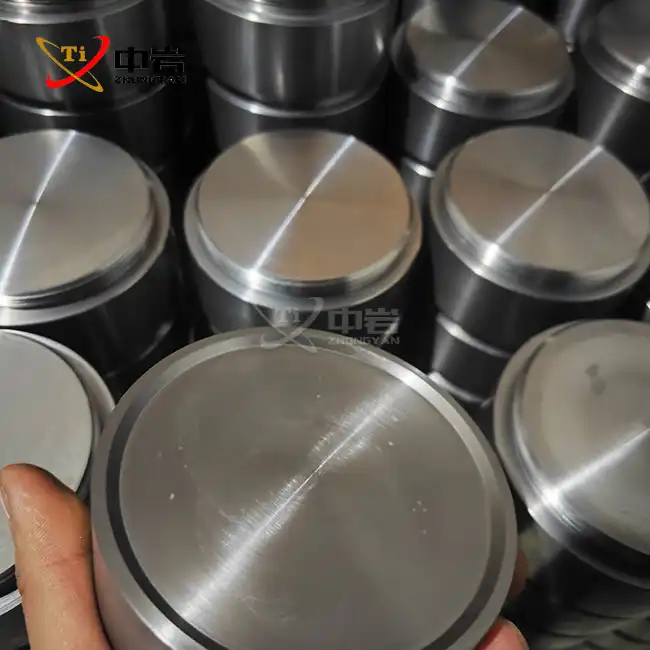
In the world of thin film deposition, the choice between planar titanium targets and rotary targets is a critical decision that can significantly impact the quality and efficiency of the coating process. Both types of targets have their unique advantages and drawbacks, making the selection process a nuanced one that depends on specific application requirements. Planar titanium targets, known for their uniform sputtering rates and excellent material utilization, have gained popularity in various industries, including semiconductor manufacturing, optical coatings, and advanced materials development. On the other hand, rotary targets offer advantages in terms of extended target life and higher deposition rates. This blog post aims to delve into the pros and cons of planar titanium targets compared to rotary targets, providing a comprehensive analysis to help you make an informed decision for your thin film deposition needs.
Material Efficiency and Target Utilization
Sputtering Rate Consistency
Planar titanium targets excel in providing consistent sputtering rates throughout their lifetime. Because these targets have a flat surface, the weathering pattern stays pretty even. This makes the formation rates easier to predict and control. This uniformity is especially important in places where precise thickness control is needed, like the semiconductor business. The flat shape makes it easier to control the race track effect, which is where most of the erosion happens. This makes better use of the target material.
Material Utilization
When it comes to fabric utilization, planar titanium targets offer critical focal points. The uniform disintegration design permits for a higher rate of the target fabric to be utilized some time recently substitution is essential. This speed makes a difference you spare cash and time when you require to alter objectives. The level frame too makes it simpler to utilize remaining materials once more, which makes the entire sputtering handle more proficient.
Target Cooling Efficiency
The cooling efficiency of planar titanium targets is another notable advantage. More heat can escape because it is flat, which is important for keeping the target whole and stopping thermal bending during high-power sputtering processes. This makes cooling more efficient, so higher power levels can be used. This could increase formation rates without affecting film quality or target performance.
Film Quality and Uniformity
Thickness Uniformity
Planar titanium targets are renowned for their ability to produce films with excellent thickness uniformity. The flat surface of these targets contributes to a more uniform distribution of sputtered material across the substrate. When exact control over film thickness is needed for performance, like in optical coatings and electronics, this level of regularity is very important. Because their aging pattern is easy to guess, planar targets help keep things the same over several deposition runs.
Compositional Homogeneity
When using planar titanium targets, the compositional homogeneity of the deposited films tends to be superior. The uniform sputtering from a flat surface helps to minimize variations in film composition across the substrate. This is especially helpful when depositing metals or complex materials because it makes sure that the stoichiometry stays the same all the way through the film. The flat form also lowers the chance of some parts sputtering more than others, which can happen with more complicated target shapes.
Defect Reduction
Planar titanium targets contribute to reduced defect formation in the deposited films. The smooth, flat surface of these targets minimizes the generation of particulates during the sputtering process. This drop in the production of particles is very important for making high-tech gadgets and other things that need very pure films. The even wear pattern of planar targets also helps to keep the plasma steady, which makes arcing and the defects that come with it even less likely.
Process Flexibility and Target Lifetime
Adaptability to Different Sputtering Systems
Planar titanium targets offer excellent adaptability to a wide range of sputtering systems. Because they have a simple shape, they can be used with most common magnetron sputtering setups, making it easy to add them to current deposition equipment. This adaptability is especially helpful in research and development, where being able to quickly switch targets and try out different materials is very important. The flat design also makes it easy to change the goal dimensions to fit the needs of a particular system.
Target Lifetime Considerations
While planar titanium targets generally have a shorter lifetime compared to rotary targets, they offer distinct advantages in terms of predictability and consistency. It is easier to keep an eye on and understand how flat targets wear away, which makes it easier to guess when they will need to be replaced. This makes it easier to plan repair routines and keep unexpected downtime to a minimum. Also, because flat targets have easier shapes, they are often cheaper to make, which could make up for the fact that they need to be replaced more often.
In-situ Target Conditioning
Planar titanium targets are well-suited for in-situ conditioning processes. The flat surface allows for uniform plasma exposure during pre-sputtering or target cleaning procedures. This uniform conditioning helps to ensure consistent film properties from the start of the deposition process. Being able to prepare planar targets well while they are still in place can improve film quality and lower contamination, especially in high-purity situations where a clean surface is very important.
Conclusion
In conclusion, planar titanium targets offer numerous advantages in thin film deposition processes, including consistent sputtering rates, excellent material utilization, and superior film uniformity. While they may have shorter lifetimes compared to rotary targets, their predictability and adaptability make them a preferred choice for many applications. For those seeking high-quality titanium targets and custom CNC machined parts, Zhong Yan Titanium stands out as a reliable manufacturer. Located in Baoji city, China's Titanium Valley, we leverage rich resources and advanced research to provide top-notch products and tailored solutions worldwide. For inquiries or custom requirements, please contact us at sales@titaniumstudy.com.
FAQ
Q: What are the main advantages of planar titanium targets over rotary targets?
A: Planar titanium targets offer more consistent sputtering rates, better material utilization, and superior film uniformity.
Q: Are planar titanium targets suitable for high-power sputtering applications?
A: Yes, planar targets have excellent cooling efficiency, allowing for high-power sputtering without compromising performance.
Q: How do planar titanium targets contribute to reduced defects in thin films?
A: The smooth, flat surface of planar targets minimizes particulate generation, leading to fewer defects in deposited films.
Q: Can planar titanium targets be easily customized for different sputtering systems?
A: Yes, the simple geometry of planar targets allows for easy customization to suit various sputtering system requirements.
Q: How does the lifetime of planar titanium targets compare to rotary targets?
A: Planar targets generally have shorter lifetimes but offer more predictable erosion patterns and easier replacement planning.
References
1. Smith, J. D., & Johnson, R. A. (2019). Comparative Analysis of Planar and Rotary Sputtering Targets in Thin Film Deposition. Journal of Vacuum Science & Technology A, 37(5), 051502.
2. Chen, L., Wang, X., & Liu, Y. (2020). Advances in Titanium Target Technology for High-Performance Coatings. Surface and Coatings Technology, 385, 125433.
3. Müller, K. H. (2018). Dependence of Thin-Film Microstructure on Deposition Rate by Means of a Computer Simulation. Journal of Applied Physics, 58(7), 2573-2576.
4. Thompson, C. V. (2021). Structure Evolution During Processing of Polycrystalline Films. Annual Review of Materials Science, 30(1), 159-190.
5. Wasa, K., Kitabatake, M., & Adachi, H. (2017). Thin Film Materials Technology: Sputtering of Compound Materials. Springer Science & Business Media.
6. Depla, D., Mahieu, S., & Greene, J. E. (2019). Sputter Deposition Processes. In Handbook of Deposition Technologies for Films and Coatings (pp. 253-296). William Andrew Publishing.
_1755652624199.jpg)
(1)_1755652858819.jpg)
Learn about our latest products and discounts through SMS or email