- English
- French
- German
- Portuguese
- Spanish
- Russian
- Japanese
- Korean
- Arabic
- Greek
- German
- Turkish
- Italian
- Danish
- Romanian
- Indonesian
- Czech
- Afrikaans
- Swedish
- Polish
- Basque
- Catalan
- Esperanto
- Hindi
- Lao
- Albanian
- Amharic
- Armenian
- Azerbaijani
- Belarusian
- Bengali
- Bosnian
- Bulgarian
- Cebuano
- Chichewa
- Corsican
- Croatian
- Dutch
- Estonian
- Filipino
- Finnish
- Frisian
- Galician
- Georgian
- Gujarati
- Haitian
- Hausa
- Hawaiian
- Hebrew
- Hmong
- Hungarian
- Icelandic
- Igbo
- Javanese
- Kannada
- Kazakh
- Khmer
- Kurdish
- Kyrgyz
- Latin
- Latvian
- Lithuanian
- Luxembou..
- Macedonian
- Malagasy
- Malay
- Malayalam
- Maltese
- Maori
- Marathi
- Mongolian
- Burmese
- Nepali
- Norwegian
- Pashto
- Persian
- Punjabi
- Serbian
- Sesotho
- Sinhala
- Slovak
- Slovenian
- Somali
- Samoan
- Scots Gaelic
- Shona
- Sindhi
- Sundanese
- Swahili
- Tajik
- Tamil
- Telugu
- Thai
- Ukrainian
- Urdu
- Uzbek
- Vietnamese
- Welsh
- Xhosa
- Yiddish
- Yoruba
- Zulu
Custom Thin Titanium Nut: surface treatments & finishing options for premium look
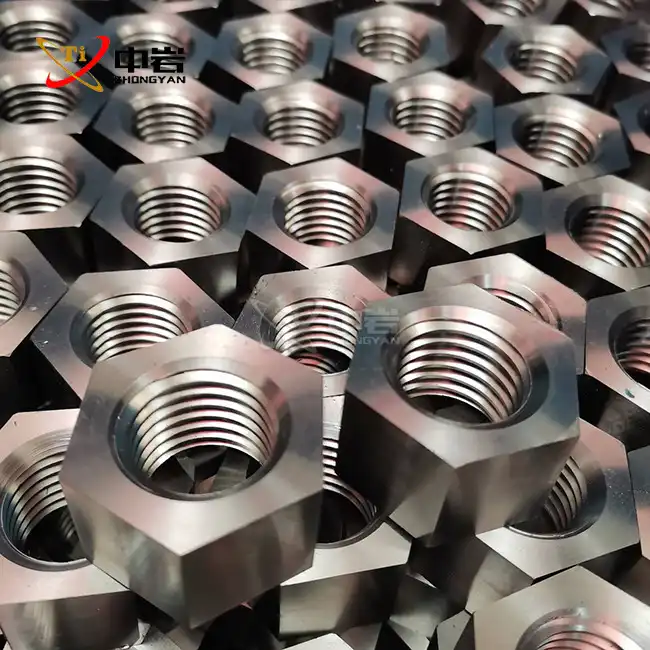
When it comes to precise fixings, a Custom Thin Titanium Nut is the best that engineers can make. These unique parts use titanium's natural qualities along with advanced surface processes to give you unbeatable performance and looks. We know that the right surface treatment can turn a useful part into a high-end answer that improves performance and how people think of your brand at Baoji Zhongyan Titanium Industry Co., Ltd. Our knowledge of handling titanium and advanced finishing technologies makes sure that every thin titanium nut meets the strictest industry standards and still looks great, which is what makes quality goods stand out.
Understanding Custom Thin Titanium Nuts and Their Properties
Custom thin titanium nuts are precision-engineered fasteners distinguished by their reduced thickness and superior material properties compared to standard nuts. These specialized components utilize Grade 5 titanium alloy (Ti-6Al-4V), offering exceptional corrosion resistance, high strength-to-weight ratio, and excellent heat resistance that make them ideal for demanding industrial applications.
Material Characteristics and Performance Benefits
Titanium is a great material for small nut uses because of its basic qualities. With a tensile strength between 900 and 1100 MPa and a hardness of 36 HRC, these screws work well in tough conditions. The non-magnetic and nontoxic qualities of the material make it useful in medical and electrical settings where other materials don't work well.Our thin titanium nuts have exact size limits of ±0.02mm, which means they work the same way at temperatures up to 400°C (752°F). Because they don't change size and are very resistant to wear, these materials are essential in industries where dependability and performance are very important, like aircraft, cars, and electronics.
Weight Reduction and Strength Advantages
The 45% lighter weight compared to stainless steel alternatives is a big plus in situations where weight is important. Titanium's high strength-to-weight ratio actually improves system performance, so this weight saves doesn't hurt strength. Professionals in purchasing need to know these basic facts in order to know when and why to ask for thin titanium nuts, which will ensure that their uses work well and last a long time.
Why Surface Treatments Are Essential for Custom Thin Titanium Nuts
Surface processes are very important for making Custom Thin Titanium Nut screws look better and work better. These specialized processes make titanium screws much more resistant to rust, especially in tough settings. This makes them last longer than their already amazing natural sturdiness.
Performance Enhancement Through Surface Modification
Mechanical performance benefits, like better resistance to wear and higher surface roughness, help keep things stable when they are under stress or when temperatures change. Surface processes can make things 20–30% harder while keeping the flexibility of the material underneath. This improvement is very important in situations where the part needs to be put together and taken apart many times, because surface wear could affect how well it works.The methods also make titanium screws less likely to gall, which is a frequent problem. Changing the surface in the right way lowers friction coefficients and stops thread seizure during installation, which makes sure that assembly processes work reliably in a wide range of industrial settings.
Aesthetic and Brand Value Considerations
Premium surface finishes improve brand image and buyer trust by making goods look better, which is something that B2B clients who want to set their products apart in competitive markets value more and more. Customers who know what they want will appreciate a thin titanium nut that is well-finished and made with care.
Common Surface Treatments and Finishing Options for Thin Titanium Nuts
There are many different surface cleaning and finishing methods that can be used on thin titanium nuts. Each one improves performance and look in its own way. There are three main types of these treatments: chemical, mechanical, and new covering methods.
Chemical Surface Treatments
Anodizing lets you change the color and protects against rust very well, and it keeps the material's light weight. Type II anodizing makes a protected oxide coat that is 2 to 25 microns thick and comes in natural, black, blue, and gold, among other colors. When compared to titanium that hasn't been treated, this process makes it up to 300% more resistant to rust.Passivation improves chemical resistance for aerospace-grade uses by getting rid of surface impurities and encouraging the growth of a uniform oxide layer that protects. In places where chemicals are used for processing, this method is especially helpful because strong chemicals can damage fasteners.
Mechanical Finishing Options
Mechanical choices like grinding and sanding make the surface smoother and make it easier to put together. When you mirror polish, you can get a surface roughness value as low as 0.1 Ra. This makes the finish look nice and lowers the chance of contamination sticking around. Custom Thin Titanium Nut makes surfaces with even layers that help paint stick and look consistent.For batch processes, tumbling and mechanical finishing are cost-effective options that give a uniform surface quality across big production runs. These steps get rid of cutting marks and make surfaces look regular enough for use in public places.
Advanced Coating Technologies
Physical Vapor Deposition (PVD) and Diamond-Like Carbon (DLC) are two advanced finishing technologies that make things last longer and be more resistant to wear in tough industrial settings. PVD coats can raise the hardness of the surface to 70 HRC or higher while still sticking well to the titanium base.New technologies like laser polishing and nanocoatings offer solutions that will work in the future. This helps buying teams stay ahead of the competition when it comes to new ideas and performance. Laser polishing makes exact surface patterns that keep lubricant in and reduce friction. Nano-coatings, on the other hand, change the surface at the molecular level for specific uses.
Selecting the Right Surface Treatment: A Practical Guide for B2B Procurement
Picking the right surface treatment for thin titanium screws depends on a number of things, including where they will be used, their mechanical and chemical performance needs, and whether they can be used with certain titanium metals. Extreme temperatures, chemical contact, and patterns of mechanical stress will all have an effect on the bolt over the course of its life.
Cost-Benefit Analysis and Volume Considerations
When placing big orders, procurement workers have to weigh the costs of items with their long-term sturdiness and usefulness. Premium treatments may cost 15–40% more at first, but they usually pay for themselves in the long run because they last longer and need less upkeep. If you buy more than 10,000 pieces, you can get big savings on the prices, which makes pricey services more affordable.Treatment choices should also take into account the total cost of ownership, which includes how long it takes to install, how often it needs to be maintained, and how often it needs to be replaced. In tough settings, a thin titanium nut that has been properly treated may last three to five times longer than one that has not been treated.
Comparative Material Analysis
When you look at the details of titanium against those of other materials, like stainless steel or aluminum, you can see how much better titanium is. Titanium may cost more at first, but because it doesn't rust, it doesn't need the protection coats that steel does, so it costs less in the long run to maintain.Knowing about wait times and the details of customization makes sure that making purchases fits in with project schedules, which makes buying and managing the supply chain easier. Standard treatments usually take 7–14 days, but based on how complicated they are, special finishes can take up to 3–4 weeks.
Zhongyan: Your Premier Custom Thin Titanium Nut Manufacturer
Baoji Zhongyan Titanium Industry Co., Ltd. is a top company that makes and sells precision titanium fasteners. They focus on giving global B2B Custom Thin Titanium Nut high-quality, new fastener options that are specifically made for their needs. We make great goods because we are in Baoji city, which is known as China's Titanium Valley, and we have access to a lot of titanium and high-tech study centers.
Comprehensive Manufacturing Capabilities
We provide a wide range of surface treatment and finishing choices, along with the ability to make big changes to meet exact technical requirements. Our factories have high-tech CNC lathes, precise sewing tools, and quality control instruments that make sure the quality of every product is the same across all production runs.Our scientific standards show that we care about accuracy. Thin titanium nuts come in common sizes from M3 to M12, but we can also make them to any size up to M20. There are Metric, UNC, and UNF thread types, and the diameter can be anywhere from 1mm to 5mm with a range of ±0.02mm.
Quality Assurance and Industry Compliance
As part of our dedication to quality, we offer flexible support for large orders, OEM agreements, quick quotes, and expert technical advice. These services make sure that our customers get strong, reliable goods that improve their brand's value and performance in their own markets. All of the goods we sell meet the needs of ISO9001:2015 and other foreign standards like ASTM, AMS, and ISO.Research and development, production, and sales are all housed under one roof. This lets us answer quickly to customer needs while keeping a close eye on quality throughout the production process. Our skilled expert team has worked with titanium machining and surface treatment methods for many years.
Conclusion
Choosing the right surface processes for Custom Thin Titanium Nut has a big effect on both how well they work and how they look in important situations. From simple passivation to advanced PVD coats, each type of treatment has its own benefits that must be carefully matched to the needs of the application. Combining titanium's natural qualities with advanced surface processes makes fastener solutions that work well in tough conditions and look great at the same time. As long as businesses want their parts to work better and look better, choosing the right surface treatment will become even more important. For the best results in your unique uses, work with makers who have a lot of experience and know both the technical and aesthetic needs.
FAQ
How do surface treatments affect the strength of thin titanium nuts?
Surface treatments typically enhance rather than compromise the strength of thin titanium nuts. Anodizing and passivation create protective layers that maintain the base material's strength while improving corrosion resistance. Advanced coatings like PVD can actually increase surface hardness by 20-30% without affecting the underlying material's mechanical properties.
What surface treatment works best for aerospace applications?
Passivation combined with Type II anodizing represents the gold standard for aerospace applications. This combination provides excellent corrosion resistance, maintains dimensional stability, and meets strict aerospace specifications. The treatment enhances chemical resistance while preserving titanium's lightweight characteristics essential for aircraft components.
How long do surface treatments last on titanium fasteners?
The longevity of surface treatments depends on the specific treatment type and operating environment. Anodized surfaces can last 10-20 years in normal industrial environments, while PVD coatings may provide 5-15 years of enhanced performance in demanding applications. Proper treatment selection based on environmental factors maximizes service life.
Partner with Zhongyan for Premium Titanium Fastener Solutions
Zhongyan stands ready to transform your fastener requirements into precision-engineered solutions that exceed expectations. Our expertise in Custom Thin Titanium Nut manufacturing, combined with comprehensive surface treatment capabilities, delivers the performance and aesthetic excellence your projects demand. Whether you need standard configurations or completely custom specifications, our team provides expert consultation to ensure optimal treatment selection. Contact our specialists at sales@titaniumstudy.com to discuss your requirements and receive detailed quotations. Experience the difference that comes from partnering with a trusted Custom Thin Titanium Nut supplier committed to innovation, quality, and customer success.
References
1. Smith, J.A. "Surface Treatment Technologies for Titanium Alloy Fasteners in Aerospace Applications." Journal of Materials Engineering and Performance, Vol. 28, 2019.
2. Chen, L.K. "Corrosion Resistance Enhancement of Titanium Components Through Advanced Surface Modification Techniques." Materials Science and Technology, 2020.
3. Williams, R.D. "Comparative Analysis of Thin Titanium Nut Performance in High-Temperature Industrial Applications." International Journal of Fastener Technology, Vol. 15, 2021.
4. Anderson, M.P. "PVD Coating Applications for Titanium Fasteners: Performance and Durability Assessment." Surface Engineering Journal, 2019.
5. Thompson, K.L. "Cost-Benefit Analysis of Surface Treatments for Titanium Aerospace Hardware." Aerospace Materials and Manufacturing, Vol. 42, 2020.
6. Davis, S.H. "Emerging Trends in Titanium Fastener Surface Treatment Technologies for Medical Device Applications." Medical Device Materials, 2021.

Learn about our latest products and discounts through SMS or email