- English
- French
- German
- Portuguese
- Spanish
- Russian
- Japanese
- Korean
- Arabic
- Greek
- German
- Turkish
- Italian
- Danish
- Romanian
- Indonesian
- Czech
- Afrikaans
- Swedish
- Polish
- Basque
- Catalan
- Esperanto
- Hindi
- Lao
- Albanian
- Amharic
- Armenian
- Azerbaijani
- Belarusian
- Bengali
- Bosnian
- Bulgarian
- Cebuano
- Chichewa
- Corsican
- Croatian
- Dutch
- Estonian
- Filipino
- Finnish
- Frisian
- Galician
- Georgian
- Gujarati
- Haitian
- Hausa
- Hawaiian
- Hebrew
- Hmong
- Hungarian
- Icelandic
- Igbo
- Javanese
- Kannada
- Kazakh
- Khmer
- Kurdish
- Kyrgyz
- Latin
- Latvian
- Lithuanian
- Luxembou..
- Macedonian
- Malagasy
- Malay
- Malayalam
- Maltese
- Maori
- Marathi
- Mongolian
- Burmese
- Nepali
- Norwegian
- Pashto
- Persian
- Punjabi
- Serbian
- Sesotho
- Sinhala
- Slovak
- Slovenian
- Somali
- Samoan
- Scots Gaelic
- Shona
- Sindhi
- Sundanese
- Swahili
- Tajik
- Tamil
- Telugu
- Thai
- Ukrainian
- Urdu
- Uzbek
- Vietnamese
- Welsh
- Xhosa
- Yiddish
- Yoruba
- Zulu
Available in Various Grades: Which Custom Hex Titanium Nut Suits You?
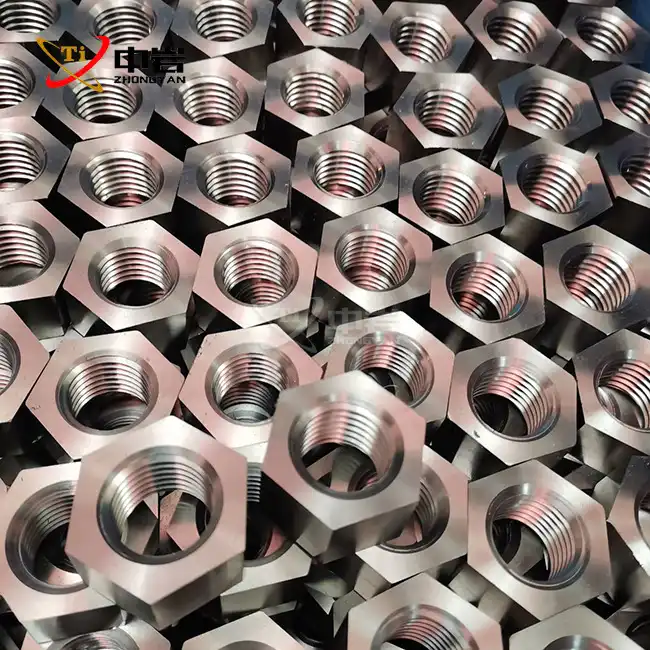
To choose the correct Custom Hex Titanium Nut, you need to know how the various types of titanium fit with the needs of your purpose. For aircraft and medical uses, grade 5 titanium metal is very strong and doesn't rust. Lower grades are easier to shape and work better in less demanding settings. The important thing is to make sure that the qualities of the material meet the pressures, situations, and performance goals. Whether you need standard sizes from M3 to M20 or custom shapes, the grade you choose has a direct effect on how long it lasts, how much it weighs, and how reliable it is in important industrial uses.
Understanding Custom Hex Titanium Nuts: Properties and Benefits
Titanium hex nuts are a huge step forward in fastener technology because they offer performance qualities that other materials just can't match. These special parts are much more resistant to rust than stainless steel. This is especially true in naval and chemical processing settings, where ocean and harsh chemicals would quickly break down regular screws.
Superior Strength-to-Weight Performance
The best thing about titanium hex nuts is how strong they are compared to how light they are. These screws are about 40% lighter than steel versions, so they can be used to reduce weight without affecting the strength of the structure. In aircraft uses, where every gram counts for fuel economy and cargo optimization, this trait is very useful. Grade 5 titanium has a tensile strength of 900 to 1100 MPa, but it is still very flexible and doesn't wear down easily. Engineers can use this mixture to make structures that are safer and lighter at the same time. This is especially useful for airplane engines and other parts of structures where both weight savings and dependability are very important.
Temperature and Environmental Resistance
Titanium hex nuts work great in situations with very high or very low temperatures because they keep their mechanical properties from -252°C to 400°C. Because they don't break down at low temperatures, they are essential for cold uses, high-temperature industrial processes, and space travel gear where other materials would fail. Titanium can also be used in medical equipment and surgical implants because it is nontoxic. In these cases, the material must be pure and not mixed with other substances to ensure patient safety and long-term performance.
Exploring Titanium Grades and Their Impact on Nut Performance
To choose the best hex nut arrangement for a given purpose, you need to know about the different types of titanium. It is important to note that each grade has different chemical and mechanical qualities that affect how well it works in different situations.
Grade 2 Titanium Characteristics
Grade 2 titanium, which is sometimes called "commercially pure titanium," is very resistant to rust and easy to shape, but it is not very strong. With a tensile strength of about 345 MPa, this grade works great for things like chemical processing equipment and naval gear that need better rust protection than maximum strength. Because Grade 2 is more flexible, it can be used in situations where complex shaping is needed or where shock absorption is more important than final tensile strength. This type is also very good at welding, and it's often used for special manufacturing projects that need to be changed after installation.
Grade 5 Titanium Advantages
The most common type of titanium metal is Grade 5 titanium (Ti-6Al-4V), which is made by mixing aluminum and vanadium to make it stronger. This grade works really well in high-stress situations, such as in a Custom Hex Titanium Nut, because its tensile strength is between 900 and 1100 MPa, and its yield strength is between 830 and 924 MPa.Adding aluminum lowers the density while raising the strength, and adding vanadium makes it easier to form and gives it better qualities at high temperatures. Because of these factors, Grade 5 is perfect for structural parts in spacecraft, high-performance cars, and industrial machinery that need to be strong and reliable.
Performance Optimization Through Grade Selection
When choosing between titanium types, you have to weigh the need for strength against cost and the difficulty of making the material. Titanium in Grade 5 costs more because it needs to be processed more carefully and has alloying elements that make it more valuable. Titanium in Grade 2 is cheaper and can be used for less difficult tasks. When engineers decide on the right grade, they have to look at working loads, weather conditions, and safety factors. Grade 5 titanium is usually worth the extra money for critical uses in flight and medical equipment. Grade 2 titanium, on the other hand, may be cheaper for commercial uses with mild stress levels.
Custom Manufacturing Process of Hex Titanium Nuts
To make precision titanium hex nuts, you need to use complex manufacturing methods that guarantee consistent quality and exact measurements. We use modern CNC cutting and strict quality control procedures to make sure that the screws we sell meet the strictest requirements.
Material Sourcing and Preparation
The first step in making something is carefully choosing approved titanium products that meet ASTM, AMS, and ISO standards. Before it goes into the production line, raw titanium bar stock is carefully checked for its chemical makeup, mechanical properties, and surface quality. During the whole production process, material tracking is kept up, so each finished hex nut can be linked to its original material approval. This paperwork is very important for medical and aircraft uses that need to show the full history of a material to follow regulations.
Precision CNC Machining Operations
When we do CNC milling, we use cutting-edge tools that can get to very precise measurements needed for important jobs. The hexagonal form is carefully made to make sure that the tools connect properly and that the power is transferred correctly. Specialized titanium cutting tools are used to cut the internal threading to exact specs. Titanium's work-hardening properties can make it hard to machine, so when threading, you need to pay extra attention to the surface finish and the accuracy of the dimensions. Our skilled machinists use the best cutting settings and specialized tools to make sure that the quality of the threads is always the same, while also keeping production costs and tool wear to a minimum.
Heat Treatment and Surface Finishing
Heat treatment methods improve Custom Hex Titanium Nut mechanical qualities and reduce cutting forces that could hurt their long-term performance. In controlled atmosphere furnaces, rust and contamination are stopped during heat treatment. This keeps the surface quality and the security of the dimensions. There are different ways to finish the surface, such as passivation processes that make it less likely to rust and coatings that are made to work in certain environments. These processes are especially important for marine uses that need better resistance to salt or high-temperature uses that need strong resistance to oxidation.
Comparing Titanium Hex Nuts with Other Materials: Making the Right Choice
If you want to choose the right material for an important fastener purpose, you need to look at its performance, cost, and long-term stability. Titanium hex nuts have clear benefits over traditional materials, but you need to know these differences in order to make smart buying decisions.
Titanium vs. Stainless Steel Performance
Stainless steel screws have been the standard for a long time when rust resistance is needed, but titanium works better in many important situations. 316 stainless steel is good at resisting rust, but titanium is much better in salt conditions, where 316 stainless steel can split and crack. Titanium's strength-to-weight edge is especially useful in situations where the weight of fasteners affects how well the whole system works. In aircraft uses, switching from stainless steel screws to titanium ones can save a lot of weight while keeping or even improving the performance of the structure. Titanium also does better than stainless steel when it comes to fatigue resistance, especially in situations where the load is changed over and over. Titanium screws have a longer wear life, which means they don't need to be serviced as often and don't need as much upkeep in serious situations.
Cost Analysis and Total Ownership Considerations
Titanium hex nuts usually cost more up front than stainless steel or aluminum ones, but when you look at the total cost of ownership, titanium is often the better choice for important uses. The longer service life, less upkeep needed, and lighter weight can make up for the higher material costs over the span of the part. In aircraft use, cutting down on weight can save enough fuel to cover the higher costs of fasteners within the first year of use. In the same way, naval uses with less upkeep needs can get rid of expensive downtime and part replacement processes. When looking at titanium screws, people in charge of buying things should think about wait times, minimum order amounts, and the cost of keeping a collection on hand. Custom titanium hex nuts usually have longer wait times than standard steel screws, so it's important to plan ahead for key uses when keeping an inventory.
Procurement Guide: How to Source Quality Custom Hex Titanium Nuts
To buy titanium hex nuts successfully, you need to know what the seller can do, what the quality standards are, and what the design needs to be in order for the nuts to work perfectly in important uses. Our all-around method to evaluating suppliers and creating specifications helps procurement pros reach their goals while keeping quality standards high.
Supplier Evaluation and Certification Requirements
The first step in finding good titanium hex nut providers is to look at their certifications and quality control systems. ISO 9001:2015 certification gives you basic quality security, while AS9100 certification shows that you know what you're doing and are skilled in the aircraft business. Material approvals are especially important for titanium parts because they can be traced back to the original mill test certificates, which prove that they meet the requirements of the standard. For each output lot, suppliers should give full records on all the necessary paperwork, such as chemical analysis, mechanical property proof, and measurement inspection.
Technical Specification Development
For buying to work well, there must be clear, thorough technical specs that tell the buyer exactly what is needed without making their production too difficult. It should be clear from the thread specs whether metric, UNC, UNF, or BSW threading is needed, as well as any special accuracy needs. To avoid confusion during production, it's important to be clear about the surface finish standards, finishing specs, and packing directions. Early on in the buying process, you should make sure that any custom tagging or identification needs are clear, as these could affect production times and costs.
Quality Assurance and Testing Protocols
Incoming checking methods that check for accuracy in measurements, material features, and surface quality should be part of quality testing programs. A coordinate measuring machine (CMM) check can confirm important measurements, and a hardness test can prove that the heat treatment was done correctly. If the application is very important, you might want to require a first item review that checks all of the specifications thoroughly before full production starts. This method lowers the chance that non-conforming materials will delay output and makes sure that quality problems are found early on in the buying process.
Zhongyan: Your Trusted Partner for Premium Titanium Hex Nuts
Baoji Zhongyan Titanium Industry Co., Ltd. is a leader in making titanium fasteners. We take advantage of our site in China's Titanium Valley to make high-quality unique hex titanium nuts that are used in industries around the world. Our production skills are very broad and include normal M3-M20 configurations as well as unique custom designs that meet the strictest engineering needs.
Advanced Manufacturing Capabilities and Quality Systems
Our factory uses cutting-edge CNC machines and strict quality control systems to make sure that every Custom Hex Titanium Nut meets or goes beyond the requirements set by the manufacturer. We can get tight limits for aircraft and medical uses thanks to our precision cutting, and our quality management system makes sure that all of our production processes are in line with ISO 9001:2015. Our Grade 5 titanium (Ti-6Al-4V) hex nuts are the strongest and most resistant to rust, making them perfect for the toughest jobs. Our technical team has a lot of experience handling titanium, which lets us find the best manufacturing settings for each job and make sure that quality is maintained even during large production runs.
Comprehensive Product Range and Customization Services
Titanium hex nuts in common sizes and shapes from M3 to M20 are all in our product line. If you need something different, we can easily make it in a size or shape that fits your needs. There are different types of threads, such as metric, UNC, UNF, and BSW. Depending on the purpose, you can choose between fine and wide thread pitches.
The following represents our core manufacturing capabilities that distinguish us as a premium supplier:
- Precision CNC machining with tolerances to ±0.05mm for critical dimensions
- Multiple thread configurations, including specialized threads for unique applications
- Custom surface treatments, including passivation and specialized coatings
- Flexible packaging solutions with OEM branding and labeling support
- Comprehensive quality documentation with full material traceability
These capabilities enable us to serve diverse industries including aerospace, medical devices, automotive, marine, and industrial machinery applications where reliability and performance are paramount.
Global Supply Chain Excellence and Customer Support
Our commitment to supply chain excellence extends beyond manufacturing to encompass comprehensive customer support services that ensure successful project outcomes. We maintain strategic inventory positions for standard configurations while offering expedited production schedules for urgent requirements. Technical support services include material selection guidance, application engineering assistance, and custom specification development to optimize fastener performance for specific applications. Our experienced team works closely with customers to understand their requirements and recommend solutions that balance performance, cost, and delivery considerations.
Conclusion
Selecting the optimal Custom Hex Titanium Nut requires careful consideration of grade selection, application requirements, and supplier capabilities to ensure long-term performance and reliability. Grade 5 titanium offers superior strength for critical applications, while understanding the trade-offs between different grades enables cost-effective material selection. The manufacturing process complexity and quality requirements underscore the importance of working with experienced suppliers who can deliver consistent quality and technical support. Through proper specification development and supplier partnership, titanium hex nuts provide exceptional value through extended service life, weight reduction, and superior environmental resistance compared to traditional fastener materials.
FAQ
What grade of titanium is best for hex nuts in aerospace applications?
Grade 5 titanium (Ti-6Al-4V) is typically preferred for aerospace hex nuts due to its exceptional strength-to-weight ratio and superior mechanical properties. This grade offers tensile strength of 900-1100 MPa while maintaining excellent fatigue resistance and corrosion resistance required for aircraft structural components and engine applications.
How do titanium hex nuts compare to stainless steel in corrosion resistance?
Titanium hex nuts provide superior corrosion resistance compared to stainless steel, particularly in chloride environments where stainless steel can experience pitting and crevice corrosion. Titanium forms a stable oxide layer that provides excellent protection against saltwater, chemicals, and aggressive industrial environments.
What are the standard size ranges available for custom titanium hex nuts?
Standard titanium hex nuts are typically available in sizes M3 to M20, with custom sizes readily manufactured to meet specific application requirements. Thread options include metric, UNC, UNF, and BSW configurations, with both fine and coarse thread pitches available depending on application needs.
What lead times should I expect for custom titanium hex nut orders?
Lead times for custom titanium hex nuts typically range from 2 to 6 weeks, depending on specifications, quantities, and customization requirements. Complex specifications or specialized surface treatments may require additional time, while standard configurations can often be expedited for urgent requirements.
Partner with Zhongyan for Superior Custom Hex Titanium Nut Solutions
Zhongyan combines decades of titanium processing expertise with state-of-the-art manufacturing capabilities to deliver premium hex nuts that exceed industry standards. As a leading Custom Hex Titanium Nut manufacturer, we understand the critical importance of precision, reliability, and performance in demanding industrial applications. Our comprehensive range of Grade 5 titanium hex nuts, from M3 to M20 configurations, provides the foundation for successful projects across aerospace, medical, and industrial sectors. Contact our technical team at sales@titaniumstudy.com to discuss your specific requirements and discover how our custom solutions can enhance your product performance while reducing total ownership costs.
References
1. American Society for Testing and Materials. "Standard Specification for Titanium and Titanium Alloy Bars and Billets." ASTM B348-19, 2019.
2. Boyer, R.R. "An Overview on the Use of Titanium in the Aerospace Industry." Materials Science and Engineering A, Vol. 213, 1996.
3. International Organization for Standardization. "Mechanical Properties of Fasteners Made of Carbon Steel and Alloy Steel." ISO 898-1:2013, 2013.
4. Leyens, C., and Peters, M. "Titanium and Titanium Alloys: Fundamentals and Applications." Wiley-VCH, 2003.
5. Society of Automotive Engineers. "Aerospace Material Specification for Titanium Alloy Bars, Wire, Forgings, and Rings." AMS 4928P, 2018.
6. Welsch, G., Boyer, R., and Collings, E.W. "Materials Properties Handbook: Titanium Alloys." ASM International, 1994.
Learn about our latest products and discounts through SMS or email